
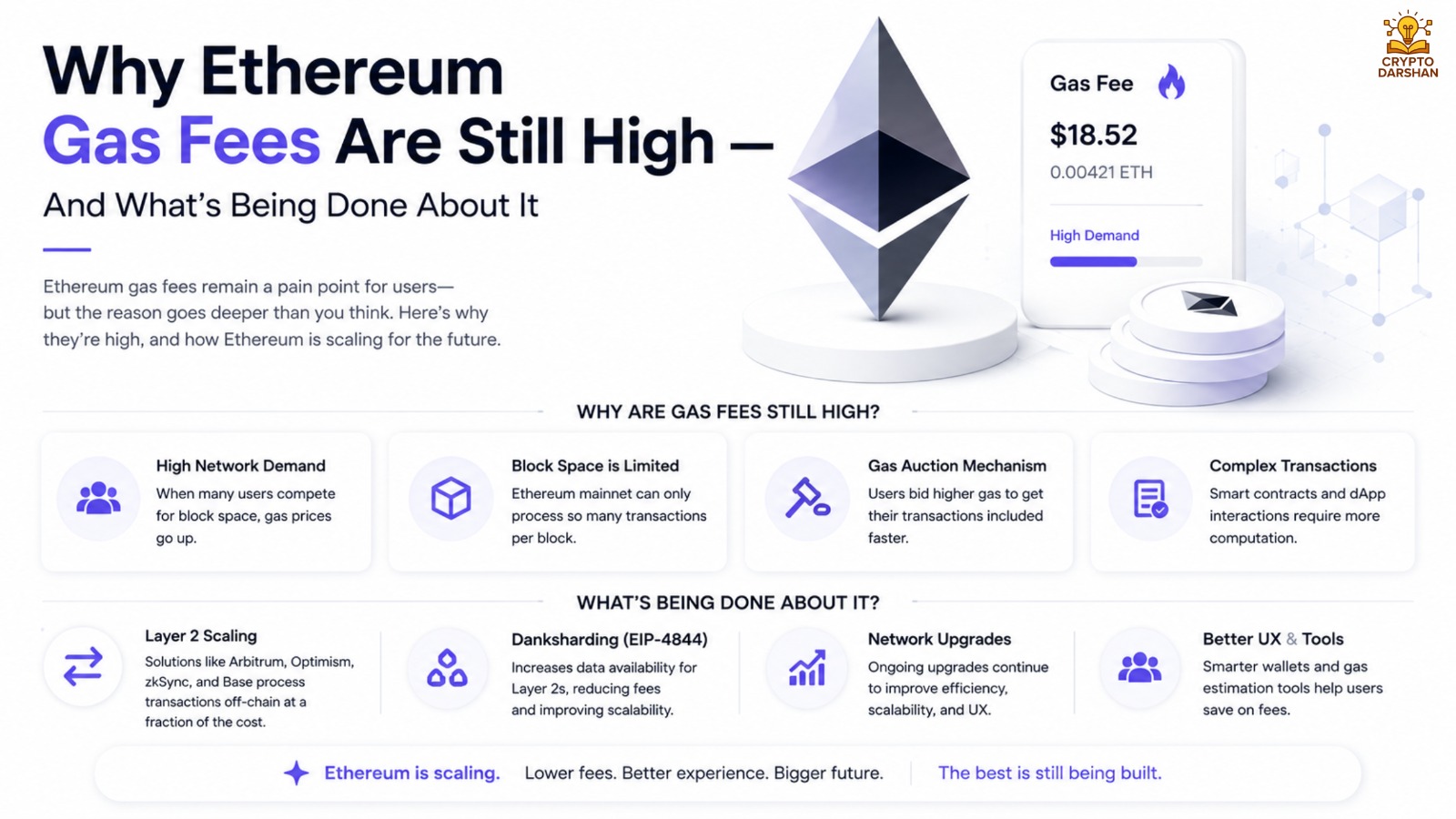
Ethereum has long been one of the most popular blockchain networks in the world, powering thousands of decentralized applications (dApps), smart contracts, and tokens. However, one persistent issue continues to frustrate users and developers alike — Ethereum Gas Fees. Despite multiple upgrades and scaling solutions, Ethereum Gas Fees remain high, especially during periods of heavy network activity. Understanding why this happens and what’s being done to fix it is essential for anyone involved in the crypto ecosystem.
This article explores the reasons behind high Ethereum Gas Fees, how gas works, the impact on users and developers, and the ongoing efforts to reduce costs through upgrades, scaling solutions, and innovations in blockchain technology.
Understanding Ethereum Gas Fees
What Are Ethereum Gas Fees?
Ethereum Gas Fees are transaction costs paid by users to perform operations on the Ethereum network. Every action — from sending ETH to executing a smart contract — requires computational power. Gas represents the amount of computational effort required to process these actions.
Gas fees are paid in Ether (ETH), Ethereum’s native cryptocurrency. The fee compensates miners (or validators, in Ethereum’s Proof-of-Stake system) for verifying and processing transactions. Without gas fees, the network would be vulnerable to spam and inefficiency.
How Gas Fees Are Calculated
Gas fees are determined by two main factors:
- Gas Limit – The maximum amount of gas a user is willing to spend on a transaction.
- Gas Price – The amount of ETH the user is willing to pay per unit of gas, usually measured in gwei (1 gwei = 0.000000001 ETH).
The total transaction fee is calculated as:
Transaction Fee = Gas Used × Gas Price
For example, if a transaction uses 21,000 gas and the gas price is 50 gwei, the total fee would be:
21,000 × 50 gwei = 1,050,000 gwei = 0.00105 ETH.
When network demand increases, users compete to have their transactions processed faster by offering higher gas prices. This competition drives Ethereum Gas Fees up.
Why Ethereum Gas Fees Are Still High
Despite Ethereum’s transition to Proof-of-Stake (PoS) and several upgrades, Ethereum Gas Fees remain high. Several factors contribute to this ongoing issue.
1. Network Congestion
Ethereum’s popularity is both its strength and its weakness. Thousands of dApps, NFTs, and DeFi platforms run on Ethereum, leading to heavy network usage. When too many users try to execute transactions simultaneously, the network becomes congested. Validators prioritize transactions with higher gas fees, leaving others waiting or paying more to get processed quickly.
2. Limited Block Space
Each Ethereum block has a limited capacity for transactions. The block gas limit determines how much computation can fit into a single block. When demand exceeds this limit, users must bid higher gas prices to secure space in the next block. This bidding war drives Ethereum Gas Fees upward.
3. Complex Smart Contracts
all transactions are equal. Simple ETH transfers require less gas, while complex smart contracts — such as those used in decentralized finance (DeFi) or NFT minting — consume significantly more gas. As DeFi and NFTs have exploded in popularity, the average gas consumption per transaction has increased, pushing Ethereum Gas Fees higher.
4. Popularity of DeFi and NFTs
DeFi protocols like Uniswap, Aave, and Compound, along with NFT marketplaces like OpenSea, generate massive transaction volumes. Each trade, swap, or minting event requires multiple smart contract interactions, consuming large amounts of gas. During NFT drops or DeFi yield farming events, Ethereum Gas Fees can spike dramatically.
5. MEV (Maximal Extractable Value)
Validators can reorder, include, or exclude transactions within a block to maximize their profit — a phenomenon known as Maximal Extractable Value (MEV). This practice can lead to front-running and gas wars, where users pay excessively high fees to ensure their transactions are prioritized.
6. Inefficient dApp Design
Some decentralized applications are not optimized for gas efficiency. Poorly written smart contracts can consume unnecessary computational resources, increasing the gas required for execution. As more users interact with these inefficient contracts, Ethereum Gas Fees rise across the network.
The Impact of High Ethereum Gas Fees
1. Barriers for Small Users
High Ethereum Gas Fees make small transactions uneconomical. For example, sending $10 worth of ETH might cost $5 or more in gas, discouraging casual users from participating in the network. This limits Ethereum’s accessibility and inclusivity.
2. Reduced dApp Adoption
Developers building on Ethereum face challenges attracting users when transaction costs are high. Many users migrate to cheaper alternatives like Binance Smart Chain, Polygon, or Solana, reducing Ethereum’s market share in certain sectors.
3. Slower Innovation
High Ethereum Gas Fees can stifle innovation. Startups and developers may hesitate to deploy new projects due to the high cost of testing and interacting with smart contracts. This slows down the overall growth of the Ethereum ecosystem.
4. Fragmentation of the Ecosystem
As users and developers seek cheaper alternatives, the Ethereum ecosystem becomes fragmented. Assets and liquidity spread across multiple Layer 2 networks and sidechains, complicating interoperability and user experience.
What’s Being Done to Reduce Ethereum Gas Fees
Ethereum’s developers and community are actively working on multiple solutions to address high Ethereum Gas Fees. These efforts include protocol upgrades, Layer 2 scaling solutions, and improved dApp design.
1. Ethereum 2.0 and the Move to Proof-of-Stake
The transition from Proof-of-Work (PoW) to Proof-of-Stake (PoS), known as “The Merge,” was a major milestone. While it significantly reduced energy consumption, it did not directly lower Ethereum Gas Fees. However, it laid the foundation for future scalability improvements.
PoS enables more efficient block validation and paves the way for sharding — a key upgrade that will increase network capacity and reduce congestion.
2. Sharding
Sharding is one of the most anticipated upgrades in Ethereum’s roadmap. It involves splitting the blockchain into multiple smaller chains, or “shards,” that process transactions in parallel. This will dramatically increase throughput and reduce competition for block space, leading to lower Ethereum Gas Fees.
3. Layer 2 Scaling Solutions
Layer 2 (L2) solutions are built on top of Ethereum to handle transactions off-chain, reducing the load on the main network. Popular L2 solutions include:
- Optimistic Rollups (e.g., Optimism, Arbitrum): Bundle multiple transactions into a single batch and submit them to Ethereum, reducing gas costs per transaction.
- Zero-Knowledge Rollups (e.g., zkSync, StarkNet): Use cryptographic proofs to verify transactions efficiently, offering faster and cheaper processing.
- State Channels: Allow users to transact off-chain and only settle final results on Ethereum.
These solutions significantly reduce Ethereum Gas Fees for users while maintaining security through Ethereum’s main chain.
4. EIP-1559: The Fee Burn Mechanism
Introduced in August 2021, Ethereum Improvement Proposal (EIP) 1559 changed how gas fees are structured. Instead of all fees going to miners, a portion of the base fee is burned (permanently removed from circulation), while users can add a tip to incentivize faster processing.
EIP-1559 made gas fees more predictable and introduced a deflationary mechanism for ETH. However, it did not directly reduce Ethereum Gas Fees — it only stabilized them.
5. EIP-4844 (Proto-Danksharding)
EIP-4844, also known as Proto-Danksharding, is a major upcoming upgrade designed to reduce Ethereum Gas Fees for Layer 2 rollups. It introduces “blob-carrying transactions,” which allow rollups to store data more efficiently. This will drastically lower the cost of posting data to Ethereum, making L2 transactions cheaper.
6. Better Smart Contract Optimization
Developers are increasingly focusing on writing gas-efficient smart contracts. By optimizing code and minimizing unnecessary computations, dApps can reduce the gas required for each transaction. This helps lower Ethereum Gas Fees across the network.
7. Cross-Chain and Multi-Chain Solutions
Interoperability protocols like Polkadot, Cosmos, and bridges between Ethereum and other blockchains allow users to move assets to cheaper networks. While this doesn’t directly reduce Ethereum Gas Fees, it helps distribute demand and relieve pressure on the main chain.
The Role of Layer 2 in Reducing Ethereum Gas Fees
Layer 2 solutions are currently the most effective way to reduce Ethereum Gas Fees without compromising security. They process transactions off-chain and periodically settle them on Ethereum, combining scalability with decentralization.
Optimistic Rollups
Optimistic Rollups assume transactions are valid by default and only run fraud proofs when challenged. This approach reduces computation on the main chain, lowering gas costs. Platforms like Arbitrum and Optimism have already gained significant adoption, offering users up to 90% lower fees.
Zero-Knowledge Rollups
Zero-Knowledge (ZK) Rollups use cryptographic proofs to verify large batches of transactions efficiently. They offer faster finality and even lower Ethereum Gas Fees than Optimistic Rollups. zkSync and StarkNet are leading projects in this space.
Sidechains and Plasma
Sidechains like Polygon operate independently but are connected to Ethereum. They process transactions at lower costs and periodically anchor data to Ethereum for security. Plasma chains also allow off-chain computation, reducing mainnet congestion.
The Future of Ethereum Gas Fees

1. The Surge, Verge, Purge, and Splurge
Ethereum’s roadmap includes several phases beyond The Merge:
- The Surge: Focuses on scaling through sharding and rollups.
- The Verge: Introduces Verkle trees to optimize data storage.
- The Purge: Removes old data to streamline the network.
- The Splurge: Adds miscellaneous improvements and refinements.
These upgrades collectively aim to make Ethereum more scalable, efficient, and affordable, ultimately reducing Ethereum Gas Fees.
2. Rollup-Centric Future
Ethereum’s long-term vision is a rollup-centric ecosystem, where most transactions occur on Layer 2 networks. The main chain will serve as a secure settlement layer. This model could reduce Ethereum Gas Fees for end users to near-zero levels while maintaining decentralization.
3. Increased Competition and Innovation
Competition from other blockchains like Solana, Avalanche, and Cardano pushes Ethereum to innovate faster. As more efficient technologies emerge, Ethereum must continue improving scalability and reducing Ethereum Gas Fees to remain dominant.
4. User Experience Improvements
Wallets and dApps are integrating features that automatically select the most cost-effective transaction routes. Gas fee estimators, batching tools, and cross-chain bridges are making it easier for users to minimize Ethereum Gas Fees without technical expertise.
How Users Can Reduce Ethereum Gas Fees Today
While waiting for future upgrades, users can take several steps to minimize Ethereum Gas Fees right now.
1. Use Layer 2 Networks
Transacting on Layer 2 solutions like Arbitrum, Optimism, or zkSync can reduce fees by up to 90%. Many popular dApps now support these networks.
2. Time Transactions Strategically
Gas prices fluctuate throughout the day. Using tools like GasNow or Etherscan’s Gas Tracker helps identify periods of low network activity, allowing users to transact when Ethereum Gas Fees are cheaper.
3. Optimize Smart Contract Interactions
Batching multiple actions into a single transaction or using gas-efficient dApps can reduce costs. Some DeFi platforms offer “gasless” transactions by subsidizing fees for users.
4. Use Wallets with Fee Optimization
Modern wallets like MetaMask and Rainbow offer gas optimization features that automatically suggest the best gas price for a given transaction.
5. Bridge Assets to Cheaper Chains
Users can move assets to sidechains like Polygon or alternative Layer 1 networks for cheaper transactions, then bridge back to Ethereum when needed.
The Economics of Ethereum Gas Fees
Supply and Demand Dynamics
Ethereum Gas Fees are fundamentally driven by supply and demand. When demand for block space exceeds supply, fees rise. Conversely, when demand drops, fees fall. This dynamic ensures that the network remains secure and efficient but also means that fees will always fluctuate with usage.
The Role of ETH Price
Because gas fees are paid in ETH, the price of ETH directly affects transaction costs in USD terms. When ETH’s price rises, even stable gas prices can translate into higher dollar costs for users.
Fee Markets and User Behavior
EIP-1559 introduced a more predictable fee market, but user behavior still plays a major role. During hype cycles — such as NFT launches or DeFi booms — users willingly pay higher fees to secure transactions quickly, driving Ethereum Gas Fees upward.
Challenges Ahead

Despite progress, several challenges remain in reducing Ethereum Gas Fees:
1. Layer 2 Adoption Barriers
Many Ethereum users continue to transact on the mainnet despite higher costs because they’re more familiar with it. Layer 2 networks, while cheaper, require users to bridge their assets and learn new interfaces. Additionally, liquidity is often fragmented across different L2 solutions, making it harder for users to find the best prices for trades. This hesitation to migrate slows down the overall reduction of mainnet congestion and keeps Ethereum Gas Fees elevated for those who remain on the primary chain.
2. Interoperability Complexity
Moving assets between Ethereum’s mainnet and various Layer 2 solutions, or between different L2 networks, can be technically challenging and risky. Users must navigate bridge protocols that sometimes have security vulnerabilities or require multiple transaction steps. Each bridge interaction costs gas fees and introduces potential points of failure.
3. Security and Decentralization Trade-offs
Some scaling solutions achieve lower fees by compromising on Ethereum’s core principles of security and decentralization. Sidechains may use fewer validators, making them more vulnerable to attacks. Certain Layer 2 solutions rely on centralized sequencers or have longer withdrawal periods.
4. Developer Knowledge Gap
Writing gas-efficient smart contracts requires specialized expertise in Solidity optimization techniques and a deep understanding of the Ethereum Virtual Machine. Many developers, especially those new to blockchain, lack this knowledge and inadvertently create contracts that consume excessive gas. Educational resources exist, but the learning curve is steep.
5. User Education and Awareness
Average users often don’t understand how gas fees work, when to transact for lower costs, or how to access Layer 2 alternatives. They may not know about gas tracking tools, optimal transaction timing, or the benefits of batching operations. This knowledge gap means users frequently overpay for transactions or avoid using Ethereum altogether.
FAQ: Why Ethereum Gas Fees Are Still High — And What’s Being Done About It

1. What are Ethereum gas fees?
Ethereum gas fees are transaction costs paid to validators for processing and securing transactions on the Ethereum network. Fees are measured in gas units and paid in ETH.
2. Why are Ethereum gas fees sometimes so high?
Gas fees rise when network demand exceeds available block space. During periods of heavy activity, users compete to have their transactions processed quickly, driving fees higher.
3. What factors affect Ethereum gas fees?
Several factors influence gas fees, including network congestion, transaction complexity, NFT minting events, DeFi activity, and overall market volatility.
4. How is the gas fee calculated on Ethereum?
The total fee is calculated by multiplying the gas used by the gas price. Since the EIP-1559 upgrade, users pay a base fee plus an optional priority fee (tip).
5. Did Ethereum’s transition to Proof-of-Stake reduce gas fees?
No. Ethereum’s move to Proof-of-Stake improved energy efficiency and network security, but it did not directly lower transaction fees.
6. What is EIP-1559 and how does it affect gas fees?
EIP-1559 introduced a base fee that is burned and a priority fee paid to validators. It made fee estimation more predictable but did not eliminate high fees during congestion.
7. What are Layer 2 solutions?
Layer 2 networks are scaling solutions built on top of Ethereum that process transactions more efficiently. Examples include Arbitrum, Optimism, and Base.
8. How do Layer 2 networks reduce gas costs?
Layer 2 networks bundle multiple transactions together and settle them on Ethereum, significantly reducing the cost per transaction for users.
Conclusion
Ethereum Gas Fees remain one of the most significant challenges facing the Ethereum ecosystem. While the network’s popularity and versatility have driven innovation, they have also created congestion and high costs. However, the future looks promising. With ongoing upgrades like sharding, EIP-4844, and the rise of Layer 2 solutions, Ethereum is steadily moving toward a more scalable and affordable future.
The combination of protocol improvements, developer optimization, and user education will ultimately determine how quickly Ethereum Gas Fees decline. As Ethereum continues to evolve, it remains the backbone of decentralized innovation — and solving the gas fee problem is key to unlocking its full potential.