The blockchain industry is constantly evolving, with networks competing to deliver faster transactions, lower fees, and greater scalability. Among these networks, Solana has consistently stood out for its high throughput and low transaction costs. However, as demand for decentralized applications (dApps), NFTs, and DeFi protocols continues to grow, even Solana faces challenges in maintaining performance under heavy network load. To address these challenges, the Solana development team has introduced a major network enhancement known as Solana’s Alpenglow upgrade.
Solana’s Alpenglow represents a significant step forward in the blockchain’s evolution. It is designed to improve transaction speed, reduce congestion, and stabilize fees across the network. This upgrade introduces new optimizations to Solana’s consensus mechanism, validator performance, and fee prioritization system. The result is a more efficient, scalable, and user-friendly blockchain capable of supporting the next generation of decentralized applications.
This article explores Solana’s Alpenglow upgrade in depth—its technical improvements, impact on transaction speed and fees, benefits for developers and users, and what it means for the future of the Solana ecosystem. It also examines how this upgrade positions Solana in the broader blockchain landscape and why it could redefine performance standards for high-speed networks.
Understanding Solana’s Architecture
Before diving into Solana’s Alpenglow, it’s important to understand the foundation on which Solana operates. Solana is a high-performance blockchain that uses a unique combination of technologies to achieve scalability without sacrificing decentralization.
Proof of History (PoH)
At the core of Solana’s architecture is Proof of History (PoH), a cryptographic clock that timestamps transactions before they are added to the blockchain. This allows validators to process transactions in parallel rather than sequentially, dramatically increasing throughput.
Tower BFT Consensus
Solana uses Tower Byzantine Fault Tolerance (BFT), a consensus mechanism optimized for PoH. It enables validators to reach agreement quickly while maintaining network security and decentralization.
Gulf Stream and Turbine
Solana’s Gulf Stream protocol pushes transaction caching and forwarding to the network edge, reducing confirmation times. Meanwhile, Turbine breaks data into smaller packets for faster propagation across nodes.
Sealevel Runtime
The Sealevel runtime allows Solana to execute thousands of smart contracts simultaneously, leveraging parallel processing to maximize efficiency.
These innovations have made Solana one of the fastest blockchains in the world, capable of processing over 65,000 transactions per second (TPS) under ideal conditions. However, as network usage has grown, congestion and fee volatility have occasionally affected performance. Solana’s Alpenglow upgrade aims to solve these issues.
What Is Solana’s Alpenglow?

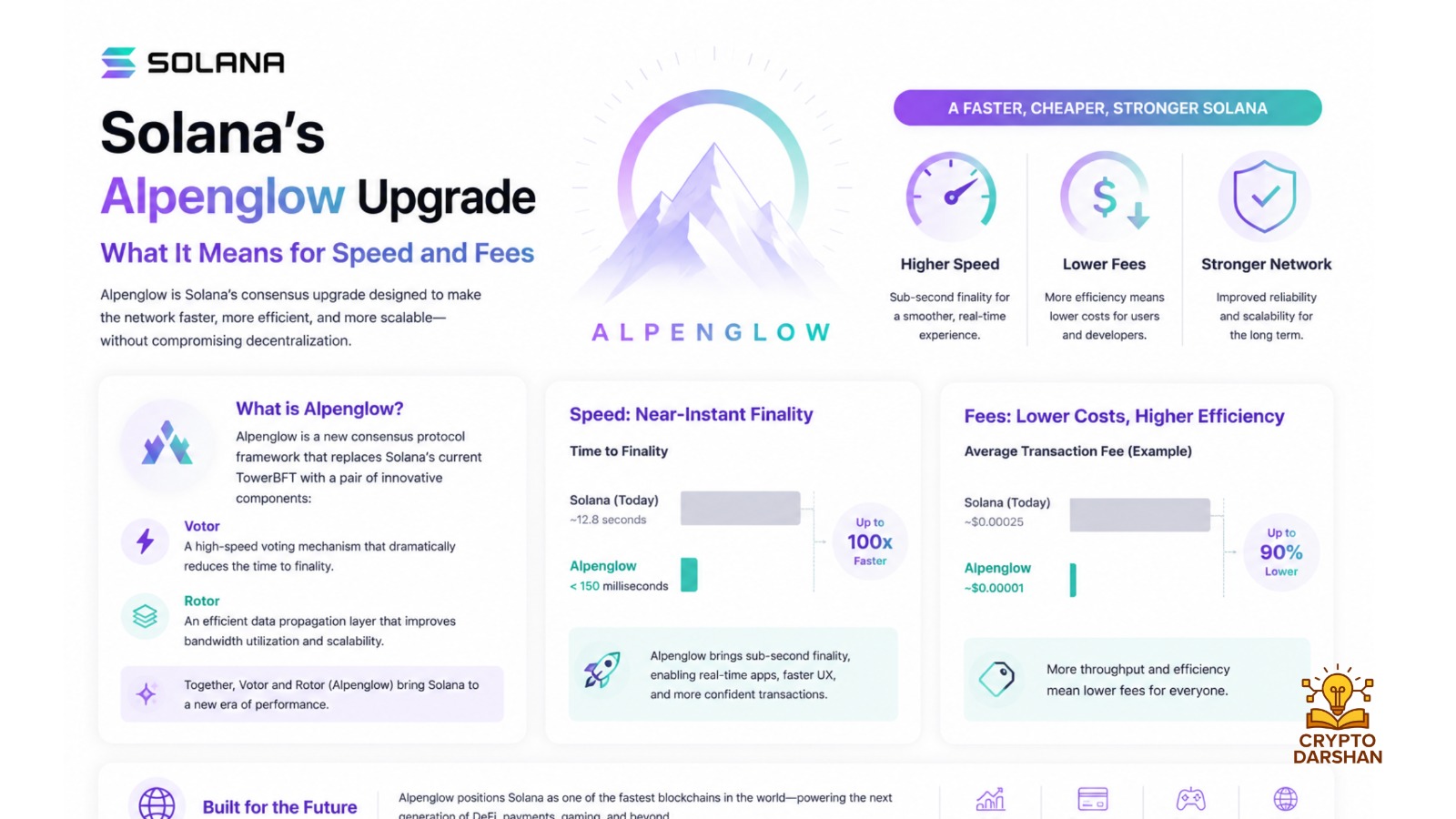
Solana’s Alpenglow is a comprehensive network upgrade focused on improving transaction speed, fee stability, and overall network efficiency. The name “Alpenglow” symbolizes the dawn of a new era for Solana—one where performance and scalability reach new heights.
This upgrade introduces several key improvements:
- Enhanced Transaction Scheduling – Optimized transaction prioritization to reduce congestion.
- Dynamic Fee Adjustment – A new fee model that balances network load and user costs.
- Validator Performance Optimization – Improved node synchronization and resource management.
- Improved Parallel Execution – Upgrades to the Sealevel runtime for faster smart contract execution.
- Network Stability Enhancements – Better handling of high-traffic events and spam prevention.
Together, these changes make Solana’s Alpenglow one of the most important updates since the network’s mainnet launch.
The Goals of Solana’s Alpenglow
The primary goals of Solana’s Alpenglow upgrade are to:
- Increase Transaction Speed: Reduce latency and improve block finalization times.
- Stabilize Fees: Prevent sudden spikes in transaction costs during periods of high demand.
- Enhance Network Reliability: Ensure consistent performance even under heavy load.
- Support Developer Growth: Provide a more predictable environment for dApp developers.
- Strengthen Ecosystem Scalability: Prepare Solana for mass adoption across DeFi, gaming, and Web3 applications.
By achieving these goals, Solana’s Alpenglow ensures that the network remains competitive in an increasingly crowded blockchain landscape.
Technical Improvements in Solana’s Alpenglow

1. Enhanced Transaction Scheduling
One of the biggest challenges Solana has faced is transaction congestion during peak usage. Solana’s Alpenglow introduces a new transaction scheduling system that prioritizes transactions based on network conditions and user-defined parameters.
This system uses a priority fee mechanism, allowing users to pay slightly higher fees for faster confirmation when the network is busy. However, unlike previous models, the new system dynamically adjusts priorities to prevent fee wars and ensure fairness.
The result is smoother transaction flow, reduced backlog, and more predictable confirmation times.
2. Dynamic Fee Adjustment
Solana’s Alpenglow introduces a dynamic fee model that automatically adjusts transaction costs based on network demand. Instead of static fees, the network now uses a variable fee curve that increases slightly during congestion and decreases when traffic is low.
This approach prevents spam attacks while keeping fees affordable for regular users. It also ensures that validators are fairly compensated for processing transactions during high-load periods.
For developers, this means more predictable gas costs, making it easier to design dApps with stable transaction pricing.
3. Validator Performance Optimization
Validators are the backbone of the Solana network. Solana’s Alpenglow includes several optimizations to improve validator performance, including:
- Better CPU and memory management
- Faster block propagation
- Improved synchronization between nodes
These enhancements reduce block production delays and improve overall network efficiency. Validators can now process more transactions per second with lower hardware strain, leading to a more stable and decentralized network.
4. Improved Parallel Execution
The Sealevel runtime, which enables Solana’s parallel transaction processing, receives a major upgrade in Solana’s Alpenglow. The new version enhances concurrency management, allowing smart contracts to execute even more efficiently.
This improvement benefits complex dApps that rely on multiple simultaneous operations, such as decentralized exchanges (DEXs) and NFT marketplaces. With Solana’s Alpenglow, these applications can handle higher transaction volumes without slowing down.
5. Network Stability Enhancements
Network stability is crucial for maintaining user trust. Solana’s Alpenglow introduces new mechanisms to handle sudden surges in traffic, such as NFT mints or token launches, which previously caused temporary slowdowns.
The upgrade includes spam prevention algorithms that detect and filter malicious transactions before they clog the network. It also improves error recovery, ensuring that nodes can quickly resynchronize after temporary disconnections.
How Solana’s Alpenglow Improves Speed
Speed has always been Solana’s defining feature. With Solana’s Alpenglow, the network takes another leap forward in performance.
Reduced Latency
The new transaction scheduler and validator optimizations reduce latency between transaction submission and confirmation. Users experience near-instant feedback, even during high-demand periods.
Faster Block Finalization
By improving consensus efficiency, Solana’s Alpenglow shortens block finalization times. This means transactions are confirmed faster and become irreversible sooner, enhancing user confidence and reducing waiting times for dApps.
Optimized Parallel Processing
The upgraded Sealevel runtime allows more transactions to be processed simultaneously. This parallelism ensures that even complex smart contracts execute quickly, maintaining Solana’s reputation as one of the fastest blockchains in existence.
How Solana’s Alpenglow Reduces Fees
Transaction fees are a critical factor for blockchain adoption. Solana’s Alpenglow introduces several mechanisms to keep fees low and stable.
Dynamic Fee Market
The dynamic fee model ensures that fees adjust automatically based on network demand. During periods of low activity, fees drop to minimal levels. When demand spikes, fees rise slightly to prevent spam but remain affordable compared to other blockchains.
Fair Prioritization
The new priority fee system ensures that users who need faster confirmations can pay a small premium, while others can choose lower fees for standard processing. This flexibility prevents congestion and keeps the network accessible to all users.
Efficient Resource Allocation
Validator optimizations reduce the computational cost of processing transactions. Lower resource usage translates into lower operational costs, which helps maintain Solana’s low-fee structure.
Benefits of Solana’s Alpenglow for Developers

Developers are among the biggest beneficiaries of Solana’s Alpenglow. The upgrade provides a more predictable and efficient environment for building decentralized applications.
Stable Gas Costs
With dynamic fee adjustments, developers can design dApps with consistent transaction pricing. This stability is crucial for DeFi platforms, where unpredictable fees can disrupt trading strategies and user experience.
Improved Scalability
The enhanced parallel execution engine allows developers to build more complex applications without worrying about performance bottlenecks. Games, marketplaces, and financial protocols can now handle larger user bases seamlessly.
Better Developer Tools
Solana’s Alpenglow also includes updates to developer SDKs and APIs, making it easier to integrate new features and monitor network performance. These tools help developers optimize their applications for speed and cost-efficiency.
Benefits of Solana’s Alpenglow for Users
For everyday users, Solana’s Alpenglow translates into a smoother, faster, and more affordable blockchain experience.
Faster Transactions
Users will notice significantly reduced transaction times, even during peak hours. Transfers, swaps, and NFT purchases will complete almost instantly.
Lower and More Predictable Fees
The dynamic fee model ensures that users pay fair and consistent fees. No more sudden spikes during popular events or network congestion.
Enhanced Reliability
Improved network stability means fewer transaction failures and less downtime. Users can trust that their transactions will go through quickly and securely.
Impact on the Solana Ecosystem

DeFi Applications
DeFi platforms on Solana, such as Raydium, Orca, and Jupiter, will benefit from faster transaction speeds and stable fees. This will improve liquidity, reduce slippage, and attract more traders to the ecosystem.
NFT Marketplaces
NFT platforms like Magic Eden and Solana NFT will experience smoother minting events and fewer network slowdowns. Solana’s Alpenglow ensures that large-scale NFT drops no longer cause congestion or fee spikes.
Gaming and Metaverse Projects
Blockchain games and metaverse applications require high-speed, low-cost transactions. Solana’s Alpenglow provides the infrastructure needed to support real-time gameplay and in-game economies.
Institutional Adoption
With improved stability and predictable fees, Solana’s Alpenglow makes the network more attractive to institutional investors and enterprises seeking scalable blockchain solutions.
Comparison with Other Blockchain Upgrades

Ethereum’s Upgrades
While Ethereum’s transition to Proof of Stake and rollups improves scalability, it still faces higher fees and slower speeds compared to Solana. Solana’s Alpenglow maintains Solana’s advantage in throughput and cost efficiency.
Avalanche and Polygon
Avalanche and Polygon offer fast transactions, but Solana’s Alpenglow pushes Solana’s performance even further, especially in handling high-volume events without congestion.
Aptos and Sui
Newer blockchains like Aptos and Sui use parallel execution models similar to Solana’s. However, Solana’s Alpenglow refines this approach with years of real-world data, giving it a maturity advantage.
Challenges and Considerations

While Solana’s Alpenglow brings major improvements, it also introduces new challenges.
Validator Requirements
The upgrade’s performance enhancements may require validators to upgrade hardware or optimize configurations, increasing operational costs for some participants.
Testing and Stability
As with any major upgrade, extensive testing is required to ensure stability. The Solana team has implemented phased rollouts to minimize risks.
User Education
Users and developers must understand the new fee model and transaction prioritization system to take full advantage of Solana’s Alpenglow.
The Future After Solana’s Alpenglow

1. Further Scalability Improvements Through Sharding and Cross-Chain Communication
Solana’s Alpenglow lays the groundwork for advanced scalability solutions that will dramatically increase network capacity. Sharding technology will divide the blockchain into parallel segments, allowing each shard to process transactions independently while maintaining overall network security. This could enable Solana to handle hundreds of thousands of transactions per second. Cross-chain communication protocols will also emerge, allowing seamless interaction with other blockchains like Ethereum and Polygon. Users will be able to transfer assets between networks without centralized bridges, reducing security risks. These improvements will support global-scale applications, from international payment systems to massive online games, without congestion or slowdowns.
2. Enhanced Security Features to Protect Against Emerging Threats
As Solana grows, it will face more sophisticated security challenges. Future upgrades will include quantum-resistant cryptography to protect against quantum computing threats that could break current encryption. Machine learning-based spam detection will identify and block malicious transactions before they disrupt the network. Enhanced validator security will prevent attacks where bad actors try to control the network through fake identities. Improved smart contract auditing tools will help developers find and fix vulnerabilities before launching applications. These security measures will build trust among institutional investors and enterprises, making Solana a safer platform for valuable digital assets.
3. Integration with AI and Data Analytics for Smarter Transaction Routing
Artificial intelligence will revolutionize how Solana operates. Machine learning algorithms will analyze network patterns, predict congestion, and automatically route transactions through the most efficient paths. AI systems will monitor validator performance in real-time, redistributing workload when nodes experience issues. Smart routing will consider transaction size, priority, and network conditions to find the fastest and cheapest path for each transaction. Data analytics will provide developers with insights into user behavior and resource consumption, helping them optimize their applications. This intelligence layer will make Solana self-optimizing, automatically adjusting performance without manual upgrades.
4. Strengthened Position as a Leading Platform for Web3 Innovation
Solana’s Alpenglow reinforces Solana’s status as a top blockchain for Web3 development. The network will become the preferred choice for DeFi platforms offering sophisticated financial instruments, gaming applications requiring real-time interactions, and social media platforms giving users true content ownership. Enterprise adoption will increase as companies use Solana for supply chain tracking, digital identity, and asset tokenization. The improved stability and predictable fees will attract more venture capital into Solana projects, creating a growth cycle that keeps Solana at the forefront of blockchain innovation across multiple industries.
5. Support for Millions of Users and Applications Without Compromising Performance
The ultimate goal is creating a blockchain ready for mainstream adoption. Future upgrades will implement horizontal scaling, allowing more capacity by adding validators and infrastructure. Advanced load balancing will prevent bottlenecks by distributing transactions evenly. Efficient data storage solutions will reduce validator storage requirements while maintaining security. User experience improvements will make Solana as simple as traditional apps, with intuitive interfaces hiding complex operations. Mobile optimization will bring blockchain to billions of smartphone users worldwide. These advancements will enable everything from micropayments to high-frequency trading, all with sub-second speeds and minimal fees.
FAQ: Solana’s Alpenglow Upgrade: What It Means for Speed and Fees

1. What is the Alpenglow upgrade in Solana?
Alpenglow is a proposed upgrade to the Solana network designed to improve transaction finality, network efficiency, and overall user experience.
2. Why is the Alpenglow upgrade important?
The upgrade aims to make Solana faster, more reliable, and more scalable, helping the network handle growing demand from users and developers.
3. How does Alpenglow improve transaction speed?
Alpenglow introduces changes to Solana’s consensus process that can reduce the time required for transactions to reach finality.
4. What is transaction finality, and why does it matter?
Transaction finality is the point at which a transaction is considered irreversible. Faster finality improves user confidence and application performance.
5. Will Alpenglow reduce transaction fees on Solana?
While the upgrade is primarily focused on performance and efficiency, improved network operations could help keep transaction costs low even as activity increases.
6. Does Alpenglow replace Solana’s existing consensus mechanism?
The proposal introduces significant changes to how consensus works, aiming to streamline communication between validators and improve network responsiveness.
7. How could Alpenglow benefit developers?
Developers may gain access to a faster and more predictable network environment, making it easier to build high-performance decentralized applications.
8. Will users need to do anything when Alpenglow is implemented?
Most users are unlikely to need to take any action, as protocol upgrades are generally handled at the network level.
Conclusion
Solana’s Alpenglow marks a new chapter in the blockchain’s journey toward unmatched speed, efficiency, and affordability. By addressing key challenges such as congestion, fee volatility, and validator performance, this upgrade ensures that Solana remains one of the fastest and most cost-effective blockchains in the world.
For developers, Solana’s Alpenglow offers a stable and scalable foundation for building next-generation decentralized applications. For users, it delivers faster transactions, lower fees, and a more reliable experience. For the broader ecosystem, it reinforces Solana’s reputation as a leader in blockchain innovation.
As the blockchain industry continues to evolve, Solana’s Alpenglow stands as a shining example of how continuous improvement and technological innovation can drive the future of decentralized systems. With this upgrade, Solana not only enhances its current capabilities but also sets the stage for a truly scalable, user-friendly, and quantum-ready blockchain era.