Self-custody scares most users since a single private key mistake leads to permanent fund loss. Custodial alternatives provide recovery, reducing this fear significantly. The rise of cryptocurrency has transformed how people think about money, ownership, and financial freedom. At the heart of this transformation lies a powerful concept: self-custody. Self-custody means holding and managing one’s own digital assets without relying on third parties like exchanges or custodial wallets. It embodies the core philosophy of decentralization — giving individuals full control over their wealth.
Yet, despite its promise, self-custody remains one of the most intimidating aspects of crypto for most users. Many prefer to leave their assets on centralized exchanges or custodial platforms, even after witnessing major collapses like FTX, Celsius, and Mt. Gox. The fear of losing access to funds, making irreversible mistakes, or dealing with complex technology keeps users away from taking full control.
This article explores why self-custody still scares most users in crypto. It examines the psychological, technical, and social barriers that prevent mass adoption, while also discussing how education, innovation, and better design can make self-custody more accessible and less intimidating.
Understanding Self-Custody

What Is Self-Custody?
Self-custody refers to the practice of personally managing private keys — the cryptographic codes that grant access to digital assets. In traditional finance, banks or payment processors hold and manage funds on behalf of users. A self-custody wallet means you fully own your account and the assets within it. You control the keys. Not a bank, exchange, or trading platform. In crypto, self-custody eliminates intermediaries, allowing individuals to be their own bank.
When users hold their private keys, they have complete control over their funds. No one can freeze, seize, or restrict access. However, this also means that if the keys are lost or stolen, the assets are gone forever. There is no customer support or password reset option.
The Philosophy Behind Self-Custody
Self-custody aligns with the foundational principles of blockchain technology — decentralization, transparency, and autonomy. Bitcoin’s original vision was to create a peer-to-peer financial system free from centralized control. Self-custody is the practical expression of that vision.
However, the same independence that empowers users also burdens them with responsibility. Managing private keys, securing seed phrases, and understanding wallet mechanics require technical literacy and discipline. For many, this responsibility feels overwhelming.
The Psychological Barriers to Self-Custody

Fear of Losing Funds
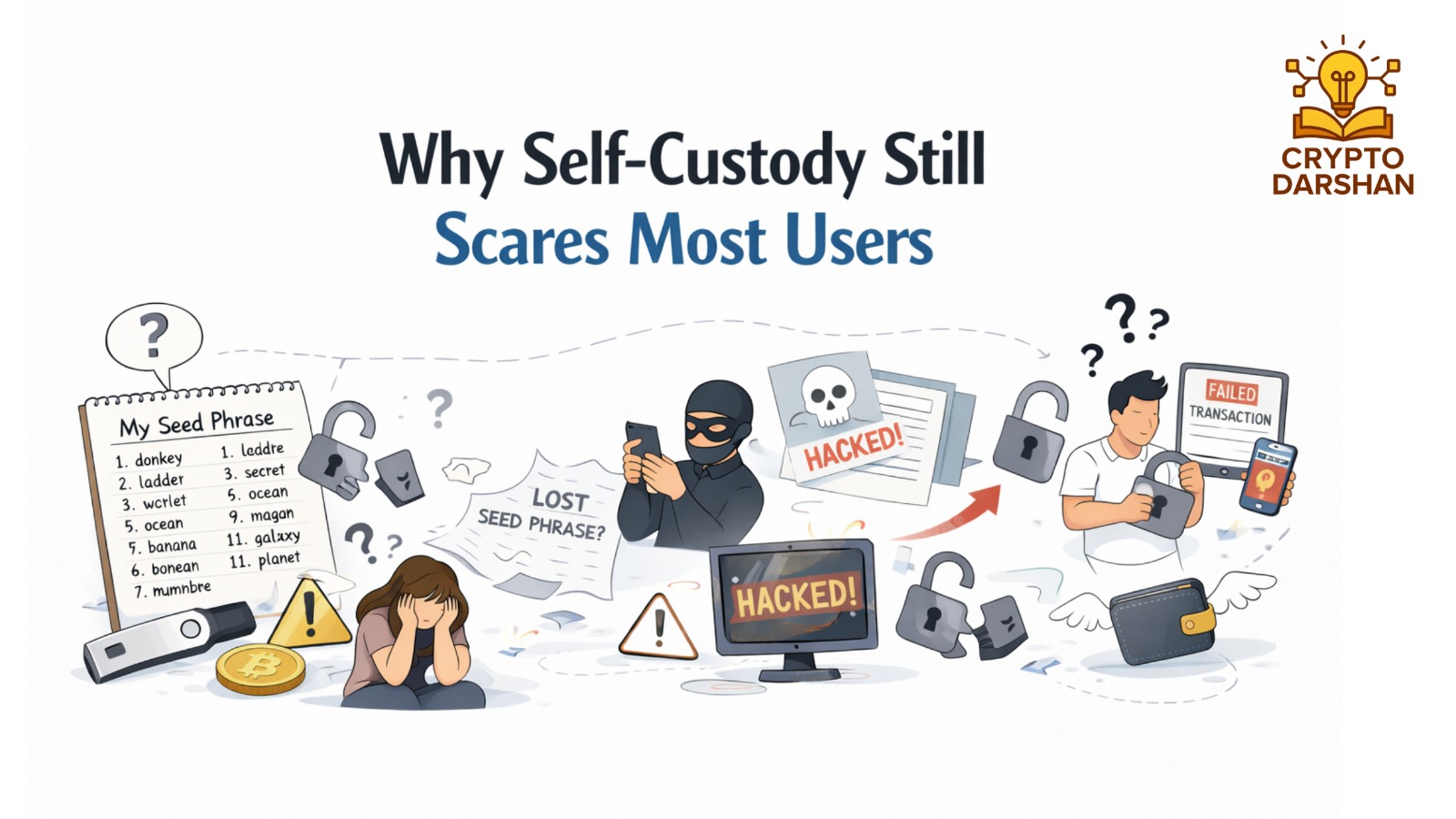
The biggest fear surrounding self-custody is the possibility of losing access to funds. Unlike traditional banking, where forgotten passwords can be reset, crypto transactions are irreversible. If a private key or seed phrase is lost, the assets are permanently inaccessible.
This fear is not unfounded. Numerous stories circulate online about users losing millions because of misplaced hardware wallets, forgotten passwords, or damaged devices. These cautionary tales reinforce the perception that self-custody is risky and unforgiving.
Lack of Confidence in Technical Skills
Many users feel unprepared to handle the technical aspects of self-custody. Setting up a hardware wallet, managing seed phrases, and verifying transactions can seem daunting. Even small mistakes such as sending funds to the wrong address can result in irreversible losses.
This lack of confidence discourages users from taking control. They prefer the perceived safety of custodial platforms, where customer support can assist in case of errors.
Psychological Comfort in Delegation
Humans are naturally inclined to delegate complex tasks to experts. Just as people trust banks to manage their money, they trust exchanges to manage their crypto. Delegation provides psychological comfort the sense that someone else is responsible for security and maintenance.
Self-custody removes this safety net. The idea of being solely responsible for one’s wealth can trigger anxiety. For many, the emotional burden outweighs the benefits of autonomy.
The Paradox of Control
Self-custody offers ultimate control, but that control comes with ultimate responsibility. This paradox creates cognitive dissonance. Users want freedom but fear the consequences of mistakes. The result is hesitation and avoidance.
Technical Barriers to Self-Custody

Complexity of Wallets
Crypto wallets, especially non-custodial ones, can be confusing for beginners. Terms like “seed phrase,” “private key,” and “cold storage” are unfamiliar to most people. The setup process often involves multiple steps, including writing down recovery phrases and verifying addresses.
The hesitation around self-custody often stems from unfamiliarity. By learning about crypto wallets and security, users can see that protecting assets is feasible without giving up control to a bank or exchange.
Even experienced users can find wallet management cumbersome. The lack of intuitive design and user-friendly interfaces contributes to the perception that self-custody is only for tech-savvy individuals.
Security Risks
While self-custody eliminates third-party risks, it introduces personal security risks. Users must protect their devices from malware, phishing attacks, and physical theft. A single lapse in security can lead to total loss.
Phishing scams targeting wallet users have become increasingly sophisticated. Fake wallet apps, malicious browser extensions, and deceptive websites trick users into revealing their private keys. Without proper education, even cautious users can fall victim.
Backup and Recovery Challenges
Backing up seed phrases is essential for self-custody, but it’s also one of the most vulnerable points. Storing a seed phrase on paper can lead to physical damage or loss. Digital backups, on the other hand, can be hacked if not encrypted properly.
Finding a secure yet convenient backup method is difficult. Some users resort to splitting seed phrases across multiple locations, while others use metal backups. Each method has trade-offs between security and accessibility.
Lack of Standardization
The crypto ecosystem lacks consistent standards for wallet design and recovery processes. Different wallets use different formats, making migration between platforms complicated. This fragmentation adds another layer of confusion for users trying to manage their assets independently.
Social and Cultural Factors

1. Institutional Trust and Historical Conditioning
For generations, people have been taught to trust banks, governments, and financial institutions as the ultimate guardians of wealth. This trust is reinforced through consistent messaging, regulation, and social proof. From childhood, individuals are encouraged to open bank accounts, use credit cards, and rely on financial advisors. As a result, the idea of managing one’s own assets without institutional oversight feels unnatural and risky.
Self-custody challenges this long-standing conditioning by shifting responsibility from institutions to individuals. Many users struggle to accept that they, not a bank, are now the final authority over their funds. This cultural shift requires unlearning decades of reliance on centralized systems.
2. Fear of Isolation and Lack of Support
Traditional financial systems provide a sense of community and support. If something goes wrong, users can contact customer service, visit a branch, or rely on legal protections. In contrast, self-custody can feel isolating. There is no helpline to call if a private key is lost or a transaction goes wrong.
This lack of institutional safety nets creates emotional discomfort. People fear being alone in managing their finances, especially when mistakes can lead to irreversible losses. The absence of human support reinforces the perception that self-custody is only for experts or risk-takers.
3. Media Narratives and Public Perception
Mainstream media plays a powerful role in shaping public opinion. Stories about lost Bitcoin, hacked wallets, and forgotten passwords dominate headlines, painting self-custody as dangerous and impractical. These fear-driven narratives overshadow success stories of individuals who manage their assets securely.
The media’s focus on sensational losses rather than educational content perpetuates a culture of fear. As a result, many potential users associate self-custody with risk and regret rather than empowerment and independence.
4. Peer Influence and Social Proof
Human behavior is heavily influenced by social proof, the tendency to follow what others are doing. If friends, family, or colleagues use centralized exchanges, individuals are more likely to do the same. Few people want to be the first in their social circle to try something perceived as complex or risky.
This herd mentality slows the adoption of self-custody. Without visible examples of peers successfully managing their own wallets, users lack the confidence to leap. Conversely, when influential figures or communities advocate for self-custody, adoption tends to rise.
5. Cultural Attitudes Toward Risk and Responsibility
Different cultures have varying attitudes toward risk and personal responsibility. In societies where collective security and institutional trust are valued, individuals may be less inclined to take full control of their finances. In contrast, cultures that emphasize independence and self-reliance may be more open to self-custody.
For many, the idea of being solely responsible for their wealth feels burdensome rather than empowering. The fear of making irreversible mistakes outweighs the appeal of autonomy. This cultural mindset makes it difficult for self-custody to gain mainstream acceptance.
6. Generational and Educational Gaps
Younger generations, who grew up with digital technology, are generally more comfortable with concepts like private keys and blockchain. Older generations, however, often find these ideas abstract and intimidating. The lack of accessible education on digital finance widens this generational gap.
Moreover, financial education in most countries still focuses on traditional banking systems. Schools rarely teach concepts like cryptography, decentralized finance, or digital asset management. Without proper education, users rely on familiar systems, reinforcing the cycle of dependence on centralized platforms.
The Role of Fear, Uncertainty, and Doubt (FUD)

Fear, uncertainty, and doubt, commonly known as FUD play a significant role in shaping perceptions of self-custody. Media coverage often highlights horror stories of lost Bitcoin or hacked wallets, reinforcing negative associations.
While these stories are real, they represent a small fraction of the overall user base. Millions of people successfully manage their own wallets without incident. However, fear spreads faster than facts, and the narrative of danger persists.
FUD also benefits centralized entities. Exchanges and custodial services have little incentive to promote self-custody, as it reduces their control and revenue. Subtle messaging that emphasizes convenience and safety over autonomy keeps users dependent.
The Evolution of Self-Custody Solutions

Hardware Wallets
Hardware wallets like Ledger, Trezor, and Coldcard have made self-custody more secure and accessible. These devices store private keys offline, protecting them from online threats. However, they still require users to manage seed phrases and understand basic security practices.
While hardware wallets are a step forward, their setup process can still intimidate beginners. The need for physical devices also introduces logistical challenges, such as cost and availability.
Software Wallets and Mobile Apps
Non-custodial mobile wallets like MetaMask, Trust Wallet, and Phantom have simplified access to decentralized applications (dApps) and tokens. They integrate with browsers and mobile devices, offering convenience and flexibility.
However, mobile wallets are more vulnerable to malware and phishing attacks. Users must remain vigilant about app authenticity and device security.
Smart Contract Wallets
Smart contract wallets, such as Argent and Safe (formerly Gnosis Safe), introduce advanced features like social recovery, multi-signature access, and spending limits. These innovations reduce the risk of total loss from a single point of failure.
Social recovery allows users to designate trusted contacts who can help restore access if keys are lost. This approach blends decentralization with human trust, making self-custody more forgiving.
Multi-Party Computation (MPC)
MPC technology splits private keys into multiple parts, distributed across different devices or entities. No single party holds the complete key, reducing the risk of theft or loss. MPC wallets are gaining traction among institutions and retail users alike.
By abstracting away key management, MPC wallets make self-custody more user-friendly without compromising security.
Bridging the Gap Between Custody and Convenience

The Rise of Hybrid Models
Hybrid custody models combine the security of self-custody with the convenience of custodial services. For example, some platforms allow users to retain control of their keys while offering recovery assistance through encrypted backups or multi-signature setups.
These models appeal to users who value autonomy but still want a safety net. They represent a transitional step toward full self-custody adoption.
User Experience (UX) Improvements
Improving user experience is critical for mass adoption. Wallet interfaces must become as intuitive as mainstream financial apps. Clear instructions, visual cues, and guided onboarding can reduce user anxiety.
Simplifying terminology is equally important. Replacing technical jargon with plain language helps users understand what they are doing and why it matters.
Education and Awareness Campaigns
Education is the foundation of empowerment. Community-driven initiatives, online courses, and interactive tutorials can demystify self-custody. Influencers, developers, and organizations must collaborate to promote responsible ownership practices.
Gamified learning experiences and simulation tools can help users practice wallet management without risking real funds.
The Future of Self-Custody

Integration with Web3 and DeFi
As decentralized finance (DeFi) and Web3 applications grow, self-custody will become increasingly essential. Interacting with decentralized protocols requires direct wallet connections. Users who rely solely on custodial platforms will miss out on the full potential of blockchain innovation.
Many users shy away from self-custody because they are used to the simplicity of centralized platforms. For those curious about alternatives, exploring decentralized exchanges (DEX) can offer insight into how users maintain control over their assets without relying on a third party.
Future wallets will likely integrate seamlessly with DeFi platforms, NFTs, and decentralized identity systems. This integration will make self-custody not just a security choice but a functional necessity.
Institutional Adoption
Institutions are also exploring self-custody solutions. Large asset managers and corporations require secure, compliant ways to hold crypto. The development of enterprise-grade custody tools will drive innovation that benefits retail users as well.
As institutional confidence grows, it will legitimize self-custody as a standard practice rather than a niche activity.
Regulatory Developments
Regulation plays a dual role. On one hand, it can provide clarity and consumer protection. On the other, excessive regulation could stifle innovation or push users toward centralized intermediaries.
Balanced regulation that recognizes the legitimacy of self-custody while promoting security standards will encourage broader adoption.
The Role of Decentralized Identity
Decentralized identity (DID) systems could revolutionize self-custody recovery. By linking wallets to verifiable digital identities, users could regain access without compromising privacy or control. This approach could eliminate the need for traditional seed phrases altogether.
Overcoming the Fear of Self-Custody

Building Trust Through Transparency
Transparency builds confidence. Open-source wallets, audited smart contracts, and verifiable security practices reassure users that their tools are trustworthy. The more transparent the ecosystem becomes, the less intimidating self-custody will feel.
Community Support and Peer Learning
Communities play a vital role in onboarding new users. Peer-to-peer education, mentorship programs, and local workshops can make learning about self-custody more approachable. When users see others successfully managing their wallets, their fear diminishes.
Gradual Transition Strategies
Users don’t need to switch to full self-custody overnight. Gradual transitions — such as starting with small amounts or using hybrid wallets — allow users to build confidence over time. As familiarity grows, so does comfort.
Emphasizing Empowerment Over Fear
The narrative around self-custody should shift from fear to empowerment. Instead of focusing on what can go wrong, the conversation should highlight the freedom, privacy, and sovereignty that self-custody provides. Education campaigns that frame self-custody as a path to empowerment can change perceptions.
FAQ: Why Self-Custody Still Scares Most Users in Crypto
1. What is self-custody in crypto?
Self-custody means you control your crypto directly through a wallet where you hold the private keys. No exchange, bank, or third party can access, freeze, or recover your funds—only you can.
2. If self-custody is more secure, why don’t most people use it?
Because responsibility feels riskier than trust. Many users would rather rely on a company than take full responsibility for something irreversible. One mistake in self-custody can mean permanent loss, which creates fear even when custodial platforms have failed before.
3. What scares people the most about self-custody?
The biggest fears include losing the recovery phrase, sending funds to the wrong address, getting phished or hacked, and not knowing how to fix mistakes. Crypto’s irreversibility makes these risks feel extreme.
4. Isn’t this just a user education problem?
Not really. Education helps, but poor user experience is the bigger issue. Wallets expose users to complex concepts like seed phrases, gas fees, and network choices before they’re ready, increasing the chance of error.
5. Haven’t exchanges proven to be risky too?
Yes. There’s a long history of exchange hacks, failures, and withdrawals being frozen. But psychologically, shared risk feels safer than solo responsibility—when an exchange fails, users blame the platform, not themselves.
6. Why does self-custody feel harder than online banking?
Banks hide complexity. They manage keys, recover accounts, detect fraud, and offer support. Self-custody removes those safety nets without offering equivalent protections, making users feel exposed.
7. Are hardware wallets the solution?
They improve security but don’t eliminate fear. Hardware wallets still rely on recovery phrases, can be lost or damaged, and require careful setup. They reduce attack surface, not user anxiety.
8. Is self-custody only for “power users”?
Today, mostly yes. When a system requires expert-level behavior to be safe, mass adoption stalls. Self-custody needs to work for average users, not just crypto-native ones.
Conclusion
Self-custody remains one of the most powerful yet misunderstood aspects of cryptocurrency. It embodies the spirit of decentralization and financial independence but also demands responsibility and awareness. The fear surrounding self-custody stems from psychological, technical, and social factors — fear of loss, lack of confidence, complexity, and cultural habits of delegation.
However, the landscape is evolving. Innovations like smart contract wallets, MPC technology, and improved user interfaces are making self-custody safer and more accessible. Education, transparency, and community support are key to overcoming fear and building trust.
The future of crypto depends on empowering individuals to take control of their assets. As tools become simpler and knowledge spreads, self-custody will no longer be a source of fear but a symbol of true financial freedom.