The world of cryptocurrency has evolved rapidly since Bitcoin’s creation in 2009. What began as a niche digital experiment has grown into a trillion-dollar asset class that attracts investors, institutions, and governments alike. Yet, for many beginners, the idea of buying and storing Bitcoin directly can seem intimidating. The volatility, technical complexity, and security risks often discourage newcomers from participating.
Enter the Bitcoin ETF, a financial innovation designed to bridge the gap between traditional investing and the crypto world. A Bitcoin Exchange-Traded Fund (ETF) allows investors to gain exposure to Bitcoin’s price movements without having to buy, store, or manage the cryptocurrency themselves. It combines the familiarity of stock market investing with the potential of digital assets.
This article explores what a Bitcoin ETF is, how it works, its types, benefits, risks, and whether beginners should consider investing in it. The goal is to provide a comprehensive, beginner-friendly guide that demystifies this modern financial product.
1. Understanding the Basics: What Is an ETF?

1.1 Definition of an ETF
An Exchange-Traded Fund (ETF) is a type of investment fund that tracks the performance of an underlying asset, index, or commodity. ETFs are traded on stock exchanges, just like individual stocks. Investors can buy and sell ETF shares throughout the trading day at market prices.
For example, there are ETFs that track the S&P 500 index, gold prices, or oil futures. Instead of buying each stock or commodity individually, investors can purchase ETF shares to gain exposure to the entire asset class.
1.2 How ETFs Work
ETFs are managed by financial institutions that hold the underlying assets or derivatives representing them. The value of an ETF share reflects the performance of those assets. When the price of the underlying asset rises, the ETF’s value increases, and vice versa.
ETFs offer several advantages:
- Diversification: Exposure to multiple assets through a single investment.
- Liquidity: Easy to buy and sell on exchanges.
- Transparency: Holdings are often disclosed daily.
- Low cost: Typically lower fees than mutual funds.
1.3 The Rise of Thematic ETFs
In recent years, ETFs have expanded beyond traditional markets. Thematic ETFs now allow investors to target specific sectors such as clean energy, artificial intelligence, or blockchain technology. The Bitcoin ETF is part of this evolution, a product that brings cryptocurrency exposure into the regulated world of traditional finance.
2. What Is a Bitcoin ETF?

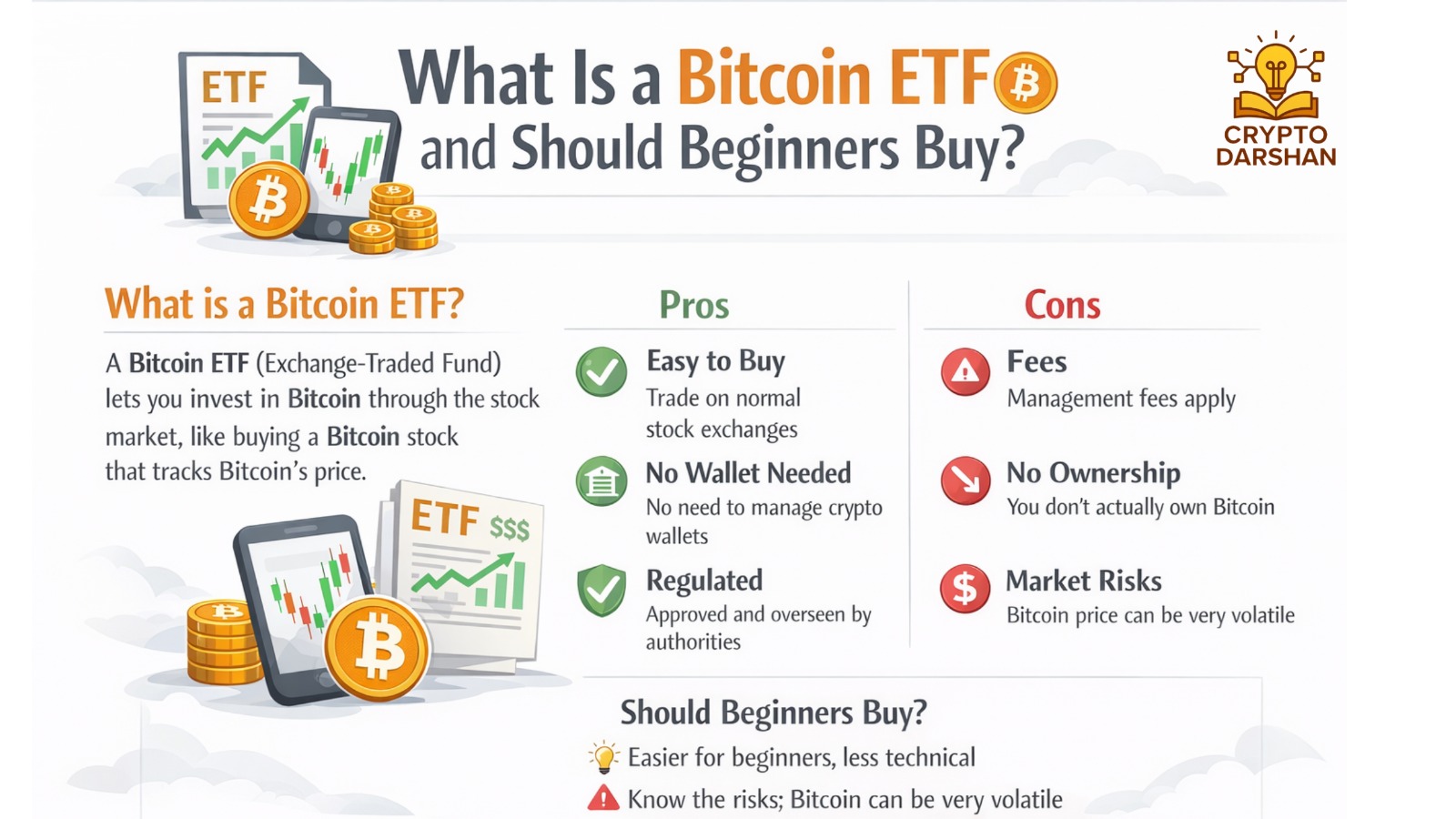
A Bitcoin ETF is an exchange-traded fund that tracks the price of Bitcoin. Instead of buying Bitcoin directly, investors purchase shares of the ETF, which represent ownership in a fund that either holds Bitcoin or Bitcoin-related assets.
The ETF’s price moves in line with Bitcoin’s market price, allowing investors to benefit from Bitcoin’s price fluctuations without dealing with digital wallets, private keys, or crypto exchanges.
2.1 The Purpose of a Bitcoin ETF
The main goal of a Bitcoin ETF is to make Bitcoin investing more accessible and regulated. It allows traditional investors, especially those who prefer stock markets, to gain exposure to Bitcoin through familiar investment channels like brokerage accounts or retirement funds.
2.2 The Birth of Bitcoin ETFs
The idea of a Bitcoin ETF has been around since 2013, when the Winklevoss twins first proposed one to the U.S. Securities and Exchange Commission (SEC). Bitcoin ETFs are exchange-traded funds that track the value of Bitcoin and trade on traditional market exchanges rather than cryptocurrency exchanges. They allow investors to invest in Bitcoin without having to go through the hassle of using a cryptocurrency exchange while providing leverage to its price.
After years of debate, the first Bitcoin futures ETF was approved in the United States in 2021, followed by the approval of spot Bitcoin ETFs in 2024. This marked a major milestone in the integration of cryptocurrency into mainstream finance.
3. Types of Bitcoin ETFs

Bitcoin ETFs come in two main forms: futures-based ETFs and spot ETFs. Understanding the difference between them is crucial for investors.
3.1 Bitcoin Futures ETFs
A Bitcoin futures ETF does not hold actual Bitcoin. Instead, it invests in Bitcoin futures contracts to buy or sell Bitcoin at a predetermined price on a future date. A bitcoin futures exchange-traded fund (ETF) issues publicly traded securities that offer exposure to the price movements of bitcoin futures contracts.
These ETFs track the price of Bitcoin indirectly through the futures market. The first U.S.-approved Bitcoin ETF, the ProShares Bitcoin Strategy ETF (BITO), is a futures-based ETF.
Advantages:
- Regulated under existing futures laws.
- Easier for regulators to monitor.
- Provides exposure to Bitcoin’s price movements.
Disadvantages:
- May not perfectly track Bitcoin’s spot price due to contango (when futures prices are higher than current prices).
- Higher management costs due to rolling over contracts.
- Potential for reduced returns over time.
3.2 Spot Bitcoin ETFs
A spot Bitcoin ETF directly holds Bitcoin as its underlying asset. Each share of the ETF represents a portion of the Bitcoin held in custody by the fund.
This type of ETF provides a more accurate reflection of Bitcoin’s real-time market price. The approval of spot Bitcoin ETFs in major markets like the U.S. and Canada has been a game-changer for investors seeking direct exposure.
Advantages:
- Tracks Bitcoin’s price more accurately.
- Simpler structure ,no futures contracts.
- Lower long-term costs.
Disadvantages:
- Requires secure custody solutions for Bitcoin.
- Regulatory scrutiny remains high.
- Vulnerable to Bitcoin’s inherent volatility.
4. How a Bitcoin ETF Works

4.1 The Structure
A Bitcoin ETF operates similarly to other ETFs. A financial institution (the fund manager) creates the ETF and issues shares to investors. The fund either:
- Holds Bitcoin directly (spot ETF), or
- Holds Bitcoin futures contracts (futures ETF).
The ETF’s share price reflects the value of its underlying holdings. When Bitcoin’s price rises, the ETF’s value increases proportionally.
4.2 Custody and Security
For spot ETFs, the fund must securely store Bitcoin in cold wallets offline storage systems that protect against hacking. Reputable custodians like Coinbase Custody or Gemini Trust often handle this responsibility.
4.3 Trading and Liquidity
Bitcoin ETFs trade on traditional stock exchanges such as the NYSE or NASDAQ. Investors can buy and sell shares through their regular brokerage accounts, just like any other stock or ETF. This provides liquidity and accessibility that direct Bitcoin ownership lacks.
4.4 Price Tracking and Arbitrage
Authorized participants (large financial institutions) ensure that the ETF’s price stays close to Bitcoin’s market price. If the ETF trades at a premium or discount, they buy or sell shares and underlying assets to restore balance, a process known as arbitrage.
While Bitcoin ETFs focus only on Bitcoin, beginners often wonder how it compares with other major cryptocurrencies. This guide breaks it down simply: Bitcoin vs Ethereum: Simple Guide for New Investors.
5. Why Bitcoin ETFs Matter

5.1 Bridging Traditional Finance and Crypto
Bitcoin ETFs serve as a bridge between the traditional financial system and the emerging world of digital assets. They allow institutional investors, pension funds, and retail traders to participate in the Bitcoin market without navigating crypto exchanges or wallets.
5.2 Legitimization of Bitcoin
The approval of Bitcoin ETFs by regulators signals growing acceptance of Bitcoin as a legitimate asset class. It marks a shift from skepticism to recognition, paving the way for broader adoption.
5.3 Increased Market Liquidity
ETFs attract large volumes of capital from traditional markets, increasing liquidity in the Bitcoin ecosystem. This can lead to more stable prices and reduced volatility over time.
5.4 Accessibility for Beginners
For beginners, Bitcoin ETFs simplify the investment process. There’s no need to worry about private keys, blockchain transactions, or crypto wallets. Investors can gain exposure to Bitcoin through familiar platforms and tax structures.
6. Benefits of Investing in a Bitcoin ETF
6.1 Simplicity and Convenience
Buying Bitcoin directly requires setting up a digital wallet, securing private keys, and navigating crypto exchanges. A Bitcoin ETF eliminates these complexities. Investors can buy shares through their existing brokerage accounts with a few clicks.
6.2 Regulatory Oversight
Bitcoin ETFs operate under the supervision of financial regulators, providing a layer of protection that direct crypto investments lack. This oversight ensures transparency, audited holdings, and compliance with investor protection laws.
6.3 Diversification
ETFs can be easily integrated into diversified portfolios. Investors can allocate a small percentage to Bitcoin exposure without overcommitting to the volatile crypto market.
6.4 Tax Efficiency
In many jurisdictions, ETFs enjoy favorable tax treatment compared to direct cryptocurrency holdings. Investors can benefit from capital gains tax structures similar to stocks.
6.5 Institutional-Grade Security
Spot Bitcoin ETFs use professional custodians to store Bitcoin securely. This reduces the risk of hacks or loss due to user error,a common concern in the crypto world.
7. Risks and Drawbacks

7.1 Price Volatility
Bitcoin remains a highly volatile asset. While ETFs make investing easier, they don’t eliminate price swings. Investors must be prepared for significant fluctuations in value.
7.2 Tracking Errors
Futures-based ETFs may not perfectly mirror Bitcoin’s spot price due to contract rollovers and market conditions. This can lead to performance discrepancies over time.
7.3 Management Fees
ETFs charge management fees, which can erode returns, especially in futures-based products that require frequent contract renewals.
7.4 Regulatory Uncertainty
Although Bitcoin ETFs are regulated, the broader crypto market still faces evolving regulations. Changes in government policies or taxation could impact ETF performance.
7.5 Lack of True Ownership
When investing in a Bitcoin ETF, investors don’t actually own Bitcoin. They own shares in a fund that tracks Bitcoin’s price. This means they can’t use Bitcoin for transactions or transfers.
8. Comparing Bitcoin ETFs to Direct Bitcoin Ownership
| Feature | Bitcoin ETF | Direct Bitcoin Ownership |
| Ownership | Indirect (shares in a fund) | Direct (actual Bitcoin) |
| Storage | Managed by custodian | Requires personal wallet |
| Security | Institutional-grade | User-dependent |
| Accessibility | Through stock exchanges | Through crypto exchanges |
| Regulation | Fully regulated | Partially regulated |
| Usability | Investment only | Can be used for payments |
| Volatility Exposure | Same as Bitcoin | Same as Bitcoin |
| Fees | Management fees | Exchange and network fees |
Both methods have their merits. ETFs offer convenience and regulation, while direct ownership provides autonomy and full control.
9. Who Should Consider Buying a Bitcoin ETF?
9.1 Beginners and Traditional Investors
Bitcoin ETFs are ideal for beginners who want exposure to Bitcoin without dealing with the technical aspects of crypto. They’re also suitable for traditional investors who prefer regulated markets.
9.2 Institutional Investors
Pension funds, hedge funds, and asset managers often face restrictions on holding cryptocurrencies directly. Bitcoin ETFs allow them to participate within regulatory boundaries.
9.3 Long-Term Investors
Those who believe in Bitcoin’s long-term potential but prefer a hands-off approach can benefit from ETFs. They can hold shares as part of a diversified portfolio without worrying about storage or security.
10. How to Invest in a Bitcoin ETF

Buying a Bitcoin ETF may feel simpler than holding crypto directly, but tax rules and regulations still apply. Beginners should understand this before investing: How Crypto Taxation Works: A Complete Beginner-to-Advanced Guide.
10.1 Choose a Brokerage Platform
Bitcoin ETFs are traded on major stock exchanges. Investors can use any standard brokerage account (like Fidelity, Charles Schwab, or Robinhood) to buy shares.
10.2 Research Available ETFs
Different Bitcoin ETFs may vary in structure, fees, and performance. Some popular examples include:
- ProShares Bitcoin Strategy ETF (BITO)
- Valkyrie Bitcoin Strategy ETF (BTF)
- iShares Bitcoin Trust (IBIT)
- ARK 21Shares Bitcoin ETF (ARKB)
10.3 Evaluate Fees and Performance
Compare expense ratios, tracking accuracy, and historical performance before investing. Lower fees and tighter tracking to Bitcoin’s price are generally preferable.
10.4 Determine Allocation
Bitcoin is a volatile asset, so it’s wise to allocate only a small portion of a portfolio — typically 1–5% — depending on risk tolerance.
10.5 Monitor and Rebalance
Like any investment, Bitcoin ETFs should be monitored regularly. Rebalancing ensures that exposure remains aligned with overall financial goals.
11. The Future of Bitcoin ETFs

11.1 Global Expansion
Countries like Canada, Brazil, and Australia have already approved Bitcoin ETFs, and more markets are expected to follow. This global acceptance could drive further adoption and liquidity.
11.2 Integration with Retirement Accounts
As Bitcoin ETFs gain legitimacy, they may become common options in retirement portfolios such as 401(k)s and IRAs, allowing long-term investors to benefit from Bitcoin’s growth potential.
11.3 Evolution of Multi-Asset Crypto ETFs
Future ETFs may include multiple cryptocurrencies or blockchain-related assets, offering diversified exposure to the entire digital asset ecosystem.
11.4 Institutional Adoption
With major financial institutions entering the space, Bitcoin ETFs could become a cornerstone of modern investment portfolios, like gold ETFs in the early 2000s.
12. Should Beginners Buy a Bitcoin ETF?

The question of whether beginners should buy a Bitcoin ETF is one of the most common among new investors exploring cryptocurrency. Bitcoin ETFs have made it easier than ever to gain exposure to Bitcoin without diving into the technical complexities of owning and managing digital assets. However, like any investment, they come with both advantages and risks.
Let’s break this down clearly so beginners can make an informed decision.
12.1 The Case for Buying a Bitcoin ETF
For many beginners, Bitcoin ETFs offer a safe and convenient way to participate in the crypto market. Here’s why they can be a good choice:
1. Ease of Access
Buying Bitcoin directly requires setting up a digital wallet, securing private keys, and navigating cryptocurrency exchanges all of which can be confusing for newcomers.
A Bitcoin ETF removes these barriers. You can buy it through your regular brokerage account, just like a stock or mutual fund. This makes it simple for anyone familiar with traditional investing to get started.
2. Regulated and Transparent
Bitcoin ETFs operate under the supervision of financial regulators such as the U.S. Securities and Exchange Commission (SEC). This means they must follow strict rules regarding transparency, custody, and reporting.
For beginners, this regulatory oversight provides peace of mind. You don’t have to worry about unregulated exchanges or potential scams that sometimes plague the crypto world.
3. No Need for Technical Knowledge
Owning Bitcoin directly means understanding blockchain transactions, wallet addresses, and private key management. Losing your private key means losing your Bitcoin forever.
With a Bitcoin ETF, you don’t need to worry about any of that. The fund handles storage, security, and management. You simply own shares that reflect Bitcoin’s price.
4. Portfolio Diversification
A Bitcoin ETF can be a great way to diversify your investment portfolio. By adding a small percentage of Bitcoin exposure, you can benefit from its potential growth while balancing risk with other assets like stocks and bonds.
Diversification helps reduce the impact of volatility in any single asset class.
5. Long-Term Growth Potential
Bitcoin has shown remarkable growth since its inception, and many investors view it as “digital gold,” a hedge against inflation and currency devaluation.
By investing in a Bitcoin ETF, beginners can participate in this long-term growth story without directly managing cryptocurrency.
12.2 The Case Against Buying a Bitcoin ETF
While Bitcoin ETFs offer convenience, they’re not perfect. Beginners should also understand the potential downsides before investing.
1. Volatility Remains High
Bitcoin’s price can rise or fall dramatically within short periods. Even though ETFs make investing easier, they don’t protect you from Bitcoin’s inherent volatility.
If you’re uncomfortable with large price swings, a Bitcoin ETF might not suit your risk tolerance.
2. No Direct Ownership of Bitcoin
When you buy a Bitcoin ETF, you don’t actually own Bitcoin you own shares in a fund that tracks its price.
This means you can’t use Bitcoin for transactions, transfers, or decentralized finance (DeFi) activities. You’re only exposed to its price movements, not its utility as a digital currency.
3. Management Fees
ETFs charge management fees, which can slightly reduce your returns over time. While these fees are generally small, they can add up, especially in futures-based ETFs that require frequent contract renewals.
4. Tracking Errors
Some Bitcoin ETFs, especially those based on futures contracts, may not perfectly mirror Bitcoin’s spot price. This difference, known as a tracking error, can cause your ETF’s performance to lag behind Bitcoin’s actual price movements.
5. Market Timing Risks
Like any investment, timing matters. Buying a Bitcoin ETF when Bitcoin’s price is at a peak could lead to short-term losses if the market corrects. Beginners should avoid emotional decisions and focus on long-term strategies instead of chasing quick profits.
12.3 A Balanced Approach for Beginners

For most beginners, the best strategy is a balanced approach one that combines caution with curiosity.
1. Start Small
If you’re new to Bitcoin or ETFs, start with a small investment. Allocating 1–5% of your portfolio to a Bitcoin ETF allows you to gain exposure without taking on excessive risk.
2. Think Long-Term
Bitcoin’s price can fluctuate wildly in the short term, but historically, it has trended upward over the long term. Treat your Bitcoin ETF investment as a long-term position rather than a quick trade.
3. Stay Informed
Even though Bitcoin ETFs simplify investing, it’s still important to understand what you’re investing in. Keep up with Bitcoin news, regulatory updates, and ETF performance reports. Knowledge helps you make better decisions.
4. Use Dollar-Cost Averaging (DCA)
Instead of investing a lump sum, consider investing a fixed amount regularly (e.g., monthly). This strategy, known as dollar-cost averaging, helps smooth out the effects of volatility and reduces the risk of buying at a market peak.
5. Combine with Other Assets
A Bitcoin ETF should be part of a diversified portfolio that includes stocks, bonds, and other investments. This balance helps protect your wealth during market downturns.
12.4 Who Should Consider Buying a Bitcoin ETF?
A Bitcoin ETF is suitable for:
- New investors who want exposure to Bitcoin without dealing with crypto exchanges or wallets.
- Traditional investors who prefer regulated financial products.
- Long-term investors who believe in Bitcoin’s potential but want a hands-off approach.
- Institutional investors restricted from holding cryptocurrencies directly.
However, it may not be ideal for:
- Active crypto users who want to use Bitcoin for payments or decentralized applications.
- Short-term traders seeking quick profits from price swings.
- Investors with low risk tolerance who can’t handle volatility.
12.5 The Verdict

So, should beginners buy a Bitcoin ETF?
Yes, but with caution and understanding.
A Bitcoin ETF is one of the easiest and safest ways for beginners to gain exposure to Bitcoin’s potential growth. It offers the benefits of regulation, simplicity, and accessibility while removing the technical barriers of direct ownership.
However, it’s not a magic solution. Bitcoin ETFs still carry the same market risks as Bitcoin itself. Prices can fluctuate sharply, and returns are not guaranteed. Beginners should approach Bitcoin ETFs as part of a diversified, long-term investment strategy not as a get-rich-quick opportunity.
Conclusion
The Bitcoin ETF represents a pivotal moment in the convergence of traditional finance and digital innovation. It transforms Bitcoin from a niche technological experiment into a mainstream investment vehicle accessible to millions of investors worldwide.
For beginners, a Bitcoin ETF offers a safe and convenient entry point into the world of cryptocurrency. It removes the technical barriers of wallets and private keys while maintaining exposure to Bitcoin’s price movements. However, like any investment, it carries risks particularly due to Bitcoin’s volatility and evolving regulatory landscape.
The decision to buy a Bitcoin ETF should depend on individual goals, risk tolerance, and investment horizon. For those seeking diversification and long-term growth potential, allocating a small portion of a portfolio to a Bitcoin ETF can be a smart move. It’s a way to participate in the digital revolution — not by diving headfirst into crypto, but by stepping confidently onto the bridge that connects the old world of finance with the new.