
For years, cryptocurrency has been dismissed by many as a speculative bubble, a niche obsession for tech enthusiasts, or a playground for risk-takers. Yet, time and again, global events remind the world that crypto’s true value emerges not in times of stability, but in moments of crisis. When banks freeze accounts, currencies collapse, or governments impose capital controls, people suddenly realize why decentralized money matters.
This article explores why most people don’t think they need crypto until they do. It examines the psychological, economic, and geopolitical factors that make digital assets essential in an increasingly uncertain world. It also breaks down how crypto provides financial sovereignty, censorship resistance, and global accessibility that traditional systems often fail to deliver.
1. Understanding Cryptocurrency: The Foundation of Digital Finance

1.1 What Is Cryptocurrency?
Cryptocurrencies are digital currencies underpinned by cryptographic systems. They enable secure online payments without the use of third-party intermediaries. “Crypto” refers to the various encryption algorithms and cryptographic techniques that safeguard these entries, such as elliptic curve encryption, public-private key pairs, and hashing functions.
Bitcoin, created in 2009 by the pseudonymous Satoshi Nakamoto, was the first cryptocurrency. It introduced the concept of peer-to-peer digital cash that can be sent directly between individuals without intermediaries like banks or payment processors. Since then, thousands of cryptocurrencies have emerged, each serving different purposes, from decentralized finance (DeFi) to digital art (NFTs) and smart contracts.
1.2 How Blockchain Technology Works
At the heart of every cryptocurrency lies blockchain, a decentralized, immutable ledger that records all transactions. Each block contains a list of verified transactions, and once added to the chain, it cannot be altered. This transparency ensures trust without the need for a central authority.
Key features of blockchain include:
- Decentralization: No single entity controls the network.
- Transparency: All transactions are publicly verifiable.
- Security: Cryptographic encryption protects data integrity.
- Immutability: Once recorded, data cannot be changed or deleted.
These features make blockchain a revolutionary technology that extends beyond finance, influencing industries like supply chain management, healthcare, and digital identity.
1.3 Key Components of the Crypto Ecosystem
The crypto ecosystem is vast and interconnected. Its main components include:
- Cryptocurrencies: Digital assets like Bitcoin (BTC), Ethereum (ETH), and Solana (SOL) used for payments, investments, and decentralized applications.
- Wallets: Software or hardware tools that store private keys, enabling users to access and manage their crypto holdings.
- Exchanges: Platforms where users buy, sell, or trade cryptocurrencies for fiat or other digital assets.
- DeFi Platforms: Decentralized financial systems offering lending, borrowing, and trading without intermediaries.
- Stablecoins: Cryptocurrencies pegged to fiat currencies to reduce volatility.
- NFTs: Non-fungible tokens representing ownership of unique digital assets like art, music, or collectibles.
Together, these elements form a self-sustaining digital economy that operates independently of traditional financial systems.
1.4 The Core Principles of Cryptocurrency
Cryptocurrency is built on several foundational principles that distinguish it from traditional finance:
- Decentralization: Power is distributed among network participants rather than centralized institutions.
- Transparency: Every transaction is recorded on a public ledger.
- Security: Advanced cryptography ensures data protection and prevents fraud.
- Accessibility: Anyone with an internet connection can participate.
- Censorship Resistance: No authority can block or reverse transactions.
- Limited Supply: Many cryptocurrencies, like Bitcoin, have a fixed supply, protecting against inflation.
These principles collectively empower individuals to take control of their financial lives, free from institutional constraints.
1.5 Why Understanding Crypto Matters
Understanding cryptocurrency is not just about learning how to buy or trade digital assets. It’s about recognizing a paradigm shift in how value is stored, transferred, and managed. As the world becomes more digital, the ability to navigate decentralized systems will become as essential as understanding how to use the internet.
Crypto represents more than an investment opportunity it’s a movement toward financial independence, privacy, and global inclusion. Those who understand its fundamentals today will be better equipped to adapt when traditional systems falter.
2. The Illusion of Financial Security

2.1 Trust in Traditional Systems
Most people grow up trusting banks, governments, and financial institutions. Paychecks arrive in bank accounts, bills are paid online, and savings are stored in fiat currency. This system feels safe until it isn’t. The 2008 financial crisis, for example, exposed how fragile the global banking system can be. Millions lost homes, jobs, and savings because of systemic failures beyond their control.
Sudden need often shows up during cross-border moments, sending money home, escaping capital controls, or paying someone when traditional rails fail. This is exactly where crypto quietly proves its value, as explored in Cross-Border Payments: Why Banks Are Quietly Copying Crypto, where speed and permissionless access matter more than ideology.
2.2 The Hidden Risks of Centralization
Centralized systems rely on trust in intermediaries. Banks can freeze accounts, governments can impose withdrawal limits, and payment processors can block transactions. These powers are rarely questioned until they are used. Crypto, by contrast, operates on decentralized networks where users control their own funds through private keys. There is no central authority to deny access or censor transactions.
2.3 Inflation and Currency Devaluation
In many countries, inflation quietly erodes purchasing power. While developed economies experience moderate inflation, others face hyperinflation that destroys savings overnight. Venezuela, Zimbabwe, and Argentina are stark examples. In such environments, crypto becomes a lifeline a way to preserve value when local currencies fail.
3. When the System Breaks: Real-World Examples

3.1 Venezuela: Bitcoin as a Lifeline
When Venezuela’s bolívar collapsed, citizens turned to Bitcoin and stablecoins to survive. Crypto allowed them to buy food, pay for services, and receive remittances from abroad. Even with limited internet access, peer-to-peer trading networks flourished. For many, crypto wasn’t an investment; it was survival.
3.2 Ukraine: Crypto in Wartime
During the 2022 Russian invasion, Ukraine received millions in crypto donations within days. Traditional banking systems were disrupted, but blockchain networks remained open. Crypto-enabled fast, borderless funding for humanitarian aid and defense efforts. It proved that decentralized finance could operate even in war zones.
3.3 Canada: The Freedom Convoy and Frozen Accounts
In 2022, the Canadian government froze bank accounts linked to protestors. Regardless of one’s stance on the issue, it demonstrated how easily financial access can be restricted. Some turned to Bitcoin to bypass these controls, highlighting crypto’s role as a censorship-resistant alternative.
3.4 Lebanon: Banking Collapse and Crypto Adoption
Lebanon’s banking crisis left citizens unable to withdraw their own money. The local currency lost over 90% of its value. As trust in banks evaporated, crypto adoption surged. People used stablecoins to protect savings and conduct international transactions.
3.5 Nigeria: Crypto as a Tool for Economic Empowerment
Nigeria has one of the highest crypto adoption rates in the world. With limited access to foreign currencies and high remittance fees, citizens use Bitcoin and stablecoins to trade, save, and send money abroad. Crypto has become a parallel economy that empowers individuals outside the traditional banking system.
4. The Psychology of “I Don’t Need Crypto ”

4.1 Normalcy Bias
Normalcy bias is the tendency to believe that things will always function as they have before. People assume banks will always be open, ATMs will always work, and governments will always protect their money. This mindset prevents proactive adoption of alternatives like crypto until a crisis forces change.
4.2 The Comfort of Convenience
Traditional finance is convenient. Credit cards, mobile banking, and instant transfers make daily life easy. Crypto, by comparison, can seem complex wallets, private keys, and gas fees intimidate newcomers. However, as user interfaces improve and education spreads, this barrier is shrinking.
4.3 Media Narratives and Skepticism
Mainstream media often portrays crypto as volatile, risky, or associated with crime. While volatility is real, these narratives overlook the technology’s resilience and utility. Over time, as more people experience financial restrictions firsthand, perceptions shift from skepticism to necessity.
3.4 The Turning Point: When Curiosity Becomes Urgency
For many, the crypto journey begins with curiosity reading about Bitcoin or hearing a friend mention Ethereum. But the real turning point often comes when traditional systems fail them personally. That’s when curiosity turns into urgency, and adoption becomes inevitable.
5. The Core Value of Crypto: Freedom and Control

5.1 Self-Custody and Ownership
Crypto allows individuals to hold their wealth without intermediaries. With a private key, anyone can store, send, or receive funds globally. This concept of self-custody is revolutionary it removes dependence on banks and governments.
5.2 Censorship Resistance
No authority can block a Bitcoin transaction or freeze an Ethereum wallet. This censorship resistance is vital in regions where financial repression is common. It ensures that money remains a tool of freedom, not control.
5.3 Borderless Access
Crypto operates beyond borders. A person in Nigeria can send funds to someone in Japan within minutes, without needing a bank or exchange rate approval. This global accessibility empowers individuals and small businesses alike.
5.4 Transparency and Accountability
Blockchain transactions are public and verifiable. This transparency reduces corruption and increases trust. Governments, charities, and corporations can use blockchain to prove how funds are used, enhancing accountability.
6. The Role of Stablecoins

6.1 Bridging the Gap Between Fiat and Crypto
Stablecoins like USDT, USDC, and DAI combine the stability of fiat with the flexibility of crypto. They are pegged to traditional currencies, making them ideal for everyday transactions and savings in unstable economies.
6.2 Use Cases in Emerging Markets
In countries with volatile currencies, stablecoins serve as digital dollars. They allow people to store value, pay for goods, and access global markets without relying on local banks. For freelancers and remote workers, stablecoins simplify cross-border payments.
6.3 Risks and Regulation
While stablecoins offer stability, they depend on the integrity of their issuers. Regulatory scrutiny is increasing to ensure transparency and proper reserves. Decentralized alternatives like DAI aim to reduce reliance on centralized entities.
6.4 Stablecoins in Humanitarian Aid and Crisis Relief
During crises, stablecoins enable fast, transparent aid distribution. NGOs and charities can send funds directly to recipients without intermediaries, ensuring that help reaches those who need it most.
7. Crypto as a Hedge Against Systemic Risk

7.1 Diversification Beyond Traditional Assets
Crypto provides an alternative asset class uncorrelated with traditional markets. During banking crises or geopolitical tensions, it can act as a hedge. Institutional investors increasingly recognize this potential, integrating Bitcoin into diversified portfolios.
7.2 Protection Against Capital Controls
Governments sometimes restrict money movement to prevent capital flight. Crypto bypasses these controls, allowing individuals to move wealth freely. This feature is crucial for entrepreneurs, expatriates, and anyone living under restrictive regimes.
7.3 The Rise of Digital Gold
Bitcoin is often called “digital gold” because of its scarcity and decentralized nature. With a fixed supply of 21 million coins, it resists inflationary pressures. As trust in fiat currencies wanes, Bitcoin’s role as a store of value strengthens.
7.4 Institutional Adoption: From Wall Street to Main Street
Major corporations and financial institutions now hold Bitcoin as part of their treasury strategy. This legitimizes crypto as a long-term asset and signals growing confidence in its role as a hedge against systemic risk.
8. The Evolution of Crypto Adoption

8.1 From Speculation to Utility
Early crypto adoption was driven by speculation. Today, utility is the focus. People use crypto for remittances, savings, and payments. Businesses accept it for goods and services. Governments explore central bank digital currencies (CBDCs), validating blockchain’s potential.
8.2 Institutional Involvement
Major financial institutions now offer crypto custody, ETFs, and trading services. This legitimizes the industry and increases accessibility. As infrastructure matures, mainstream adoption accelerates.
Crypto only feels unnecessary when everything is working. But once systems crack, it reveals itself not as an investment, but as infrastructure. This idea is explored deeper in Crypto as Digital Infrastructure, Not an Asset, where resilience matters more than returns.
8.3 The Role of Education
Education is key to adoption. Understanding how wallets, private keys, and blockchain work empowers users to take control of their finances. Initiatives promoting crypto literacy are essential for building a decentralized future.
8.4 The Role of Governments and Regulation
Governments are beginning to recognize the inevitability of crypto. Some embrace it through regulation and innovation, while others resist it. The balance between control and freedom will shape the next decade of financial evolution.
9. The Future of Financial Sovereignty

9.1 Decentralized Finance (DeFi)
DeFi platforms replicate traditional financial services lending, borrowing, trading without intermediaries. Users interact directly through smart contracts, earning yields and accessing liquidity globally. DeFi represents the next phase of financial independence.
9.2 Web3 and Ownership Economy
Web3 extends crypto principles to the internet itself. Users own their data, digital assets, and identities. NFTs, decentralized storage, and DAOs (Decentralized Autonomous Organizations) empower communities to govern themselves transparently.
9.3 The Path Toward Mass Adoption
For crypto to reach mass adoption, scalability, regulation, and user experience must improve. Layer-2 solutions, clearer legal frameworks, and intuitive apps are paving the way. As these evolve, crypto will integrate seamlessly into daily life.
9.4 The Role of Innovation: Building a Decentralized Future
Developers and entrepreneurs continue to innovate, creating tools that make crypto more accessible and secure. From decentralized identity systems to cross-chain interoperability, innovation drives the next wave of adoption.
10. When People Finally Realize They Need Crypto

10.1 Personal Financial Crises
Job loss, debt, or frozen accounts can push individuals toward crypto. When traditional systems fail to provide access or fairness, decentralized alternatives become appealing.
10.2 Political and Economic Instability
In unstable regions, crypto offers stability and freedom. It allows citizens to escape inflation, corruption, and authoritarian control. For many, it’s not about profit it’s about survival.
10.3 Global Connectivity and Opportunity
Crypto connects people to global markets, jobs, and communities. It enables participation in the digital economy regardless of geography or background. This inclusivity is transforming how people think about money and opportunity.
10.4 The Moment of Realization: From Skeptic to Believer
Every crypto user has a story, a moment when they realized the system wasn’t as stable as they thought. That moment transforms skepticism into conviction and marks the beginning of true financial independence.
11. Frequently Asked Questions (FAQ)

Why don’t most people feel they need crypto today?
Because traditional systems usually work until they don’t. As long as bank functions, cards swipe, and salaries arrive on time, people don’t question the system. Crypto only feels necessary when access, trust, or control is suddenly taken away.
When do people suddenly need crypto?
People often turn to crypto during moments of disruption bank freezes, capital controls, inflation spikes, payment shutdowns, or cross-border transfer issues. Crypto becomes relevant not in comfort, but in crisis.
Is crypto only useful during financial crises?
No, but crises reveal its value fastest. Beyond emergencies, crypto is useful for global payments, self-custody, stablecoins, and financial access for people excluded from traditional banking systems.
Why do people adopt crypto too late?
Most people wait until there’s urgency. Learning crypto during a crisis is stressful, risky, and inefficient. Early adoption allows people to understand wallets, security, and self-custody before they actually need them.
Is crypto meant to replace banks?
Not entirely. Crypto acts more like a parallel financial system one that exists when banks fail, restrict access, or move too slowly. It’s an alternative, not a full replacement.
Do I need to be tech-savvy to use crypto in emergencies?
Basic knowledge helps a lot. Knowing how to use wallets, store keys, and send funds safely can make a major difference during sudden financial disruptions. This is why education before necessity matters.
Why is self-custody important in this context?
Self-custody means you control your money without relying on banks or intermediaries. When access to accounts is restricted, self-custody can be the difference between financial freedom and being locked out.
Are stablecoins more relevant than volatile cryptocurrencies in emergencies?
Yes. Stablecoins are often the most practical option during sudden need because they maintain value while still offering the benefits of crypto speed, global access, and censorship resistance.
Is crypto adoption driven more by necessity than speculation?
Historically, yes. While speculation dominates headlines, real adoption grows fastest where people need alternatives to unstable economies, restricted banking systems, or broken payment infrastructure.
12. Conclusion: The Moment of Realization

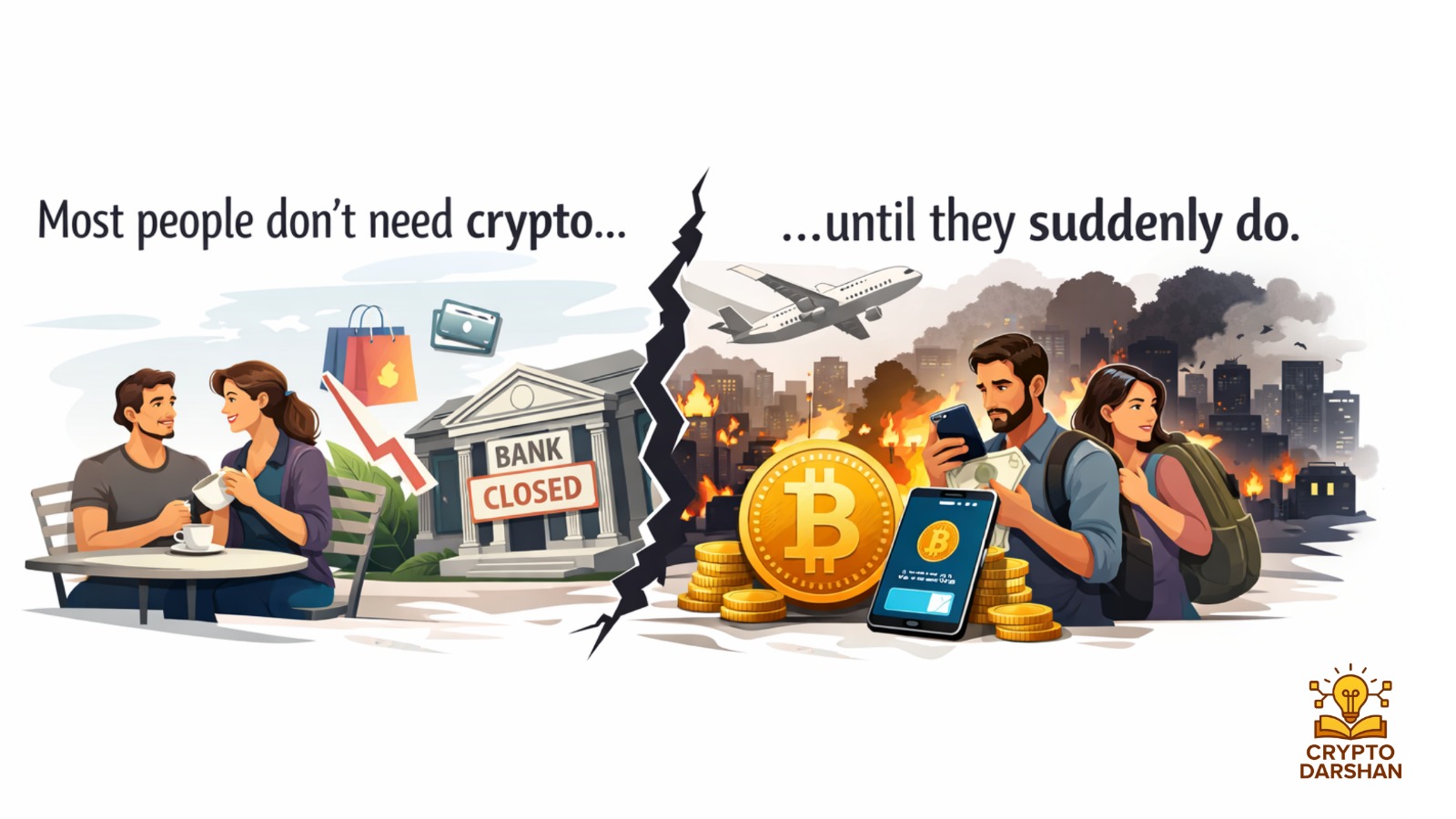
Most people don’t need crypto until they suddenly do. When banks fail, currencies collapse, or freedoms are restricted, crypto becomes more than an investment; it becomes a necessity. It represents financial sovereignty, resilience, and empowerment in a world where control over money often means control over life itself.
The future of finance is not about replacing traditional systems overnight but about offering alternatives that empower individuals. Crypto is that alternative a decentralized safety net for a world that’s learning, sometimes painfully, that trust in centralized systems has limits.
As history continues to unfold, one truth becomes clear: those who understand and embrace crypto before they “need” it will be better prepared for whatever comes next.