
DeFi Lending, short for Decentralized Finance Lending, is one of the most transformative innovations in the blockchain ecosystem. It allows users to lend and borrow cryptocurrencies without relying on traditional banks or intermediaries. Instead, smart contracts on blockchain networks like Ethereum, Binance Smart Chain, and Polygon handle all transactions automatically. This system provides transparency, accessibility, and efficiency, making DeFi Lending a cornerstone of the decentralized economy.
In DeFi Lending, users can deposit their crypto assets into lending pools and earn interest, while borrowers can use their crypto holdings as collateral to obtain loans. The process is governed by algorithms that determine interest rates, collateral requirements, and liquidation thresholds. Two of the most critical metrics in DeFi Lending are Loan-to-Value (LTV) and Liquidation Risk. These factors determine how much a user can borrow against their collateral and how close they are to losing it if the market moves unfavorably.
This comprehensive guide explores the top DeFi Lending platforms, ranked by their LTV ratios and liquidation risks. It also explains how these metrics work, what affects them, and how to choose the safest and most profitable platforms for lending and borrowing.
Understanding DeFi Lending

At its core, DeFi lending allows users to borrow and lend digital assets via smart contracts, without the need for traditional intermediaries like banks. Instead of credit scores or paperwork, loans are issued based on collateral. Value is locked in, interest accrues, and everything is executed programmatically on-chain.These platforms eliminate the need for intermediaries, allowing users to interact directly with the protocol. The process is simple:
- Lenders deposit their crypto assets into liquidity pools.
- Borrowers provide collateral and borrow other assets.
- Smart contracts manage interest rates, repayments, and liquidations.
The interest rates in DeFi Lending are determined by supply and demand. When more users want to borrow a particular asset, the interest rate increases to attract more lenders. Conversely, when supply exceeds demand, rates decrease.
DeFi Lending platforms are non-custodial, meaning users retain control of their funds until they are lent out or used as collateral. This transparency and autonomy make DeFi Lending a preferred choice for many crypto investors.
Key Concepts in DeFi Lending

Before ranking the platforms, it’s essential to understand the key concepts that define DeFi Lending performance and risk.
1. Loan-to-Value (LTV) Ratio
The LTV ratio measures how much a borrower can borrow relative to their collateral. For example, if a platform offers a 75% LTV, a user who deposits $1,000 worth of ETH can borrow up to $750 in stablecoins. Higher LTV ratios allow for more borrowing power but also increase liquidation risk.
2. Liquidation Risk
Liquidation risk refers to the possibility of losing collateral if its value drops below a certain threshold. When the collateral value falls and the LTV exceeds the platform’s limit, the smart contract automatically sells the collateral to repay the loan. Managing liquidation risk is crucial for borrowers to avoid losing assets during market volatility.
3. Collateralization
Collateralization ensures that loans are oversecured. Most DeFi Lending platforms require borrowers to deposit more value in collateral than they borrow. This protects lenders from defaults and maintains the system’s stability.
4. Interest Rates
Interest rates in DeFi Lending are dynamic and depend on market conditions. They can be fixed or variable, depending on the platform’s model. Lenders earn interest on their deposits, while borrowers pay interest on their loans.
5. Governance Tokens
Many DeFi Lending platforms issue governance tokens that allow users to vote on protocol changes, interest rate models, and new asset listings. These tokens often have additional utility, such as staking rewards or fee discounts.
Importance of LTV and Liquidation Risk in DeFi Lending

LTV and liquidation risk are the two most important metrics for evaluating DeFi Lending platforms. They determine how much leverage a borrower can use and how safe the collateral remains during market fluctuations.
- High LTV: Allows borrowers to access more funds but increases the chance of liquidation if prices drop.
- Low LTV: Provides a safety buffer against market volatility but limits borrowing capacity.
Liquidation risk depends on the volatility of the collateral asset, the platform’s liquidation threshold, and the speed of price updates from oracles. Platforms with efficient liquidation mechanisms and reliable price feeds tend to have lower risk.
Understanding these metrics helps users choose platforms that align with their risk tolerance and investment goals.
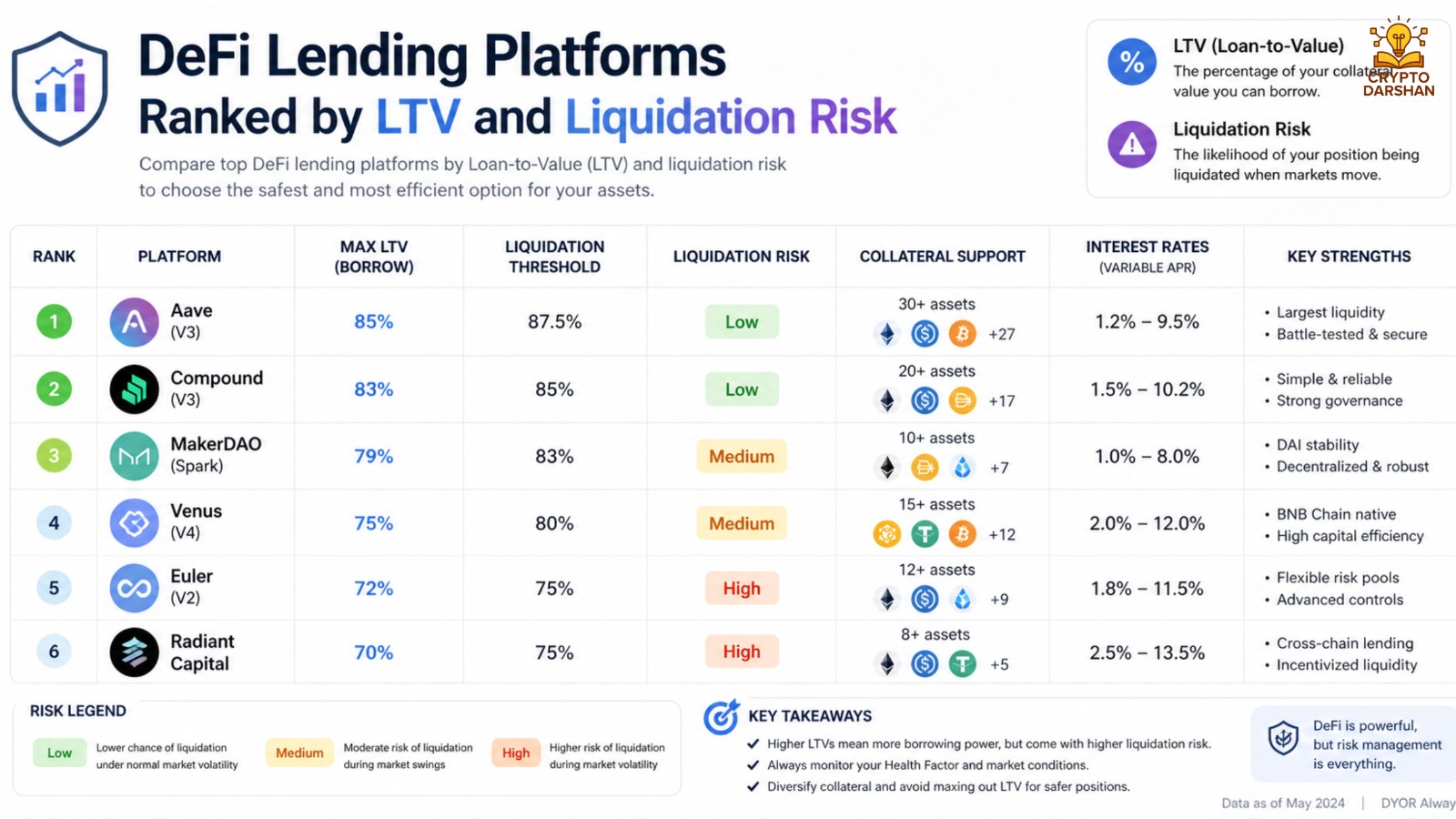
Top DeFi Lending Platforms Ranked by LTV and Liquidation Risk
The following are the leading DeFi Lending platforms, ranked based on their LTV ratios, liquidation mechanisms, and overall risk management.
1. Aave
Overview:
Aave is one of the most popular DeFi Lending platforms, known for its robust security, wide asset selection, and innovative features like flash loans and credit delegation. It operates on multiple blockchains, including Ethereum, Polygon, and Avalanche.
LTV Ratio:
Aave offers LTV ratios ranging from 50% to 80%, depending on the asset. Stablecoins and blue-chip cryptocurrencies like ETH and BTC have higher LTVs, while volatile tokens have lower ones.
Liquidation Risk:
Aave uses a liquidation threshold slightly above the LTV limit, typically around 82–85%. When a borrower’s position exceeds this threshold, the collateral is partially liquidated to restore balance. The platform’s efficient liquidation bots and real-time price oracles minimize risk.
Why It’s Safe:
Aave’s decentralized governance, audited smart contracts, and transparent risk parameters make it one of the safest DeFi Lending platforms.
2. Compound Finance
Overview:
Compound Finance is a pioneer in DeFi Lending, offering a simple and efficient protocol for lending and borrowing. It supports major assets like ETH, DAI, USDC, and WBTC.
LTV Ratio:
Compound’s LTV ratios range from 50% to 75%, depending on the asset’s volatility. Stablecoins generally have higher LTVs, while riskier tokens have lower ones.
Liquidation Risk:
Compound’s liquidation mechanism triggers when the collateral value falls below the required threshold. The protocol uses Chainlink oracles for accurate price feeds, reducing the chance of false liquidations.
Why It’s Safe:
Compound’s conservative LTV ratios and strong oracle integration make it a reliable choice for risk-averse users.
3. MakerDAO

Overview:
MakerDAO is the protocol behind the DAI stablecoin. It allows users to lock up collateral like ETH or WBTC to mint DAI. MakerDAO is one of the oldest and most trusted DeFi Lending systems.
LTV Ratio:
MakerDAO uses a concept called the Collateralization Ratio (CR), which is the inverse of LTV. For example, a 150% CR equals a 66% LTV. Different vaults have different ratios based on asset risk.
Liquidation Risk:
If the collateral value drops below the required CR, the vault is liquidated. MakerDAO’s auction-based liquidation system ensures fair pricing and minimizes losses.
Why It’s Safe:
MakerDAO’s long history, decentralized governance, and overcollateralization model make it a stable and secure DeFi Lending platform.
4. Venus Protocol
Overview:
Venus operates on the Binance Smart Chain and offers high-speed, low-cost DeFi Lending services. It supports a wide range of assets and integrates with the Venus (XVS) governance token.
LTV Ratio:
Venus provides LTV ratios up to 80% for stablecoins and around 60% for volatile assets.
Liquidation Risk:
The platform uses a liquidation threshold of 85%, meaning positions are liquidated when the LTV exceeds this limit. Venus’s fast transaction speeds on BSC help reduce liquidation delays.
Why It’s Safe:
Venus combines high LTV flexibility with efficient liquidation systems, making it suitable for experienced traders seeking leverage.
5. JustLend

Overview:
JustLend is the leading DeFi Lending platform on the TRON blockchain. It offers lending and borrowing for TRX, USDT, and other TRC-20 tokens.
LTV Ratio:
JustLend’s LTV ratios range from 50% to 75%, depending on the asset type.
Liquidation Risk:
Liquidations occur automatically when the collateral value falls below the threshold. The platform’s integration with TRON’s fast network ensures quick execution.
Why It’s Safe:
JustLend’s simplicity, low fees, and fast transactions make it a good choice for users in the TRON ecosystem.
6. Anchor Protocol
Overview:
Anchor Protocol, built on the Terra blockchain, offers stable yields for lenders and flexible borrowing options. It became popular for its fixed interest rate model.
LTV Ratio:
Anchor allows up to 60% LTV for most assets, balancing borrowing power with safety.
Liquidation Risk:
The protocol uses a liquidation threshold of 65%. When the LTV exceeds this, collateral is sold to repay the loan. Anchor’s oracle system ensures accurate pricing.
Why It’s Safe:
Anchor’s moderate LTV and predictable yields make it a stable option for conservative DeFi Lending participants.
7. Cream Finance

Overview:
Cream Finance is a flexible DeFi Lending platform that supports a wide range of assets, including long-tail tokens. It operates on Ethereum and Binance Smart Chain.
LTV Ratio:
Cream offers LTV ratios between 40% and 75%, depending on asset volatility.
Liquidation Risk:
Due to its support for smaller tokens, Cream carries higher liquidation risk. However, it compensates with higher interest rates for lenders.
Why It’s Safe:
Cream is best suited for advanced users who understand the risks of lending and borrowing less liquid assets.
8. Alpaca Finance
Overview:
Alpaca Finance focuses on leveraged yield farming and DeFi Lending on Binance Smart Chain. It allows users to borrow assets to increase farming yields.
LTV Ratio:
Alpaca’s LTV ratios vary by strategy but typically range from 50% to 75%.
Liquidation Risk:
The platform uses automated liquidation bots to manage risk efficiently. Positions are liquidated when the LTV exceeds the safety threshold.
Why It’s Safe:
Alpaca’s transparent risk parameters and active community governance make it a reliable choice for leveraged DeFi Lending.
9. Kava
Overview:
Kava is a cross-chain DeFi Lending platform that supports assets from multiple blockchains, including Bitcoin, XRP, and Binance Coin.
LTV Ratio:
Kava offers LTV ratios up to 70%, depending on the collateral type.
Liquidation Risk:
Liquidations occur when the collateral value drops below the required ratio. Kava’s cross-chain oracle system ensures accurate valuations.
Why It’s Safe:
Kava’s interoperability and conservative LTV ratios make it a secure platform for multi-chain DeFi Lending.
10. Nexo
Overview:
Nexo bridges centralized and decentralized finance by offering instant crypto loans and interest-bearing accounts. It combines DeFi Lending principles with institutional-grade security.
LTV Ratio:
Nexo provides flexible LTV ratios from 20% to 90%, depending on the user’s loyalty tier and collateral type.
Liquidation Risk:
Nexo automatically monitors collateral values and issues margin calls before liquidation. This proactive approach reduces sudden losses.
Why It’s Safe:
Nexo’s hybrid model and insurance-backed reserves make it one of the safest platforms for DeFi Lending.
You should also check our stablecoins guide to see why assets like USDC are commonly used.
Comparing LTV Ratios Across Platforms
| Platform | Maximum LTV | Liquidation Threshold | Risk Level |
| Aave | 80% | 82–85% | Low |
| Compound | 75% | 80% | Low |
| MakerDAO | 66% | 150% CR | Low |
| Venus | 80% | 85% | Medium |
| JustLend | 75% | 80% | Medium |
| Anchor | 60% | 65% | Low |
| Cream | 75% | 80% | High |
| Alpaca | 75% | 80% | Medium |
| Kava | 70% | 75% | Low |
| Nexo | 90% | 95% | Medium |
Factors Affecting LTV and Liquidation Risk
Several factors influence LTV ratios and liquidation risks in DeFi Lending:
- Asset Volatility: Highly volatile assets have lower LTVs to reduce liquidation risk.
- Liquidity: Assets with low trading volume are harder to liquidate quickly.
- Oracle Accuracy: Reliable price feeds prevent false liquidations.
- Protocol Design: Platforms with efficient liquidation mechanisms handle risk better.
- Market Conditions: Sudden market crashes can trigger mass liquidations.
Understanding these factors helps users choose platforms that align with their risk appetite.
How to Manage Liquidation Risk in DeFi Lending

1. Maintain a Safe LTV
Keeping a safe Loan-to-Value (LTV) ratio is the most effective way to manage liquidation risk in DeFi Lending. The LTV ratio determines how much can be borrowed against the collateral. A lower LTV provides a larger safety buffer against market volatility. For example, if a platform allows an 80% LTV, maintaining it around 50–60% reduces the chance of liquidation during sudden price drops. Regularly monitoring the LTV and adjusting collateral or loan amounts helps maintain a healthy balance.
2. Use Stable Collateral
Choosing stable and less volatile assets as collateral significantly reduces liquidation risk. Cryptocurrencies like Bitcoin and Ethereum are more stable compared to smaller altcoins, which can experience sharp price swings. Stablecoins such as USDC or DAI are even safer options since their value is pegged to fiat currencies. Using stable collateral ensures that the collateral value remains consistent, minimizing the risk of falling below the liquidation threshold.
3. Monitor Positions Regularly
Active monitoring of open positions is essential in DeFi Lending. The crypto market operates 24/7, and prices can change rapidly. Regularly checking the health of the collateral and loan balance helps identify potential risks early. Many DeFi platforms provide dashboards that display real-time LTV ratios and liquidation thresholds. Using portfolio tracking tools or mobile apps can make monitoring easier.
4. Set Alerts
Setting automated alerts is a proactive way to manage liquidation risk. Most DeFi Lending platforms and third-party tools allow users to set price or LTV alerts. These alerts notify users when the collateral value approaches the liquidation threshold. Alerts can be received through email, SMS, or app notifications, allowing quick responses even when not actively monitoring the market.
5. Diversify Collateral
Diversifying collateral across multiple assets and platforms spreads risk and enhances stability. Relying on a single asset or protocol increases exposure to specific market or technical risks. For instance, if one asset experiences a sudden price drop or a platform faces technical issues, diversified holdings can prevent total liquidation.
By following these practices, borrowers can minimize liquidation risk and maintain healthy positions.
The Future of DeFi Lending

DeFi Lending continues to evolve rapidly. Innovations like undercollateralized loans, credit scoring, and cross-chain lending are expanding the ecosystem. As blockchain technology matures, DeFi Lending will become more efficient, secure, and accessible.
Future trends include:
- Integration of real-world assets as collateral.
- Improved oracle systems for accurate pricing.
- Enhanced risk management through AI and analytics.
- Regulatory frameworks to protect users.
These developments will make DeFi Lending more stable and appealing to mainstream investors.
Frequently Asked Questions (FAQ)

1. What is DeFi lending?
DeFi lending allows users to lend or borrow cryptocurrencies without intermediaries using smart contracts on blockchain networks.
2. What does LTV (Loan-to-Value) mean in DeFi?
LTV is the ratio of how much you can borrow compared to the value of your collateral. For example, a 70% LTV means you can borrow $70 for every $100 of collateral.
3. Why is LTV important?
Higher LTV allows more borrowing but increases the risk of liquidation. Lower LTV is safer but less capital-efficient.
4. What is liquidation risk in DeFi lending?
Liquidation happens when your collateral value falls below a required threshold, causing your assets to be partially or fully sold to repay the loan.
5. How can I avoid liquidation?
- Maintain a low LTV ratio
- Add more collateral when prices drop
- Monitor your positions regularly
- Use alerts and risk dashboards
6. Which are the most popular DeFi lending platforms?
Some widely used platforms include:
- Aave
- Compound
- MakerDAO
7. What is the safest LTV ratio to use?
A conservative LTV (around 30–50%) is generally considered safer, especially in volatile crypto markets.
Conclusion
DeFi Lending has revolutionized the financial landscape by enabling permissionless borrowing and lending. Understanding LTV ratios and liquidation risks is crucial for navigating this space safely. Platforms like Aave, Compound, and MakerDAO lead the industry with strong risk management and transparent operations.
Choosing the right DeFi Lending platform depends on individual goals, risk tolerance, and preferred assets. By analyzing LTV ratios, liquidation mechanisms, and platform reliability, users can make informed decisions and maximize returns while minimizing risk.
DeFi Lending is not just a trend,it’s the foundation of a new financial era built on transparency, autonomy, and innovation.