Blockchain technology has revolutionized the digital economy by introducing decentralized systems that operate without intermediaries. However, one of the most discussed and sometimes misunderstood aspects of blockchain networks. These fees are the lifeblood of blockchain ecosystems, ensuring that transactions are processed, validated, and recorded securely. Understanding the economics of Gas Fees is essential for anyone involved in cryptocurrency, decentralized finance (DeFi), or blockchain development.
This article explores the intricate world of Gas Fees, examining how they work, who truly pays for them, and how they influence blockchain scalability, security, and accessibility. It also delves into the economic principles behind Gas Fees, their impact on users and developers, and the future of blockchain cost structures.
What Are Gas Fees?

Gas fees are an integral part of the Ethereum blockchain. They are transaction costs that users pay to execute operations on the network. They represent the computational effort required to execute transactions, deploy smart contracts, or interact with decentralized applications (dApps). In simple terms, they are the price users pay to use blockchain resources.
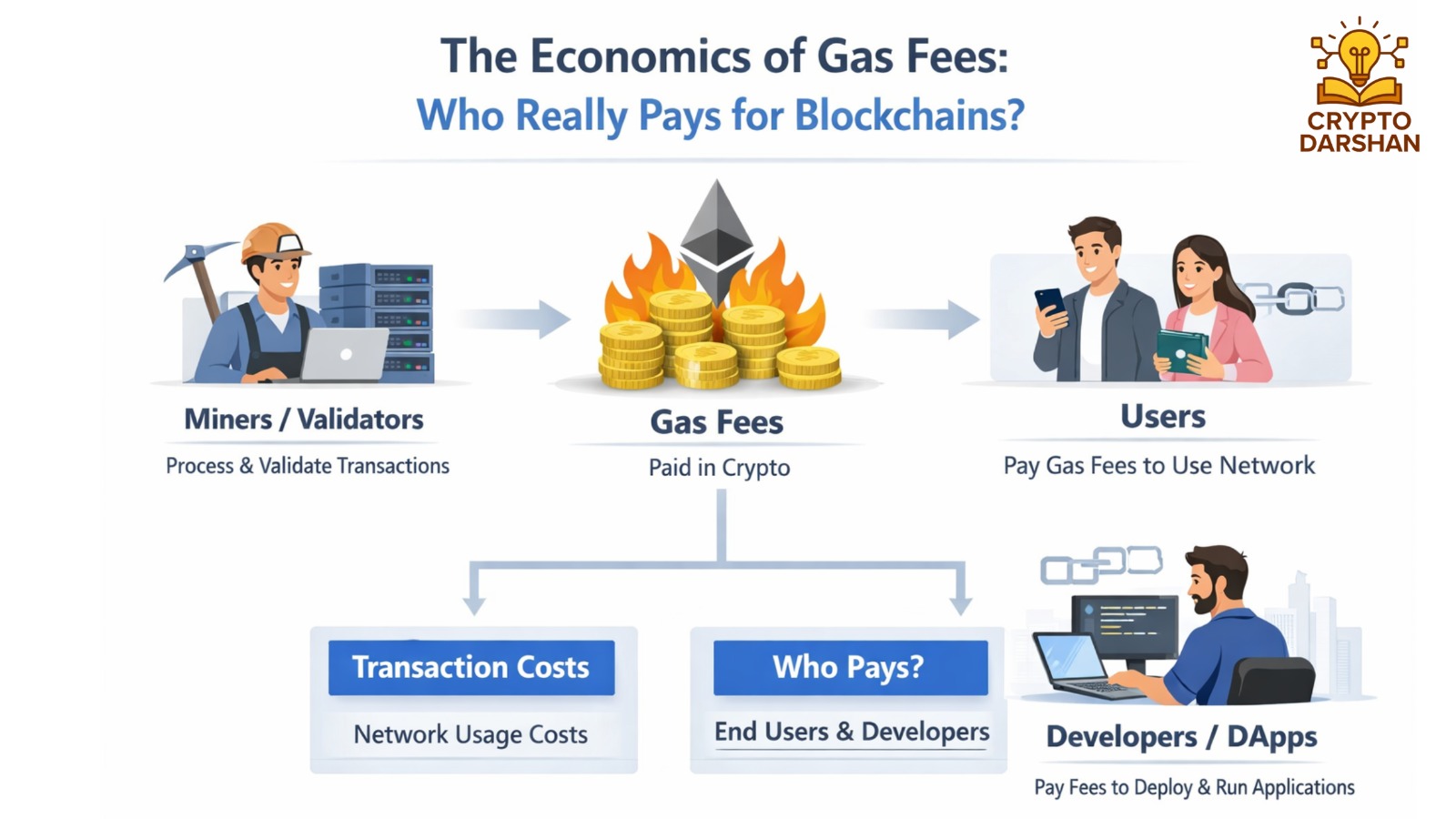
Every blockchain transaction consumes computational power. Validators or miners, depending on the consensus mechanism, use their hardware and energy to process these transactions. Fees compensate them for their work, ensuring that the network remains secure and functional.
For example, on Ethereum, Gas Fees are measured in “gas units,” and the total fee is calculated as:
Gas Fee = Gas Limit × Gas Price
- Gas Limit: The maximum amount of gas a user is willing to spend on a transaction.
- Gas Price: The amount of cryptocurrency (e.g., ETH) paid per unit of gas.
When network demand increases, Gas Fee rise because users compete to have their transactions processed faster. This dynamic pricing mechanism ensures that the network remains efficient and prevents spam.
To fully understand why gas fees exist, it helps to look at how different blockchain layers operate, something we explain in detail in our guide to Layer 0, Layer 1, Layer 2, and Layer 3 networks.
The Purpose of Gas Fees in Blockchain Networks

Gas Fees serve several critical purposes in blockchain ecosystems:
Incentivizing Validators and Miners
Validators and miners are responsible for verifying transactions and maintaining the blockchain’s integrity. Gas Fees reward them for their computational work, ensuring that they continue to secure the network.
Preventing Network Spam
Without Gas Fee, malicious actors could flood the network with meaningless transactions. By requiring users to pay for every operation, blockchains discourage spam and maintain efficiency.
Allocating Network Resources
Gas Fees act as a market mechanism that allocates limited computational resources. Users willing to pay higher fees get priority, ensuring that the most valuable transactions are processed first.
Supporting Network Sustainability

they provide ongoing revenue for validators, miners, and developers, contributing to the long-term sustainability of blockchain ecosystems.
Prioritizing Transactions
Gas fees create a market-based system where users can pay higher fees to have their transactions processed faster. Validators naturally prioritize transactions with higher fees, ensuring that limited block space is allocated efficiently based on demand.
Supporting Network Sustainability
Gas fees provide ongoing revenue for validators and developers, contributing to the long-term sustainability of blockchain ecosystems. Without these fees, there would be little financial incentive for participants to maintain and secure the network.
Balancing Supply and Demand for Block Space
Each block in a blockchain has limited capacity. Gas fee act as a balancing mechanism, ensuring that only transactions with sufficient economic value are included when demand exceeds supply, keeping the network efficient and functional.
Encouraging Efficient Use of Resources
Because every operation on the blockchain costs gas, developers and users are motivated to optimize their code and transaction behavior. This promotes efficient use of computational and storage resources across the network.
Maintaining Economic Security
Gas fees play a crucial role in the economic security of a blockchain. They make it costly for attackers to manipulate or overload the system, while ensuring that honest participants are rewarded for maintaining consensus and verifying transactions.
How Gas Fees Work

To understand the economics of Gas Fee, it’s important to examine how they are calculated and distributed.
Transaction Execution
Every action on a blockchain, like sending tokens or interacting with a smart contract, requires computational power. When a user initiates a transaction, it enters a queue (called the mempool) where validators or miners pick transactions to process. The higher the gas fee a user offers, the faster their transaction is likely to be confirmed.
Gas Units and Gas Price
Each operation on the blockchain consumes a specific number of gas units, depending on how complex it is. The total cost of a transaction is calculated by multiplying the gas units used by the gas price (the amount of cryptocurrency paid per unit of gas). This determines how much the user pays overall.
Dynamic Pricing Based on Demand
Gas fee fluctuate depending on network activity. When many users are transacting at the same time, demand for block space increases, causing gas prices to rise. During quieter periods, gas fees drop because there’s less competition for validator attention.
Validator Incentives
Validators (or miners) earn gas fees as a reward for verifying and adding transactions to the blockchain. These fees compensate them for their computational work, energy costs, and help maintain network security and decentralization.
Fee Distribution and Burning
In some blockchains, like Ethereum, after the EIP-1559 upgrade, part of the gas fee (the base fee) is burned, permanently removed from circulation, to control inflation. The remaining portion (the priority fee or tip) goes to validators as an incentive for faster processing. This system balances network efficiency, security, and token value.
Who Really Pays for Gas Fees?

At first glance, it seems that users directly pay Gas Fee. However, the true economic burden is shared among multiple stakeholders in the blockchain ecosystem.
1. End Users
End users pay Gas Fee when they send tokens, interact with dApps, or execute smart contracts. During periods of high network congestion, these fees can become prohibitively expensive, limiting participation for smaller users.
2. Developers
Developers indirectly pay Gas Fee when deploying or maintaining smart contracts. High fees can discourage innovation, as developers must optimize their code to minimize costs.
3. Validators and Miners
While validators and miners earn Gas Fee, they also incur costs for hardware, energy, and maintenance. Their profitability depends on the balance between Gas Fee revenue and operational expenses.
4. Layer 2 Users
Layer 2 solutions, such as rollups and sidechains, aggregate multiple transactions into a single batch to reduce Gas Fee. However, users still pay a portion of the underlying Layer 1 fees when data is posted back to the main chain.
The Economics Behind Gas Fees

The economics of Gas Fees are driven by supply and demand. When network activity increases, demand for block space rises, pushing Fees higher. Conversely, when activity decreases, fees drop.
1. Supply and Demand Dynamics
Blockchains have limited capacity. Each block can only include a certain number of transactions. When more users compete for this limited space, Gas Fees increase.
2. Market Efficiency
fees create a market for transaction priority. Users who value speed pay more, while those who can wait pay less. This ensures that resources are allocated efficiently.
3. Inflation Control
In some blockchains, a portion of Gas Fees is burned, reducing the total supply of tokens. This mechanism helps control inflation and maintain token value.
Factors Influencing Gas Fees

Several factors determine the cost of Gas Fees on a blockchain network:
1. Network Congestion
When many users are transacting simultaneously, Gas Fees rise due to competition for block space.
2. Transaction Complexity
Complex transactions that involve multiple smart contracts or large amounts of data require more computational power, increasing Gas Fee.
3. Block Size and Throughput
Blockchains with limited block sizes or slower throughput tend to have higher Gas Fees because fewer transactions can be processed per block.
4. Consensus Mechanism
Proof-of-Work (PoW) and Proof-of-Stake (PoS) systems have different cost structures. PoW networks often have higher Gas Fee due to energy-intensive mining, while PoS networks can offer lower fees.
5. Layer 2 Adoption
Layer 2 solutions reduce Gas Fees by processing transactions off-chain and only submitting summaries to the main chain.
Gas Fees in Different Blockchain Networks

Ethereum
Ethereum is the most well-known blockchain for Gas Fees. Its fee structure is dynamic, adjusting based on network demand. The introduction of EIP-1559 changed how they are handled by introducing a base fee (burned) and a priority fee (tip for validators).
Binance Smart Chain (BSC)
BSC offers lower v Fees compared to Ethereum due to its higher throughput and centralized validator structure. However, this comes at the cost of reduced decentralization.
Polygon
Polygon uses Layer 2 scaling to reduce Gas Fees significantly. It batches transactions and posts them to Ethereum, maintaining security while improving affordability.
Solana
Solana’s high throughput allows for extremely low Gas Fees, making it attractive for developers and users. However, its architecture requires powerful hardware, which can limit decentralization.
The Impact of Gas Fee on Blockchain Adoption

1. User Accessibility
High Gas Fee can deter new users, especially those making small transactions. Affordable fees are essential for mass adoption.
2. Developer Innovation
Developers must design efficient smart contracts to minimize Gas Fee. High costs can limit experimentation and innovation.
3. DeFi and NFT Markets
In decentralized finance (DeFi) and non-fungible token (NFT) markets, Gas Fees directly affect profitability. High fees can make small trades or NFT minting uneconomical.
4. Economic Inclusion
Lower Gas Fees promote financial inclusion by allowing users from developing regions to participate in blockchain economies.
The Relationship Between Gas Fees and Network Security
Gas Fees play a vital role in maintaining blockchain security. They ensure that validators and miners are compensated for their work, incentivizing them to act honestly.
1. Validator Incentives
Validators rely on Gas Fee as part of their income. If fees are too low, they may lose motivation to secure the network.
2. Attack Prevention
High Gas Fees make it expensive for attackers to flood the network with spam transactions, protecting against denial-of-service attacks.
3. Economic Finality
Gas Fee contribute to the economic finality of transactions, ensuring that once a transaction is confirmed, it cannot be easily reversed.
The Role of Fees in Layer 2 Scaling Solutions

Layer 2 solutions aim to reduce Gas Fees while maintaining security and decentralization. They process transactions off-chain and periodically post summaries to the main chain.
1. Rollups
Rollups bundle multiple transactions into one, reducing Fees per transaction. Examples include Optimistic Rollups and zk-Rollups.
2. Sidechains
Sidechains operate independently but connect to the main chain for security. They offer lower Gas Fees but may have different trust assumptions.
3. State Channels
State channels allow users to transact off-chain and only settle the final state on-chain, minimizing Gas Fees.
The Future of Gas Fees

The future of Gas Fees depends on technological advancements, network upgrades, and user demand. Several trends are shaping the evolution of blockchain cost structures.
1. Ethereum 2.0 and Sharding
Ethereum’s transition to Proof-of-Stake and the introduction of sharding aim to increase throughput and reduce Gas Fee.
2. Modular Blockchain Architectures
Modular designs separate execution, consensus, and data availability, optimizing each layer to reduce Gas Fee.
3. Cross-Chain Interoperability
Interoperable blockchains can distribute transaction loads, reducing congestion and Gas Fee across networks.
4. Dynamic Fee Markets
Future blockchains may implement adaptive fee models that adjust Gas Fee based on real-time network conditions.
Strategies to Reduce Gas Fee

Use Layer 2 Solutions
Layer 2 networks like Arbitrum, Optimism, and Polygon process transactions off the main blockchain (Layer 1) and then post summaries back to it. This reduces congestion on the main chain and significantly lowers gas fee while maintaining security and compatibility with major blockchains like Ethereum.
Optimize Smart Contract Code
Developers can design and write more efficient smart contracts to minimize computational steps. Each unnecessary operation increases gas usage, so optimizing code by reducing loops, simplifying logic, and reusing functions helps lower the total gas required for execution.
Batch Transactions
Instead of sending multiple individual transactions, users and developers can combine several actions into one. For example, transferring tokens to multiple addresses in a single batch transaction reduces the total gas cost compared to sending them separately.
Time Transactions During Low Network Activity
Gas fees fluctuate based on network demand. Executing transactions during off-peak hours, when fewer users are active, can result in lower gas prices. Monitoring gas trackers helps identify the best times to transact at minimal cost.
Use Alternative or Scalable Blockchains
Some blockchains, such as Binance Smart Chain, Avalanche, or Solana, offer lower gas fees due to higher throughput and different consensus mechanisms. Moving certain activities to these networks can help users and developers save on transaction costs while maintaining functionality.
Economic Implications of Gas Fees

Gas Fees influence the broader blockchain economy in several ways:
1. Market Efficiency
They ensure that resources are allocated efficiently, prioritizing valuable transactions.
2. Token Value
Burning a portion of Gas Fees can reduce token supply, potentially increasing its value.
3. Network Sustainability
Gas Fees provide continuous revenue for validators, ensuring long-term network stability.
4. User Behavior
High Fees encourage users to seek more efficient networks or Layer 2 solutions.
Case Studies: Gas Fees in Practice

Ethereum’s EIP-1559
EIP-1559 introduced a base fee that is burned and a priority fee for validators. This change made Gas Fees more predictable and reduced volatility.
Polygon’s Scaling Success
Polygon’s Layer 2 solution drastically reduced Gas Fees, attracting developers and users from Ethereum.
Solana’s Low-Fee Model
Solana’s architecture allows for minimal Gas Fees, enabling high-frequency trading and microtransactions.
Challenges in Managing Gas Fees

- Scalability vs. Decentralization
Reducing Gas Fee often requires increasing throughput, which can compromise decentralization. - User Experience
Complex fee structures can confuse users, hindering adoption. - Economic Sustainability
Extremely low Fees may reduce validator incentives, threatening network security. - Regulatory Concerns
As Gas Fees represent real economic activity, they may attract regulatory scrutiny.
FAQ

1. What are gas fees in blockchain?
Gas fees are transaction costs paid by users to compensate validators or miners for processing and securing transactions on a blockchain network.
2. Why do gas fees exist?
Gas fees serve two main purposes:
- Preventing spam transactions
- Incentivizing network participants (validators/miners) to maintain the blockchain
3. Who actually pays gas fees?
Primarily, users initiating transactions pay gas fees. However, in some cases, costs are indirectly shared or shifted to developers, businesses, or end-users through pricing models.
4. Why do gas fees fluctuate so much?
Gas fees depend on network demand. When many users compete to process transactions, fees rise due to limited block space.
5. Which blockchains have the highest gas fees?
Networks with high usage and limited scalability—like Ethereum—tend to have higher fees, especially during peak activity.
6. How do Layer 2 solutions reduce gas fees?
Layer 2 solutions process transactions off the main blockchain and then settle them in batches, significantly reducing per-transaction costs.
7. Do validators or miners keep all gas fees?
Not always. In some networks, a portion of fees may be burned (destroyed), while the rest goes to validators as rewards.
8. What is fee burning, and why is it used?
Fee burning permanently removes a portion of transaction fees from circulation, helping control token supply and potentially increasing value.
Conclusion
The economics of Gas Fees reveal the delicate balance between cost, security, and accessibility in blockchain networks. While users appear to pay Gas Fee directly, the true cost is distributed across developers, validators, and infrastructure providers. Fees are not just transaction costs—they are the foundation of blockchain economics, ensuring that decentralized systems remain secure, efficient, and sustainable.
As blockchain technology evolves, innovations in scalability, Layer 2 solutions, and modular architectures will continue to reshape how they are structured and who ultimately pays for them. The future of blockchain depends on achieving a sustainable balance between affordable Gas Fees and robust network security, paving the way for a more inclusive and efficient decentralized economy.