The blockchain ecosystem has evolved from isolated networks into a complex web of interoperable systems. As decentralized finance (DeFi) continues to expand, the demand for seamless cross-chain transactions has become one of the most pressing challenges in the crypto industry. Atomic swaps trustless, peer-to-peer exchanges between different blockchains have emerged as a revolutionary solution. By 2026, technologies like RenVM and THORChain are leading the charge in enabling cross-chain fiat and crypto interoperability, reshaping how digital assets move across networks.
This article explores the state of atomic swaps in 2026, focusing on RenVM and THORChain as the primary enablers of cross-chain fiat integration. It examines their architectures, use cases, advantages, and the broader implications for decentralized finance, liquidity, and global payments.
As blockchain networks become increasingly interconnected, the infrastructure supporting interoperability continues to evolve. Innovations in modular blockchain development, such as sovereign rollups explained in Rollkit: Sovereign Rollups Made Simple are helping networks scale while supporting complex cross-chain applications and liquidity systems.
Understanding Atomic Swaps

What Are Atomic Swaps?
Atomic swaps are a way to exchange cryptocurrencies directly across different blockchains. The term “atomic” refers to the all-or-nothing nature of the transaction either both sides complete successfully, or the entire process is canceled automatically.
This technology eliminates the need for centralized exchanges, reducing counterparty risk and enhancing privacy. Atomic swaps rely on Hashed Time-Locked Contracts (HTLCs), which ensure that both parties fulfill their obligations within a set timeframe or the transaction is reversed.
The Evolution of Atomic Swaps
The concept of atomic swaps dates back to 2013, but practical implementations began around 2017 with Bitcoin and Litecoin. Early swaps were limited to chains with similar scripting languages. Over time, innovations like cross-chain bridges, wrapped tokens, and interoperability protocols expanded atomic swap capabilities to include Ethereum, Binance Smart Chain, and other networks.
By 2026, atomic swaps have matured into a cornerstone of decentralized finance, enabling not only crypto-to-crypto exchanges but also cross-chain fiat integration through synthetic assets, stablecoins, and decentralized liquidity networks.
The Rise of Cross-Chain Interoperability
The Problem of Blockchain Silos
Each blockchain operates as an independent ecosystem with its own consensus mechanism, token standards, and governance. This isolation creates “liquidity silos,” where assets cannot move freely between networks. For example, Bitcoin cannot natively interact with Ethereum smart contracts without an intermediary.
This fragmentation limits the efficiency of decentralized finance and hinders the adoption of blockchain technology for mainstream financial applications.
The Solution: Cross-Chain Protocols
Cross-chain protocols like RenVM and THORChain bridge these isolated ecosystems, enabling seamless asset transfers and swaps. They use decentralized nodes, cryptographic proofs, and liquidity pools to facilitate trustless exchanges between different blockchains.
In 2026, these protocols have evolved to support cross-chain fiat, allowing users to swap between cryptocurrencies and fiat-backed stablecoins across multiple networks without centralized exchanges.
RenVM: The Darknode-Powered Bridge
Overview
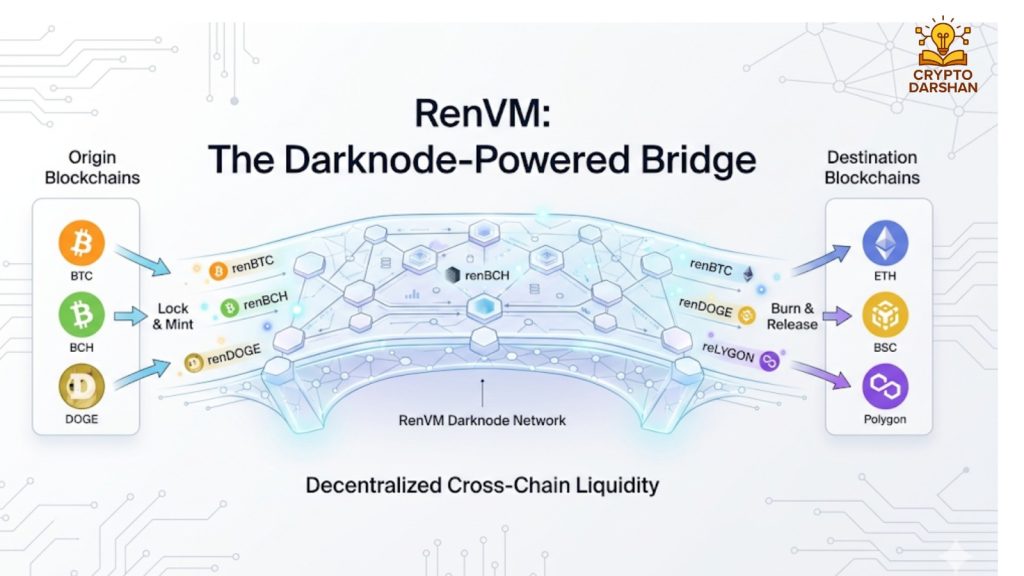
RenVM (Ren Virtual Machine) is a decentralized protocol that enables cross-chain liquidity and interoperability. It allows users to move assets like Bitcoin, Bitcoin Cash, and Zcash onto Ethereum and other blockchains in a trustless manner. RenVM operates through a network of Darknodes, which collectively manage private keys and execute cross-chain transactions securely.
How RenVM Works
RenVM uses a system of secure multiparty computation (sMPC) to manage private keys without exposing them to any single node. When a user locks an asset (e.g., BTC) on its native chain, RenVM mints a corresponding token (e.g., renBTC) on the destination chain. This token can then be used in DeFi applications, traded, or swapped for other assets.
When the user wants to redeem their original asset, the renBTC is burned, and the equivalent BTC is released from the RenVM vault.
RenVM and Cross-Chain Fiat
By 2026, RenVM has expanded its capabilities to include fiat-backed stablecoins and synthetic fiat assets. Through partnerships with decentralized stablecoin issuers and liquidity providers, RenVM enables direct swaps between crypto assets and fiat equivalents across multiple blockchains.
For example, a user can swap BTC on the Bitcoin network for USD-pegged stablecoins on Ethereum or Solana without using a centralized exchange. This functionality bridges the gap between traditional finance and decentralized ecosystems.
Key Features of RenVM
- Decentralized Custody: Assets are held by a network of Darknodes, not a single entity.
- Privacy-Preserving: Transactions are executed without revealing private keys.
- Cross-Chain Liquidity: Supports multiple blockchains and assets.
- Scalability: Designed to handle high transaction volumes efficiently.
- Fiat Integration: Enables swaps between crypto and fiat-backed assets.
Use Cases
- Cross-Chain DeFi: Users can move BTC into Ethereum-based DeFi protocols like Aave or Uniswap.
- Liquidity Provision: Traders can provide liquidity across multiple chains to earn yield.
- Cross-Chain Payments: Businesses can accept payments in one currency and receive another seamlessly.
- Stablecoin Arbitrage: Traders can exploit price differences between stablecoins across chains.
- Institutional Settlement: Financial institutions can use RenVM for secure, cross-chain asset transfers.
THORChain: The Liquidity Network for All Chains
Overview
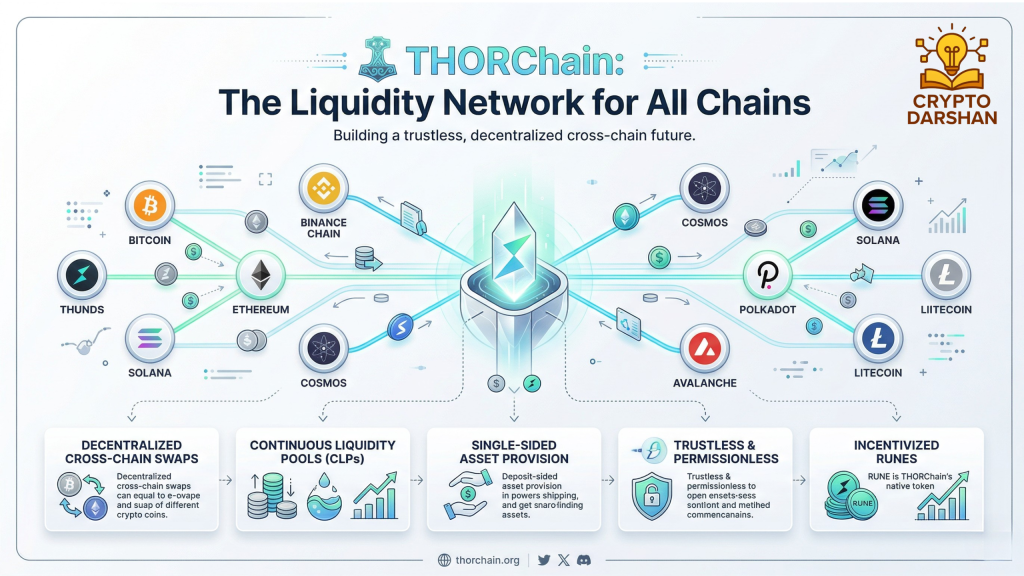
THORChain is a decentralized liquidity protocol that enables cross-chain swaps without wrapped assets. Unlike RenVM, which mints synthetic tokens, THORChain uses native assets directly. It operates as a cross-chain automated market maker (AMM), similar to Uniswap but across multiple blockchains.
How THORChain Works
THORChain uses a native token, RUNE, as the settlement asset for all swaps. Liquidity providers deposit pairs of assets (e.g., BTC and RUNE) into liquidity pools. When a user swaps BTC for ETH, the protocol executes two transactions: BTC → RUNE and RUNE → ETH. This design ensures that all assets remain native to their respective chains.
THORChain’s nodes, known as validators, manage cross-chain transactions using threshold signatures (TSS). This ensures that no single node controls the funds, maintaining decentralization and security.
THORChain and Cross-Chain Fiat
By 2026, THORChain has integrated fiat-backed stablecoins and synthetic fiat assets into its liquidity pools. This allows users to swap between cryptocurrencies and fiat equivalents directly. For instance, a user can exchange BTC for USDC or EURS across chains without centralized intermediaries.
THORChain’s integration with decentralized stablecoin protocols and fiat on/off-ramps has made it a key player in cross-chain fiat liquidity.
Key Features of THORChain
- Native Asset Swaps: No need for wrapped tokens or synthetic assets.
- Decentralized Liquidity Pools: Users provide liquidity and earn yield.
- Cross-Chain Compatibility: Supports Bitcoin, Ethereum, Binance Chain, Avalanche, and more.
- RUNE as Settlement Asset: Ensures consistent liquidity and price stability.
- Fiat Integration: Supports stablecoins and synthetic fiat assets.
Use Cases
- Cross-Chain Trading: Swap BTC for ETH or stablecoins directly.
- Liquidity Farming: Earn rewards by providing liquidity across chains.
- Decentralized Payments: Enable global payments in multiple currencies.
- Fiat Gateway: Convert crypto to fiat-backed stablecoins seamlessly.
- Merchant Solutions: Businesses can accept crypto payments and receive fiat equivalents.
Comparing RenVM and THORChain
| Feature | RenVM | THORChain |
| Architecture | sMPC-based virtual machine | Cross-chain AMM |
| Asset Type | Wrapped tokens (e.g., renBTC) | Native assets |
| Settlement Token | None | RUNE |
| Fiat Integration | Synthetic and stablecoin-based | Stablecoin and fiat liquidity pools |
| Security Model | Darknodes with sMPC | Validators with TSS |
| Primary Use Case | Cross-chain bridging | Cross-chain liquidity and swaps |
| Privacy | High (private key obfuscation) | Moderate (transparent pools) |
| Scalability | High | High |
| Decentralization | Strong | Strong |
Both protocols play complementary roles in the cross-chain ecosystem. RenVM excels in secure asset bridging and privacy, while THORChain dominates in liquidity and native asset swaps. Together, they form the backbone of decentralized cross-chain fiat integration.
The Role of Cross-Chain Fiat in 2026

The Need for Fiat Integration
Despite the growth of cryptocurrencies, fiat currencies remain the dominant medium of exchange globally. Integrating fiat into decentralized systems bridges the gap between traditional finance and blockchain technology. Cross-chain fiat enables users to move value seamlessly between crypto and fiat ecosystems without centralized intermediaries.
How Cross-Chain Fiat Works
Cross-chain fiat integration relies on stablecoins, synthetic assets, and decentralized liquidity networks. Stablecoins like USDC, USDT, and DAI represent fiat currencies on the blockchain, while synthetic assets mirror fiat values through collateralized mechanisms.
Protocols like RenVM and THORChain facilitate swaps between these assets across multiple blockchains, enabling global, borderless transactions.
Benefits of Cross-Chain Fiat
- Global Accessibility: Users can transact in fiat equivalents anywhere.
- Reduced Fees: Eliminates intermediaries and conversion costs.
- Faster Settlements: Transactions complete in seconds, not days.
- Enhanced Liquidity: Unified liquidity across chains and assets.
- Financial Inclusion: Enables access to decentralized finance for unbanked populations.
Security and Decentralization

Security Mechanisms
Both RenVM and THORChain employ advanced cryptographic techniques to ensure transaction security. RenVM uses secure multiparty computation (sMPC), while THORChain relies on threshold signature schemes (TSS). These methods prevent any single node from controlling private keys or funds.
Decentralization and Governance
RenVM’s Darknodes and THORChain’s validators operate independently, governed by decentralized consensus mechanisms. Both networks incentivize honest participation through staking and slashing mechanisms, ensuring network integrity.
Risk Factors
Despite their strengths, cross-chain protocols face challenges such as smart contract vulnerabilities, liquidity risks, and potential exploits. Continuous audits, community governance, and protocol upgrades are essential to maintaining security.
The Future of Atomic Swaps and Cross-Chain Fiat

Integration with Layer 2 Solutions
By 2026, atomic swaps are increasingly integrated with Layer 2 scaling solutions like Optimism, Arbitrum, and zkSync. This reduces transaction costs and enhances speed, making cross-chain swaps more efficient.
Institutional Adoption
Financial institutions are beginning to adopt cross-chain technologies for settlement and liquidity management. Decentralized protocols like RenVM and THORChain offer transparent, auditable, and efficient alternatives to traditional systems.
AI and Automation in Cross-Chain Trading
Artificial intelligence is being used to optimize liquidity allocation, predict market trends, and automate cross-chain swaps. This integration enhances efficiency and reduces human error in decentralized trading.
Regulatory Outlook
As cross-chain fiat becomes mainstream, regulatory frameworks are evolving to accommodate decentralized exchanges and stablecoin issuers. Compliance mechanisms like decentralized identity (DID) and on-chain KYC are being integrated into cross-chain protocols.
Integration with CBDCs
Central Bank Digital Currencies (CBDCs) are becoming a major component of the global financial system. By 2026, several countries have launched CBDCs that can interact with decentralized networks. RenVM and THORChain are exploring ways to integrate CBDCs into their ecosystems, enabling direct swaps between crypto assets and government-backed digital currencies.
This integration could revolutionize cross-border payments, allowing instant, low-cost transfers between fiat and crypto ecosystems while maintaining compliance with regulatory standards.
Challenges and Limitations

- Liquidity Fragmentation: Despite progress, liquidity remains scattered across multiple chains.
- Regulatory Uncertainty: Varying global regulations pose challenges for fiat integration.
- Security Risks: Smart contract exploits and node compromises remain potential threats.
- User Experience: Cross-chain transactions can still be complex for non-technical users.
- Scalability: As adoption grows, maintaining performance and decentralization is critical.
- Interoperability Standards: Lack of universal standards can hinder seamless integration.
Opportunities Ahead

- Global Payment Networks: Cross-chain fiat can power decentralized global payment systems.
- DeFi Expansion: Enhanced interoperability will unlock new DeFi products and services.
- Stablecoin Innovation: New fiat-backed and algorithmic stablecoins will emerge.
- Enterprise Integration: Businesses can leverage cross-chain swaps for treasury management.
- Decentralized Forex Markets: Atomic swaps can enable decentralized currency trading.
- NFT and Metaverse Payments: Cross-chain fiat can facilitate seamless payments in virtual economies.
- Remittance Solutions: Low-cost, instant remittances using cross-chain fiat will disrupt traditional money transfer services.
- Tokenized Real-World Assets: Integration with tokenized stocks, bonds, and commodities will expand the utility of atomic swaps.
Case Studies: Real-World Applications

Case Study 1: Cross-Border Remittances
A remittance company in Southeast Asia uses THORChain to enable instant swaps between BTC and USDC across multiple blockchains. Customers can send funds in Bitcoin, and recipients receive stablecoins pegged to their local currency within seconds. This eliminates the need for banks and reduces transaction fees by over 80%.
Case Study 2: Institutional Liquidity Management
A hedge fund uses RenVM to move Bitcoin liquidity into Ethereum-based DeFi protocols for yield farming. The fund locks BTC on the Bitcoin network and mints renBTC on Ethereum, which is then deployed into lending pools. When profits are realized, the renBTC is burned, and the original BTC is released back to the fund’s custody.
Case Study 3: Decentralized Forex Market
Developers build a decentralized forex platform using RenVM and THORChain. Users can trade between USD, EUR, and JPY stablecoins across multiple blockchains. The platform uses atomic swaps to ensure trustless, instant currency exchanges without intermediaries.
The Broader Impact on Global Finance

Democratizing Access to Financial Services
Cross-chain fiat and atomic swaps are breaking down barriers to financial inclusion. Individuals in developing countries can now access global liquidity, stable assets, and decentralized lending platforms without traditional banks.
Redefining Liquidity and Capital Efficiency
By connecting multiple blockchains, atomic swaps create more unified liquidity networks that enhance overall capital efficiency. Traders and institutions can move assets freely between ecosystems, reducing idle capital and improving market depth across decentralized exchanges and cross-chain platforms.
As cross-chain trading continues to grow, it may also influence broader cryptocurrency market cycles by redistributing liquidity across different blockchain ecosystems. Investors monitoring long-term trends and market signals can gain deeper insights from Crypto Bear Market Signals, which explores indicators used to identify shifts in the crypto market.
The Shift Toward Decentralized Infrastructure
As more financial services migrate to decentralized networks, atomic swaps will serve as the foundation for a new financial infrastructure one that is open, transparent, and globally accessible.
Atomic Swaps 2026: RenVM and THORChain for Cross-Chain Fiat – FAQ

1. What are atomic swaps in cryptocurrency?
Atomic swaps are a technology that allows users to exchange cryptocurrencies across different blockchains directly without using a centralized exchange. They rely on cryptographic techniques such as hashed timelock contracts (HTLCs) to ensure that either both sides of the transaction complete or neither does, preventing one party from losing funds.
2. How do atomic swaps enable cross-chain transactions?
Atomic swaps work by locking funds on two separate blockchains using cryptographic conditions. When one participant reveals a secret key to claim the asset, the other party can use that same key to unlock their funds. This process ensures that the exchange happens simultaneously across chains, enabling trustless cross-chain trading.
3. What is THORChain?
THORChain is a decentralized liquidity protocol that enables users to swap native cryptocurrencies across different blockchains without wrapped tokens or centralized intermediaries. It functions as a cross-chain decentralized exchange infrastructure that connects multiple blockchains through liquidity pools.
4. How does THORChain perform cross-chain swaps?
THORChain uses a hub-and-spoke model where each supported asset is paired with its native token RUNE in liquidity pools. When a user swaps one asset for another, the protocol first swaps the source asset to RUNE and then converts RUNE into the target asset, completing the process seamlessly for the user.
5. What is RenVM?
RenVM is a decentralized virtual machine designed to facilitate cross-chain asset transfers by locking assets on one blockchain and minting equivalent tokens on another. For example, Bitcoin can be represented on Ethereum as renBTC, enabling Bitcoin liquidity to be used in decentralized finance (DeFi) applications.
6. How does RenVM differ from THORChain?
The main difference lies in how assets are handled:
- RenVM: Locks original assets and creates wrapped tokens (e.g., renBTC on Ethereum).
- THORChain: Enables direct swaps of native assets without creating wrapped tokens.
Because of this, THORChain focuses on native asset trading, while RenVM primarily acts as a bridge for cross-chain liquidity.
7. Can atomic swaps be used for fiat currency?
Atomic swaps are designed primarily for cryptocurrencies. However, fiat integration is possible indirectly through fiat on-ramps and stablecoins. In many cases, users convert fiat to stablecoins or crypto first and then use cross-chain protocols like THORChain to move value between blockchains.
8. What advantages do atomic swaps offer in 2026?
Key benefits include:
- Trustless transactions without centralized exchanges
- Improved security by eliminating custodial risk
- Cross-chain interoperability between major blockchains
- Reduced transaction fees in some scenarios
- Greater user control over funds
These features make atomic swaps an important building block for decentralized finance and Web3 infrastructure.
Conclusion
By 2026, atomic swaps have evolved from a niche concept into a foundational technology for decentralized finance. RenVM and THORChain stand at the forefront of this transformation, enabling seamless cross-chain fiat and crypto interoperability. Their decentralized architectures, robust security models, and expanding ecosystems are redefining how value moves across blockchains.
As the world moves toward a more interconnected financial future, atomic swaps will play a central role in bridging traditional and decentralized economies. The integration of fiat into cross-chain networks marks a pivotal step toward a truly borderless, decentralized financial system—one where users can exchange value freely, securely, and globally.