The digital world runs on cloud computing. Every app, website, and online service depends on servers owned by major corporations like Amazon, Google, and Microsoft. These centralized systems have powered the internet for decades, but they also raise concerns about privacy, control, and cost. As blockchain technology evolves, a new question emerges: can decentralized cloud computing replace big tech servers?
This article explores how blockchain could transform cloud computing, the challenges it faces, and whether it can truly compete with centralized giants. It examines the technology, economics, and real-world use cases behind decentralized cloud systems, offering a clear view of what the future might hold.
Understanding Cloud Computing
What Is Cloud Computing?
Cloud computing is a form of computing in which networks, data storage, applications, AI tools, security and development tools are all enabled via the internet rather than a local computer or an on-premise server in your organization. It provides on-demand access to computing resources such as storage, databases, and applications through the internet. The model is built on three main service types:
- Infrastructure as a Service (IaaS): Provides virtualized computing resources like servers and storage.
- Platform as a Service (PaaS): Offers tools and frameworks for developers to build and deploy applications.
- Software as a Service (SaaS): Delivers software applications over the internet, accessible through browsers or apps.
The Centralized Cloud Model
In the current model, cloud services are controlled by a few large providers. Amazon Web Services (AWS), Microsoft Azure, and Google Cloud dominate the market, hosting millions of websites and applications. These companies maintain massive data centers across the globe, offering scalability and reliability.
However, this centralization comes with drawbacks:
- Data control: Users rely on third parties to store and manage their data.
- Censorship risk: Providers can restrict or remove content.
- Single points of failure: Outages can disrupt millions of users.
- High costs: Pricing models often favor large enterprises over small developers.
These issues have led to growing interest in decentralized alternatives.
The Rise of Decentralized Cloud Computing
What Is Decentralized Cloud Computing?
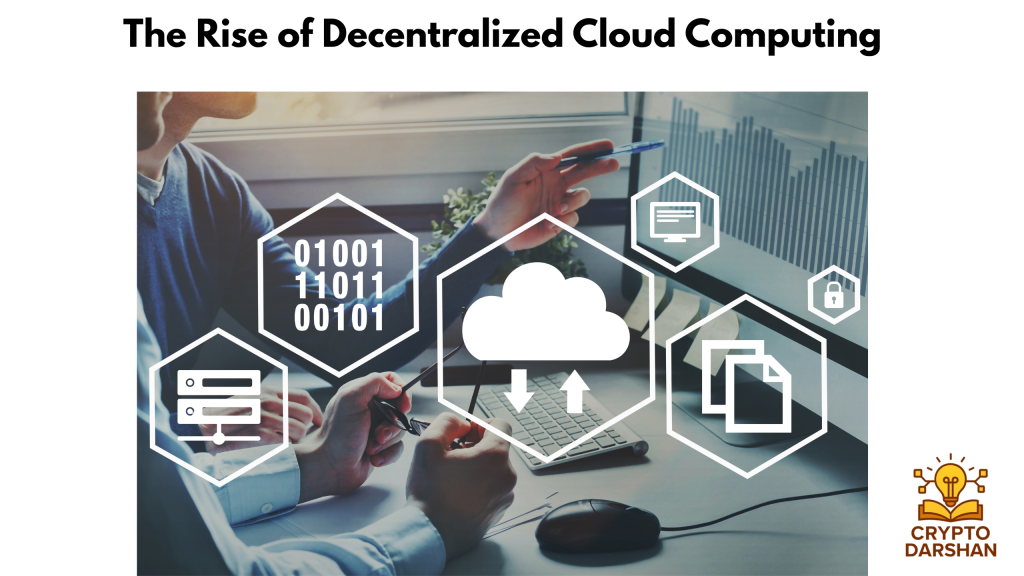
Decentralized cloud computing distributes data and processing power across a network of independent nodes rather than relying on centralized servers. Each node contributes storage, bandwidth, or computing resources, forming a peer-to-peer network. Blockchain technology ensures transparency, security, and coordination among participants.
In this model, no single entity controls the network. Instead, smart contracts and consensus mechanisms manage operations, payments, and data integrity.
How Blockchain Enables Decentralization
Blockchain provides the foundation for decentralized cloud systems through several key features:
- Distributed Ledger: Records all transactions across multiple nodes, ensuring transparency and immutability.
- Smart Contracts: Automate agreements between users and providers without intermediaries.
- Tokenization: Enables payments and incentives using digital tokens.
- Consensus Mechanisms: Validate transactions and maintain trust without central authority.
These elements create a trustless environment where users can rent computing resources directly from others, reducing dependency on big tech companies.
Key Components of a Decentralized Cloud
1. Storage Networks
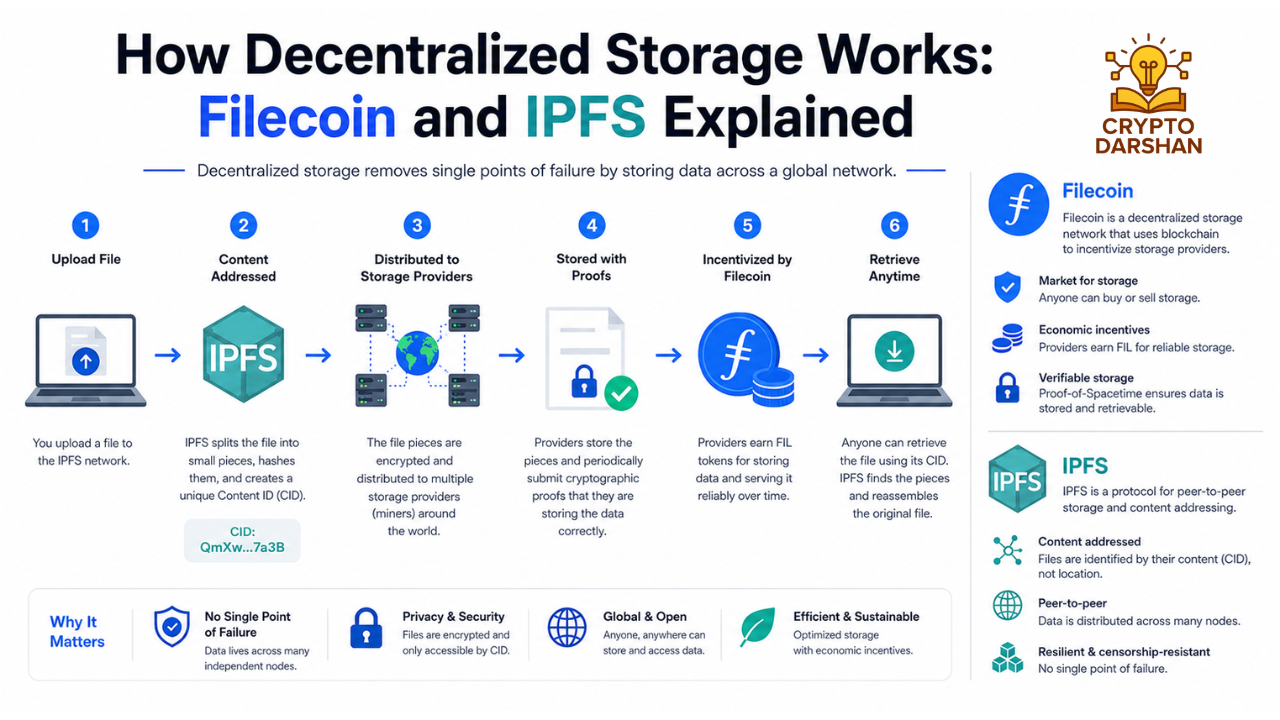
Decentralized storage networks allow users to store files across multiple nodes. Data is encrypted, split into fragments, and distributed globally. Only the owner can reassemble the data using private keys.
Examples:
- Filecoin: Uses blockchain to reward users for providing storage space.
- Storj: Encrypts and distributes data across a global network of nodes.
- Sia: Offers low-cost, peer-to-peer cloud storage secured by smart contracts.
2. Compute Networks
Decentralized compute networks provide processing power for running applications, AI models, or simulations. Users can rent idle CPU or GPU resources from others.
Examples:
- Golem: A marketplace for computing power, enabling distributed rendering and machine learning.
- iExec: Focuses on decentralized cloud computing for blockchain applications.
- Akash Network: Offers a decentralized marketplace for cloud computing resources.
3. Bandwidth and Content Delivery
Decentralized content delivery networks (CDNs) distribute web content through peer-to-peer systems, improving speed and reducing costs.
Examples:
- Theta Network: Uses blockchain to optimize video streaming and content delivery.
- Livepeer: Decentralizes video transcoding for streaming platforms.
Advantages of Decentralized Cloud Computing
1. Enhanced Security and Privacy
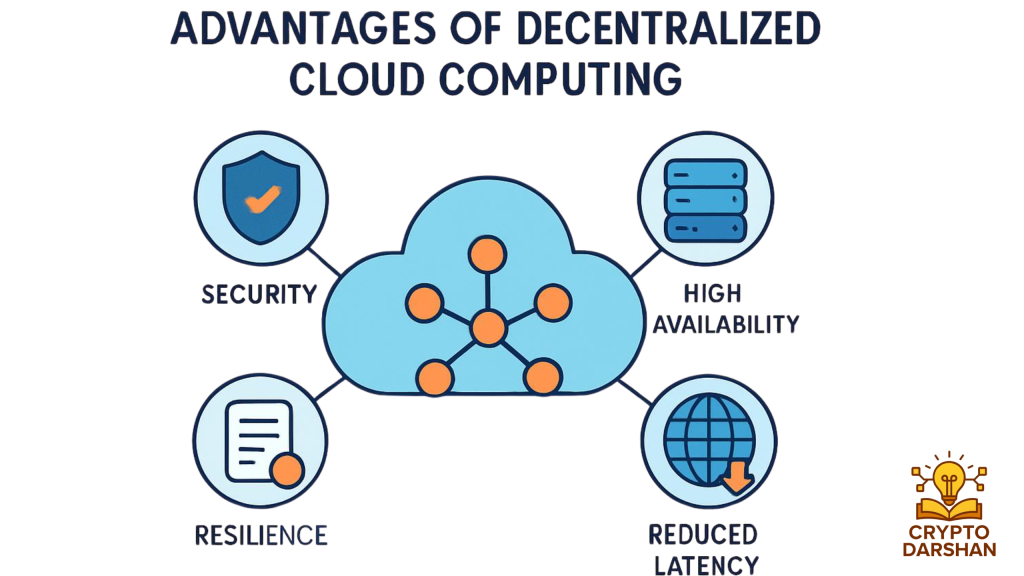
Data stored on decentralized networks is encrypted and fragmented, making it nearly impossible for hackers to access complete files. Since no central server exists, there is no single point of failure or attack.
2. Censorship Resistance
Decentralized systems operate without central control, making it difficult for governments or corporations to censor content or restrict access. This feature is especially valuable for journalists, activists, and developers in restrictive regions.
3. Cost Efficiency
By leveraging unused computing resources, decentralized networks can offer lower prices than traditional cloud providers. Users pay only for what they use, and providers earn tokens for contributing resources.
4. Transparency and Trust
Blockchain’s immutable ledger ensures that all transactions are verifiable. Users can track how their data is stored and processed, fostering trust between participants.
5. Global Accessibility
Anyone with an internet connection can join a decentralized network, either as a user or provider. This inclusivity promotes innovation and competition across borders.
Challenges Facing Decentralized Cloud Computing
1. Performance and Scalability
Centralized data centers are optimized for speed and reliability. Decentralized networks, however, rely on distributed nodes that may vary in performance and availability. Achieving consistent uptime and low latency remains a challenge.
2. Data Availability and Redundancy
While data fragmentation enhances security, it can complicate retrieval. If multiple nodes go offline, accessing complete data may become difficult unless redundancy mechanisms are robust.
3. User Experience
Traditional cloud platforms offer user-friendly dashboards and APIs. Decentralized systems often require technical knowledge, limiting adoption among non-experts.
4. Regulation and Compliance
Data protection laws like GDPR require clear accountability for data handling. In decentralized systems, identifying responsible parties can be complex, raising legal concerns.
5. Market Adoption
Enterprises are cautious about migrating critical workloads to unproven decentralized systems. Building trust and demonstrating reliability will take time.
Blockchain vs. Big Tech Servers: A Comparative Analysis
| Feature | Centralized Cloud (Big Tech) | Decentralized Cloud (Blockchain) |
| Control | Owned by corporations | Distributed among users |
| Security | Relies on provider’s infrastructure | Secured by encryption and consensus |
| Cost | Subscription-based, often expensive | Pay-per-use, potentially cheaper |
| Scalability | Highly optimized | Still developing |
| Censorship | Possible | Difficult |
| Transparency | Limited | High, via public ledger |
| Data Ownership | Provider-controlled | User-controlled |
| Reliability | Proven uptime | Dependent on network participation |
While decentralized systems offer compelling advantages, centralized clouds still lead in performance, support, and enterprise integration.
Real-World Use Cases

1. Decentralized Web Hosting
Projects like Fleek and Arweave enable developers to host websites on decentralized networks. This approach ensures uptime even if individual nodes fail and prevents censorship.
2. AI and Machine Learning
Platforms such as Golem and iExec allow distributed training of AI models using idle computing power. This democratizes access to high-performance computing resources.
3. Video Streaming
Theta Network and Livepeer reduce streaming costs by decentralizing video delivery. Viewers can earn tokens for sharing bandwidth.
4. Data Storage and dApps
Decentralized infrastructure can power applications like secure data storage, NFT platforms, and decentralized apps (dApps) by hosting them without relying on centralized servers, similar to the blockchain-based ecosystems explored in Decentralized Data Markets: How Blockchain Lets Users Sell Their Data.
5. Edge Computing
Decentralized networks can power edge computing, where data is processed closer to the source. This reduces latency for IoT devices and real-time applications.
Economic Implications
Token-Based Incentives
Decentralized cloud systems use tokens to reward participants. Users pay tokens for storage or computing, while providers earn them for contributing resources. This creates a self-sustaining economy that encourages participation.
Lower Barriers to Entry
Small businesses and developers can access affordable cloud resources without long-term contracts. This levels the playing field against large corporations.
Redistribution of Power
By removing intermediaries, decentralized systems shift control from big tech companies to individuals and communities. This could reshape the digital economy, promoting fairness and innovation.
Environmental Considerations
Centralized data centers consume vast amounts of energy. Decentralized networks can be more sustainable by utilizing existing hardware and optimizing resource use. However, blockchain’s energy consumption, especially in proof-of-work systems, remains a concern. Emerging consensus mechanisms like proof-of-stake and proof-of-space aim to reduce this impact.
The Future of Decentralized Cloud Computing
Integration with Web3
Decentralized cloud computing is a cornerstone of Web3, the next generation of the internet built on blockchain. It supports decentralized applications (dApps), NFTs, and metaverse platforms by providing secure, distributed infrastructure.
The infrastructure layer of Web3 is evolving quickly. As we explained in our blog, Rollup-as-a-Service (RaaS): The Shopify Moment for Blockchains, new tools are making it easier for developers to launch scalable blockchain ecosystems without building everything from scratch.
Hybrid Models
The future may not be purely decentralized. Hybrid models combining centralized reliability with decentralized transparency could offer the best of both worlds. Enterprises might use decentralized storage for backups while maintaining centralized servers for critical operations.
Technological Advancements
As blockchain scalability improves through technologies like sharding and layer-2 solutions, decentralized clouds will become faster and more efficient. Interoperability between networks will also enhance usability.
Growing Ecosystem
Investment in decentralized infrastructure is increasing. Startups and open-source communities are building tools to simplify adoption, from user-friendly interfaces to enterprise-grade APIs.
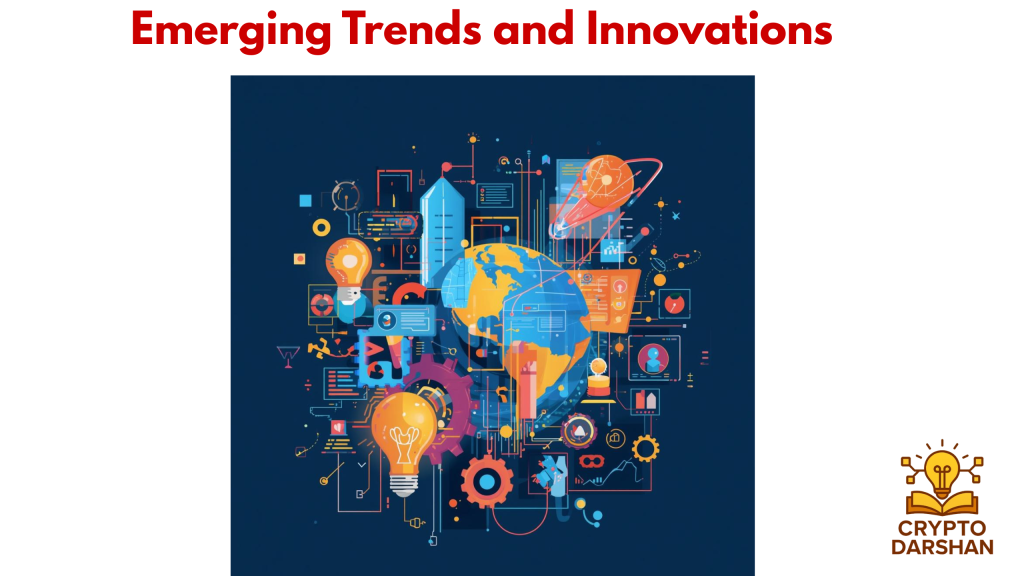
Emerging Trends and Innovations
Decentralized Identity and Access Management
Decentralized identity (DID) systems allow users to control their digital identities without relying on centralized authorities. When combined with decentralized clouds, DID ensures that only authorized users can access specific data or applications, enhancing privacy and compliance.
Interoperability Between Networks
Cross-chain protocols and interoperability frameworks are being developed to connect different blockchain networks. This will allow data and workloads to move seamlessly between decentralized and centralized systems, improving flexibility and adoption.
AI-Powered Resource Allocation
Artificial intelligence can optimize decentralized networks by predicting demand, balancing loads, and allocating resources efficiently. AI algorithms can identify underutilized nodes, reduce latency, and improve overall performance.
Quantum-Resistant Encryption
As quantum computing advances, traditional encryption methods may become vulnerable. Decentralized cloud projects are exploring quantum-resistant cryptography to future-proof data security.
Decentralized Autonomous Organizations (DAOs)
DAOs are community-governed entities that manage decentralized networks through collective decision-making. In decentralized cloud ecosystems, DAOs can oversee pricing, development, and dispute resolution, ensuring fairness and transparency without corporate control.
Industry Adoption and Case Studies
Government and Public Sector
Governments are exploring decentralized clouds for secure data storage and citizen services. Estonia’s e-governance model uses blockchain principles to ensure transparency and data integrity. Similar systems could reduce bureaucracy and improve trust in public institutions.
Healthcare
Healthcare organizations can use decentralized clouds to store patient records securely while maintaining privacy compliance. Blockchain ensures that only authorized parties can access sensitive data, reducing the risk of breaches.
Finance and Banking
Financial institutions are testing decentralized computing for fraud detection, transaction verification, and secure data sharing. By decentralizing infrastructure, banks can reduce operational costs and improve transparency.
Education
Universities and online learning platforms can use decentralized storage to host educational materials, ensuring accessibility and preventing data loss. Blockchain can also verify academic credentials, reducing fraud.
The Road Ahead: Opportunities and Risks

Opportunities
- Innovation Acceleration: Open-source collaboration fosters rapid technological progress.
- Economic Inclusion: Individuals worldwide can earn income by sharing computing resources.
- Data Sovereignty: Users regain control over their digital assets and privacy.
- Resilience: Distributed networks are less vulnerable to outages and cyberattacks.
Risks
- Regulatory Uncertainty: Governments may impose restrictions on decentralized systems.
- Market Volatility: Token-based economies can fluctuate, affecting pricing stability.
- Technical Complexity: Adoption may remain limited until user interfaces improve.
- Security Threats: Poorly designed smart contracts can still be exploited.
The Role of Decentralized Cloud in the Metaverse
The metaverse requires massive computing power, real-time data processing, and global accessibility. Decentralized cloud computing can provide the infrastructure needed to support virtual worlds, digital economies, and immersive experiences. By distributing workloads across nodes, it ensures scalability and resilience. Blockchain-based identity systems can also secure digital ownership of assets within the metaverse, creating a transparent and interoperable ecosystem.
Decentralized Cloud and Artificial Intelligence
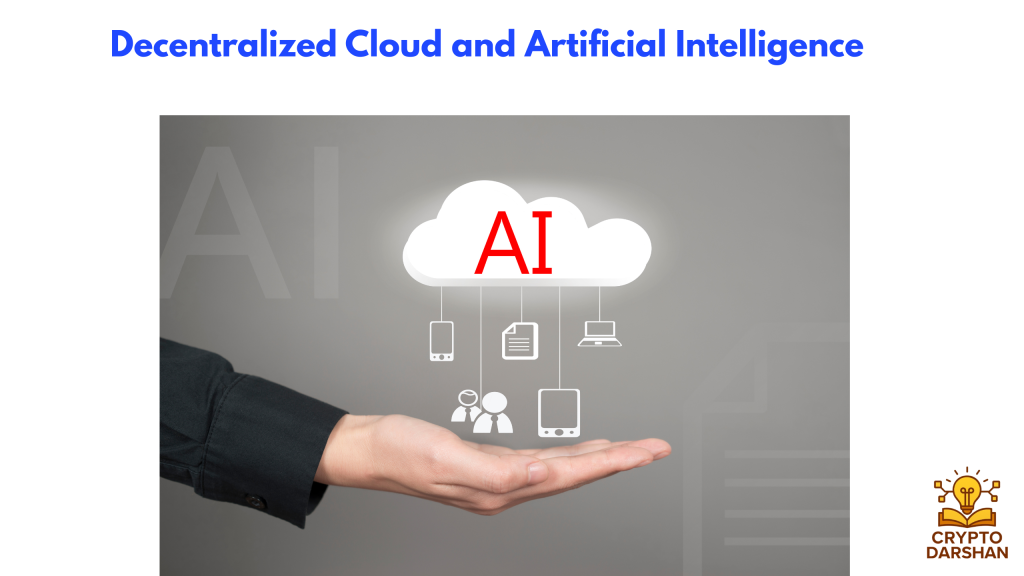
AI models require vast amounts of data and computing power. Decentralized clouds can democratize AI by allowing anyone to contribute resources or access training environments. This approach reduces dependency on centralized AI labs and promotes open innovation. Projects like Ocean Protocol are already enabling decentralized data marketplaces where AI developers can access datasets securely and ethically.
The Path Toward Mass Adoption

For decentralized cloud computing to reach mainstream adoption, several developments are essential:
- Improved User Interfaces: Simplified dashboards and APIs will make decentralized systems accessible to non-technical users.
- Enterprise Integration: Partnerships with established companies can bridge the gap between traditional and decentralized infrastructure.
- Regulatory Clarity: Governments must define frameworks that support innovation while ensuring compliance.
- Education and Awareness: Developers and businesses need to understand the benefits and limitations of decentralized systems.
- Performance Optimization: Advances in consensus algorithms and network protocols will enhance speed and reliability.
Can Blockchain Replace Big Tech Servers?
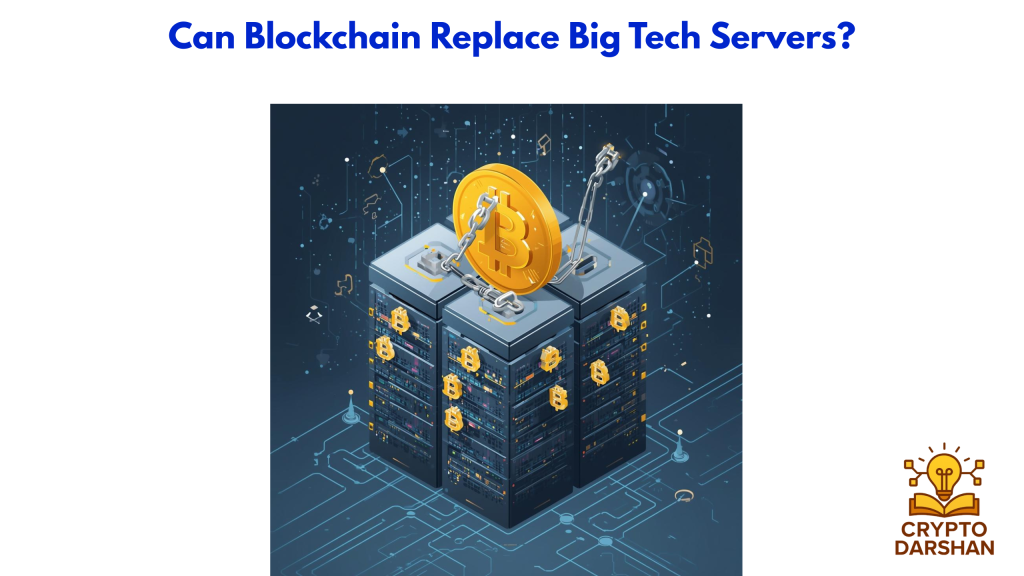
Replacing big tech servers entirely is unlikely in the near term. Centralized providers offer unmatched performance, global infrastructure, and enterprise support. However, blockchain-based systems can complement and challenge them by offering alternatives that prioritize privacy, transparency, and cost efficiency.
Over time, as technology matures and adoption grows, decentralized cloud computing could capture significant market share, especially in sectors that value data sovereignty and censorship resistance.
The shift may resemble the evolution of open-source software—once niche, now mainstream. Blockchain could do for cloud computing what Linux did for operating systems: introduce a decentralized, community-driven alternative that reshapes the industry.
Decentralized Cloud Computing: Can Blockchain Replace Big Tech Servers? – FAQ
1. What is decentralized cloud computing?
Decentralized cloud computing is a system where data storage and computing power are distributed across a network of independent nodes instead of being controlled by a single centralized company. Using blockchain technology, users can share unused storage or computing resources and earn rewards while maintaining transparency and security.
2. How does blockchain support decentralized cloud infrastructure?
Blockchain acts as a secure and transparent ledger that records transactions between users and node providers. Smart contracts automatically manage payments, resource allocation, and agreements, ensuring that decentralized cloud services operate without intermediaries.
3. How is decentralized cloud computing different from traditional cloud services?
Traditional cloud services rely on centralized data centers operated by large tech companies, whereas decentralized cloud networks distribute storage and computing tasks across thousands of independent nodes worldwide. This reduces single points of failure and increases data ownership for users.
4. What are the main benefits of decentralized cloud computing?
Key benefits include enhanced data privacy, reduced reliance on centralized providers, lower costs due to shared resources, increased resilience against outages, and improved censorship resistance.
5. What are some examples of decentralized cloud platforms?
Projects like Filecoin, Storj, and Akash Network provide decentralized storage and computing services. These platforms allow users to rent out unused storage or computing power while developers can build applications without relying on centralized infrastructure.
6. Can decentralized cloud computing improve data security?
Yes, decentralized cloud systems often encrypt and distribute data across multiple nodes, making it harder for hackers to compromise the entire dataset. Even if one node fails or is attacked, the remaining nodes can maintain the integrity of the network.
7. What challenges does decentralized cloud computing face?
Despite its advantages, decentralized cloud technology faces challenges such as network latency, scalability issues, regulatory uncertainty, and competition from well-established centralized cloud providers.
8. Can decentralized cloud networks fully replace big tech cloud providers?
While decentralized cloud computing offers strong advantages, it is unlikely to completely replace major cloud providers in the near future. Instead, hybrid models combining decentralized infrastructure with traditional cloud services may become more common.
Conclusion
Decentralized cloud computing represents a bold reimagining of how digital infrastructure operates. By leveraging blockchain, it distributes power, enhances security, and promotes transparency. While challenges remain in scalability, regulation, and user experience, the potential benefits are transformative.
Blockchain may not completely replace big tech servers soon, but it is already redefining the boundaries of cloud computing. As innovation continues, the future of the internet could become more open, equitable, and resilient—powered not by a few corporations, but by a global network of individuals.