

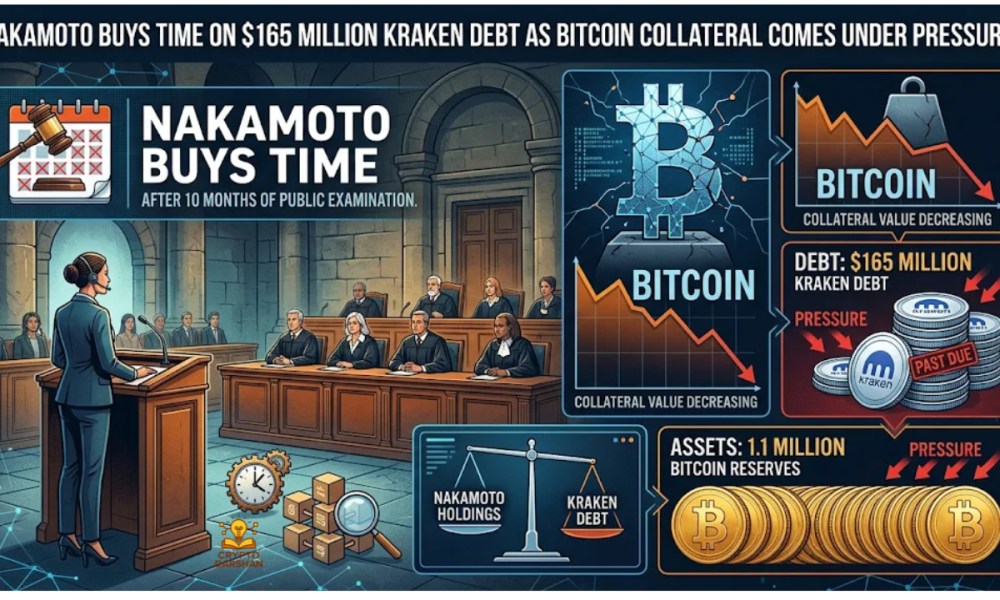
Bitcoin treasury company Nakamoto has extended its $165 million loan from Kraken into 2027, removing all scheduled principal repayments for the rest of 2026. The move gives the company more breathing room, but it also highlights the pressure created by falling Bitcoin prices and a stock market value that is now below its outstanding debt.
Nakamoto, led by Bitcoin investor David Bailey, owes 165 million USDT to Kraken. Its shares closed at $5.79 on Thursday, giving the company a market capitalization of roughly $104 million, well below the amount it owes.
Loan repayments pushed into 2027
Under the amended agreement, Nakamoto will repay $60 million USDT on December 4, 2027, instead of December 4, 2026. The remaining $105 million USDT will mature on June 30, 2027.
That means the company has no scheduled principal repayment under the Kraken facility for the remainder of 2026. The loan was originally arranged through Nakamoto Holdings, with Payward Interactive, the operator of Kraken, acting as lender.
Nakamoto’s Chief Investment Officer Tyler Evans said the revised terms extend the company’s runway and make its collateral position more resilient. He said the arrangement should give management more flexibility as Bitcoin prices move.
Why the extension matters now

The extension comes as Bitcoin trades below $69,000, reducing the value of Nakamoto’s pledged holdings. The company held 4,283 BTC as of September 30, including 3,030 BTC pledged as collateral for the Kraken loan.
At the end of September, those pledged coins were worth about $253.2 million when Bitcoin traded near $83,565. At Friday’s reference price near $68,800, the same 3,030 BTC were worth roughly $208.5 million.
That still covers about 126% of the $165 million outstanding principal. However, the cushion has narrowed sharply, and a further Bitcoin decline could force Nakamoto to add collateral, repay part of the loan, or both.
What happens if Bitcoin falls further
Nakamoto’s loan agreement requires the company to maintain a minimum collateral level. If the value of pledged assets falls below the required threshold, Nakamoto must provide more Bitcoin, repay some debt, or take another action to restore coverage.
If the collateral falls below the contractual liquidation threshold, the situation could become an event of default. In that case, Kraken may be allowed to sell the pledged Bitcoin to recover the loan.
The company has warned that further Bitcoin price declines could reduce its available liquidity and affect its ability to meet financial obligations. This is the central risk of using a volatile asset as collateral for a large loan.
Kraken will count Bitcoin derivatives
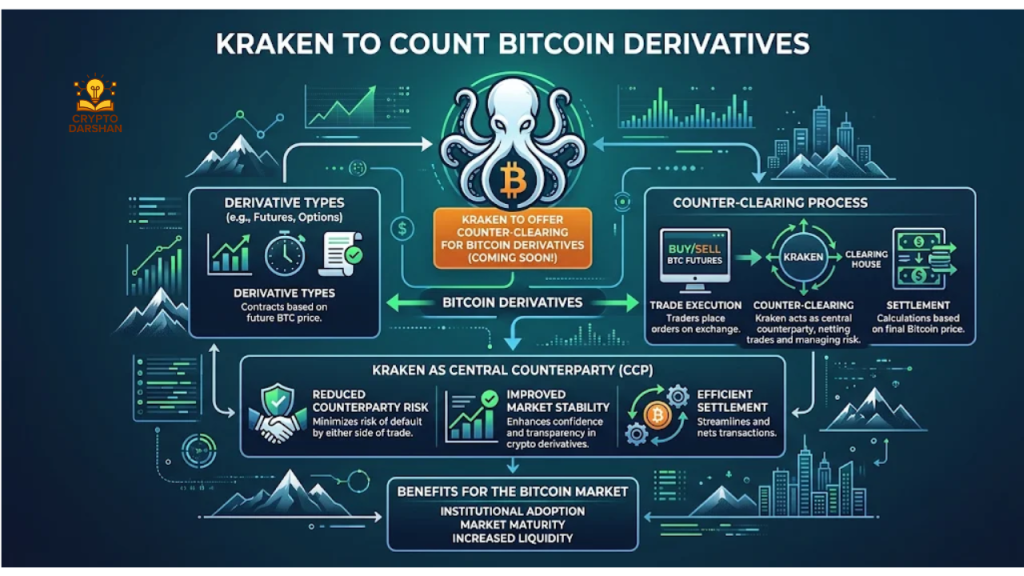
The amendment also changes how Kraken calculates Nakamoto’s collateral. Kraken can now include the net value of Nakamoto’s Bitcoin derivatives positions when assessing collateral maintenance and liquidation requirements.
Kraken will review those positions daily. If their combined value is negative, the lender will treat them as zero for collateral calculations.
Nakamoto said the change could allow protective options to offset losses on pledged Bitcoin before it needs to add collateral. At September 30, the company held put options covering 2,000 BTC with a $55,000 strike price and a December 25 expiration.
It also wrote call options covering 2,150 BTC at strike prices between $80,000 and $110,000. Those contracts generated premiums but limited potential gains on the covered Bitcoin.
Nakamoto has already sold Bitcoin
Nakamoto has not relied only on loan extensions to manage its debt. The company sold 284 BTC during the first quarter of 2026 and later sold about 600 BTC along with certain derivatives.
The June sale generated about $48 million in net proceeds, most of which went toward debt repayment. That helped reduce the original $210 million USDT loan by $45 million.
The company’s financial statements show a total Bitcoin acquisition cost of $506.3 million, or about $118,200 per coin across its September holdings. Its Bitcoin had a reported fair value of $357.9 million at the end of the quarter.
Stock value falls below debt
Nakamoto’s market value falling below its loan balance is a warning sign for investors. A company whose shares are worth less than its debt may find it harder to raise new capital or refinance borrowing on favorable terms.
The company reported $19.4 million in cash and cash equivalents at September 30. Its operating activities used $36.8 million in cash during the first nine months of 2026, compared with $15.9 million in the same period of 2025.
Nakamoto now operates financial services, asset management, and Bitcoin media businesses through BTC Inc. and UTXO Management. Its shift from the former KindlyMD business toward Bitcoin-focused operations has made its balance sheet more exposed to crypto market swings.
What investors should watch

The most important factors to monitor are Bitcoin’s price, Nakamoto’s collateral coverage, and the company’s ability to generate operating cash. A recovery in Bitcoin would strengthen the collateral position, while another decline could increase pressure before the 2027 repayment dates.
Investors should also watch whether Nakamoto sells more Bitcoin, raises new capital, or secures another loan amendment. Each option could affect the company’s Bitcoin holdings, shareholder dilution, and long-term strategy.
For now, Nakamoto has gained time rather than solved its underlying challenge. The $165 million Kraken loan remains due in 2027, and the company’s ability to repay it will depend heavily on Bitcoin’s direction over the coming months.