
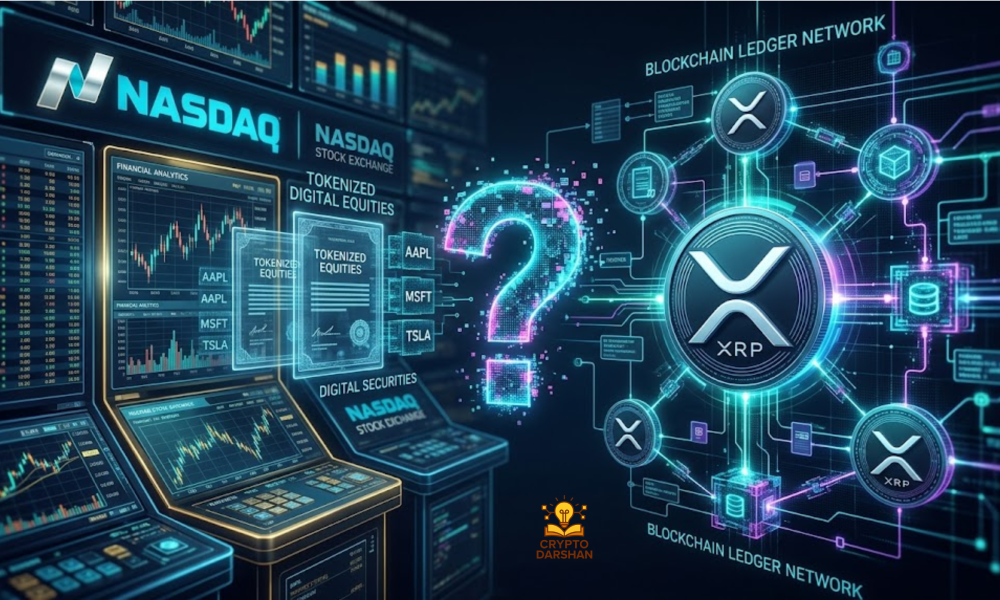
Nasdaq’s plan to bring tokenised equities to market has renewed interest in XRP, but the connection is not as direct as many investors assume. Nasdaq has agreed to invest $100 million in Kraken parent Payward and expects its Nasdaq Equity Tokens to launch in the second quarter of 2027, yet the announcement does not say the exchange will use the XRP Ledger or require XRP for stock settlement.
The more important question is whether tokenised stock platforms will need XRP for transaction fees, account reserves, or liquidity. Those functions could create demand, but only if actual products use them.
Nasdaq’s plan runs through Payward
Nasdaq announced its $100 million investment in Payward on September 10. The agreement links Nasdaq’s regulated market infrastructure with Payward’s crypto trading and xStocks ecosystem.
The companies expect Nasdaq Equity Tokens to launch in Q2 2027. However, that plan is separate from a claim that Nasdaq will settle its entire stock market on a public blockchain or use XRP in every transaction.
A stock exchange matches buy and sell orders. A central securities depository manages ownership records and settlement through participating institutions. A blockchain can support part of that process, such as recordkeeping or token transfers, without replacing every participant.
Tokenised shares are not automatically XRP demand
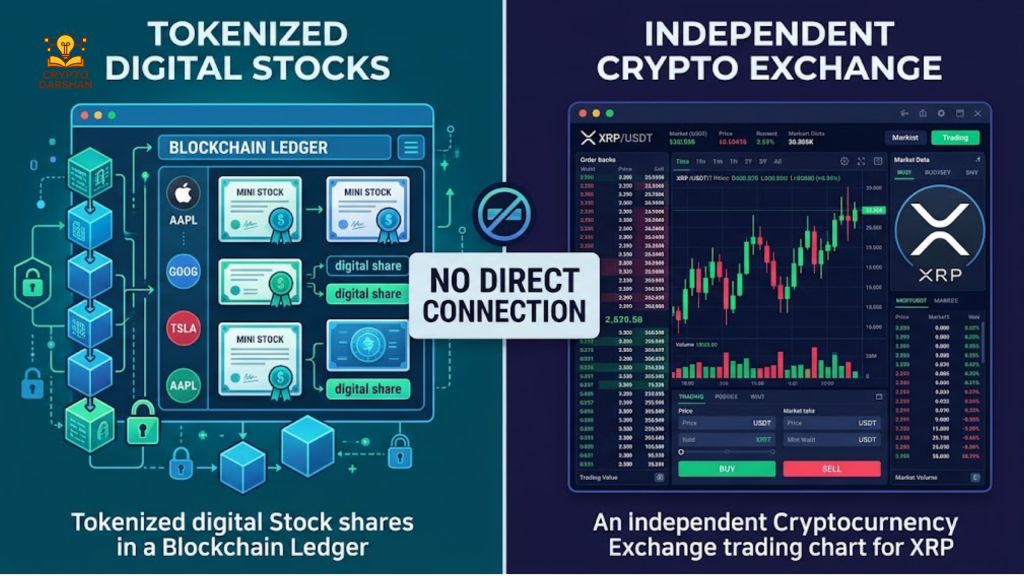
Nasdaq has also pursued tokenisation through the Depository Trust Company. The U.S. Securities and Exchange Commission approved a Nasdaq rule change on March 18 that allows eligible securities traded on Nasdaq to be settled in tokenised form through a DTC pilot.
Under that design, tokenised and traditional versions of a security can share the same order book and execution priority if they meet required equivalence standards. This does not mean every Nasdaq-listed stock will become a freely transferable public-chain token.
For XRP to benefit, a product must actually use the XRP Ledger and require XRP for fees, reserves, liquidity, or settlement. Simply mentioning Nasdaq, tokenisation, or blockchain does not establish that demand.
Legal rights matter more than blockchain labels
The SEC staff’s January 28 guidance separates issuer-sponsored tokenised securities from third-party products. A token may represent direct ownership, a custodial entitlement, or synthetic exposure to another security.
Those differences affect voting rights, dividends, redemptions, corporate communications, and what happens if an intermediary fails. A token’s ticker or name cannot prove that its holder owns the underlying share directly.
Investors should check the legal documents behind any stock token. A blockchain can show who owns a token, but it cannot by itself prove that an off-chain custodian holds the advertised shares or that every holder has identical rights.
Brazil offers a real XRPL example
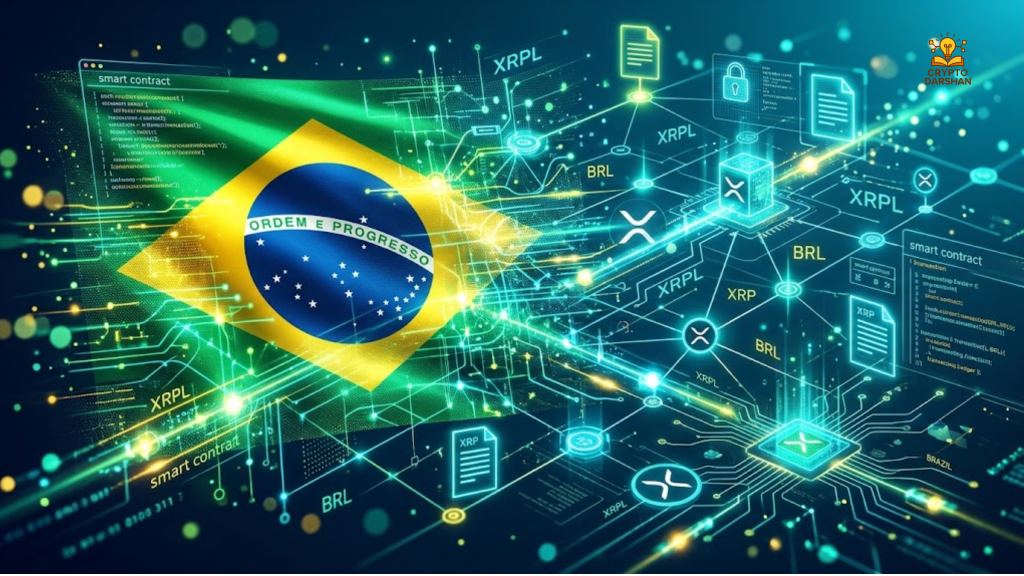
Ripple’s September 29 announcement with Brazil’s CSD BR provides a concrete institutional use case for the XRP Ledger. The first phase mirrors ownership records for selected BTG Pactual investment-fund shares, while CSD BR remains the official recordkeeper.
CSD BR said its broader registered infrastructure covers more than BRL 22 trillion in assets. That number describes the institution’s overall business, not the amount of assets already placed on XRPL.
The initial project is a mirror record, not a full migration of Brazil’s asset base. Still, it shows that a regulated market operator is testing XRPL for ownership reconciliation.
Fees are small, but measurable
A standard XRPL transaction has a minimum fee of 0.00001 XRP, or 10 drops, before network-load adjustments. The fee is burned, not paid as a dividend to XRP holders.
At that base rate, one million standard transactions would burn 10 XRP. Ten million would burn 100 XRP, and 100 million would burn 1,000 XRP. At a reference price of $1.27 per XRP, 100 million transactions would represent about $1,270 in burned fees.
That calculation shows why low fees are attractive for financial infrastructure but limited as a source of token demand. A $100 stock transfer and a $1 million transfer can require similar basic ledger work, even though the dollar exposure is very different.
Reserves and liquidity create other demand channels
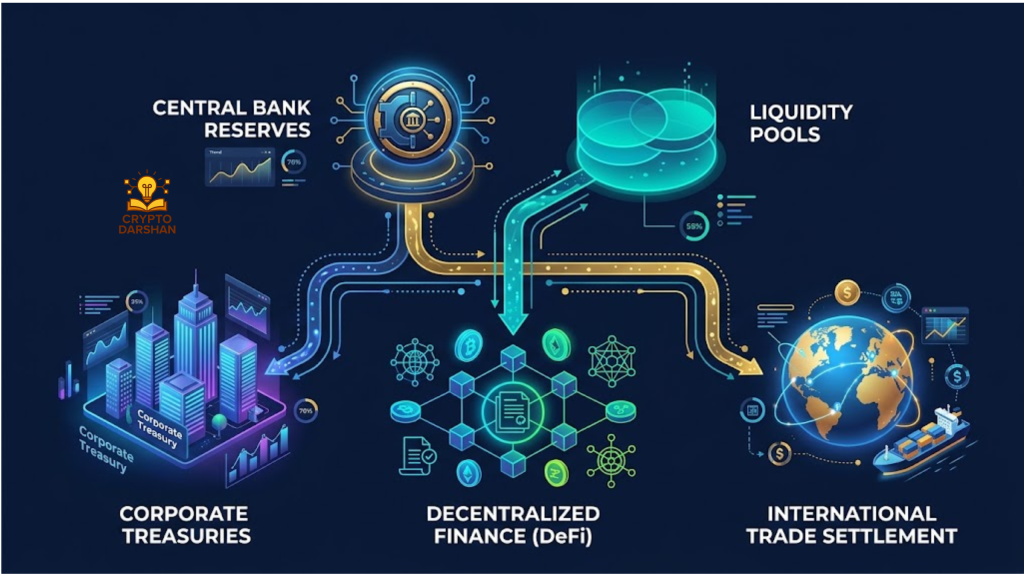
XRPL accounts require reserves: 1 XRP for a base account and 0.2 XRP for each applicable ledger object under current documented settings. Validators can change these requirements through network fee voting.
A platform with one million funded accounts could require one million XRP in base reserves, but that does not mean every customer will have an individual XRPL account. A custodian may manage customer records internally while using fewer operational accounts.
XRP could also serve as bridge liquidity. XRPL’s auto-bridging system can route token-to-token trades through XRP when that produces a better exchange rate, but direct markets and stablecoins can compete for the same business.
What investors should watch
- Whether Nasdaq’s future tokenised equity product names XRPL as a settlement or recordkeeping network.
- Whether XRP is required for fees, reserves, or liquidity rather than merely available.
- The number of live XRPL accounts, transactions, and XRP balances supporting tokenised products.
- Whether trading routes actually use XRP bridges instead of direct stablecoin or token markets.
- The legal structure of each stock token, including ownership rights, redemption rules, and investor eligibility.
The bottom line
Nasdaq’s tokenised equity initiative is a major step toward blockchain-based capital markets, but it is not automatically an XRP catalyst. The real test will be whether future products use XRPL in ways that require XRP balances or generate recurring transaction activity.
For now, investors should separate three things: the value of tokenised assets, the activity on a blockchain, and the demand for its native coin. They are related, but they are not the same number.