
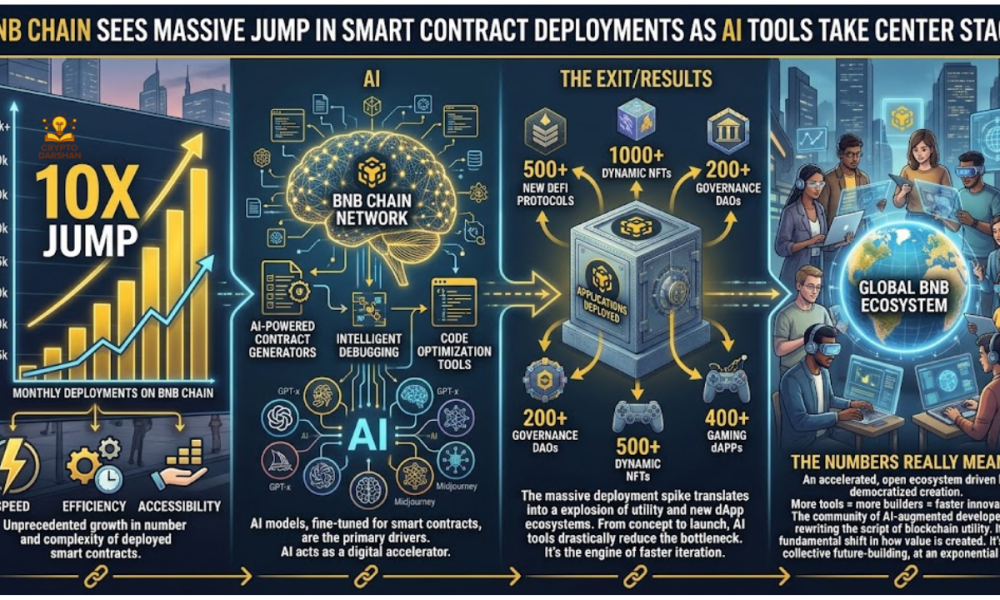
BNB Chain recorded 12.3 million smart contract deployments in the third quarter of 2026, a sharp rise from 4.5 million in the previous quarter. The nearly threefold increase came as the network pushed forward with AI agent tools, even though daily active users declined.
The figures were included in BNB Chain’s October 28 update and drawn from Blockworks’ Q3 token-holder report. The data show a network becoming more active among builders and automated systems, while overall user growth remains mixed.
Deployments surge nearly 173%
Contract deployments on BNB Chain rose by about 173% quarter over quarter, reaching 12.3 million in Q3. In comparison, the network recorded 4.5 million deployments in Q2.
The number of unique daily contract deployers also increased, but far more slowly. BNB Chain averaged about 5,100 unique daily deployers, up 13% from the prior quarter. This means each deployer was creating more contracts on average.
However, the report does not reveal how many of those contracts were active applications, factory contracts, repeated token launches, or automated deployments. That distinction matters because a high deployment count does not always equal a larger ecosystem of working products.
User activity tells a mixed story
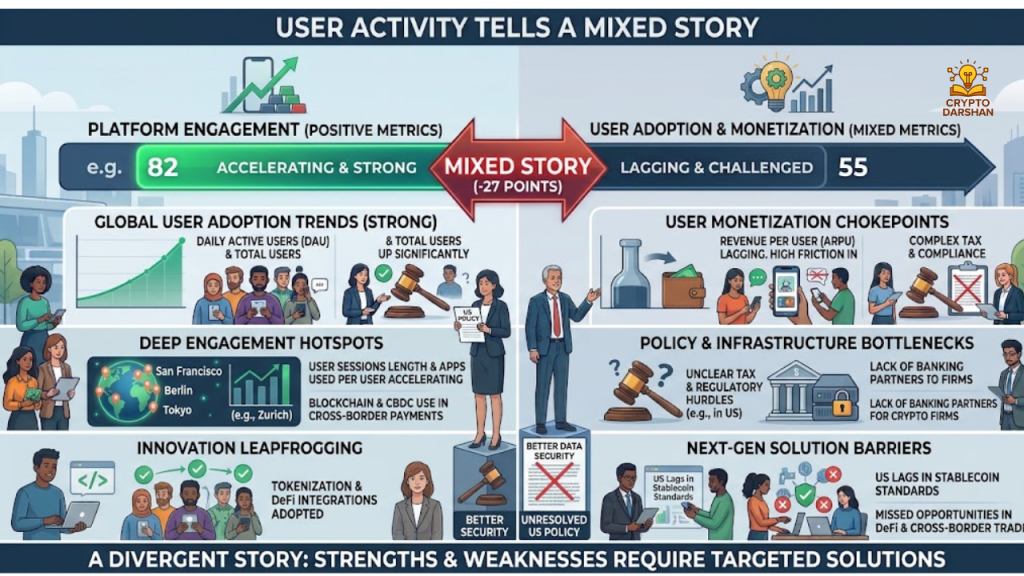
While developer activity rose, average daily active addresses fell 14% to 2.10 million, down from 2.43 million in Q2. New address creation also dropped 27%, averaging 482,000 new addresses per day.
Despite fewer active users, quarterly transactions increased 7.5% to 1.51 billion. The average active address made 7.8 transactions per day, up from 6.3 in the previous quarter. In other words, fewer people were using the network, but those who remained were far more active.
Much of the transaction growth came from a small group of applications. Prediction market Predict.fun processed 45.3 million transactions, up from 2.2 million in Q2. That single platform accounted for roughly 40% of the network’s net transaction increase.
Trading tools also played a major role. GMGN, LiFi, and MEV bots together added another 45 million transactions. Meanwhile, token launchpads generated 2.59 million token launches, nearly tripling from the previous quarter. Flap led with 2.02 million launches, followed by Four.meme with 568,000.
AI agents become a major focus
A key driver behind BNB Chain’s Q3 momentum was its growing AI agent ecosystem. BNB Agent Studio, launched on July 1, lets developers describe an AI agent using a prompt and deploy it on BNB Smart Chain with its own identity and wallet.
The platform released four versions between July and September. These updates added several important features, including paid data access through x402, agent earnings, TypeScript support, and wallet controls.
Later releases introduced Turnkey’s policy engine, which can require human approval for transactions above certain limits. The platform also added NodeOps deployment, allowing developers to launch agents without setting up a separate cloud account.
By early October, BNB Smart Chain had 330,604 ERC-8004 AI agent registrations. That represented about 61% of the 544,574 registrations tracked across all networks.
Still, registrations do not prove that an AI agent is actively working or generating revenue. Some may be test projects, demonstrations, or identities created without sustained economic use.
Tokenized stocks power network revenue

AI development was only one part of BNB Chain’s Q3 performance. Tokenized equity trading became the biggest financial driver of the quarter.
The network recorded about $25.6 billion in tokenized-equity trading volume, compared with $2.4 billion in Q2. Decentralized exchanges handled $24.4 billion of that total, while Ondo Global Markets contributed $1.2 billion.
By the end of September, BNB Chain had $1.13 billion in tokenized-equity supply, roughly double its Q2 level. The network also had 1.8 million tokenized-equity holders.
Network revenue climbed 54% to $54.2 million. Transaction fees generated $49.1 million, while MEV payments added $5.1 million. GMGN’s trading router alone produced $8.8 million in fees, up from $2.2 million in Q2.
What the numbers really mean
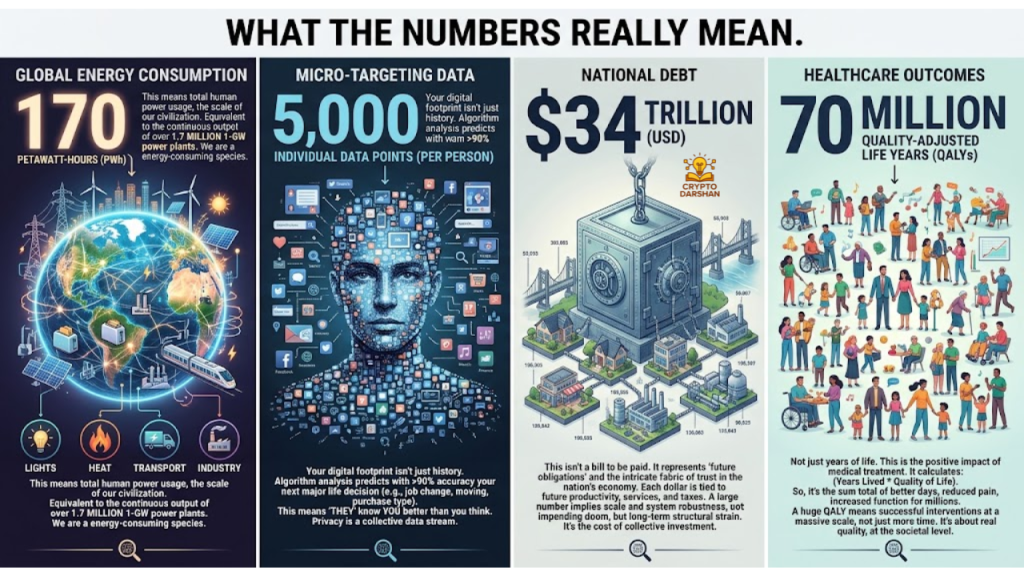
BNB Chain’s Q3 data show strong growth in deployments, transactions, and revenue. But they also reveal an important nuance: the network’s expansion is being driven more by power users, automated tools, and specific applications than by a broad increase in new users.
The rise in AI agent registrations suggests growing developer interest, but it does not yet confirm how many agents are earning money or completing meaningful transactions. Likewise, the surge in token launches may reflect automation and speculation as much as lasting product development.
BNB Chain still has major plans for the rest of 2026. Its roadmap includes a dedicated payment lane, possible gas-limit increases beyond 70 million, and a next-generation blockchain testnet expected before the end of the year.
For now, the Q3 results position BNB Chain as one of the busiest networks for contract creation and AI experimentation. The next challenge will be turning that technical activity into lasting user growth and sustainable applications