
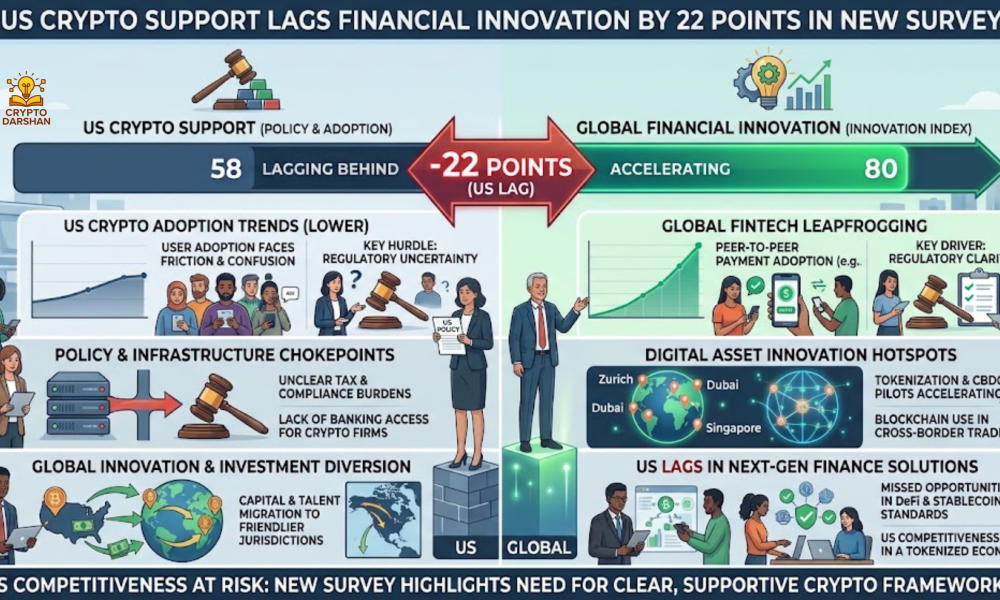
Americans are more willing to back financial innovation than policies explicitly linked to cryptocurrency, according to a new Ipsos survey. The research found that 35% want political candidates to support the development of next-generation financial technology in the United States. That figure falls to 13% when the question specifically names blockchain, cryptocurrency, and decentralized finance.
The 22-point gap highlights a challenge for the crypto industry: dissatisfaction with traditional finance does not automatically translate into support for digital assets. Respondents expressed concerns about financial security, privacy, and access to their money, but trust in decentralized platforms remained low.
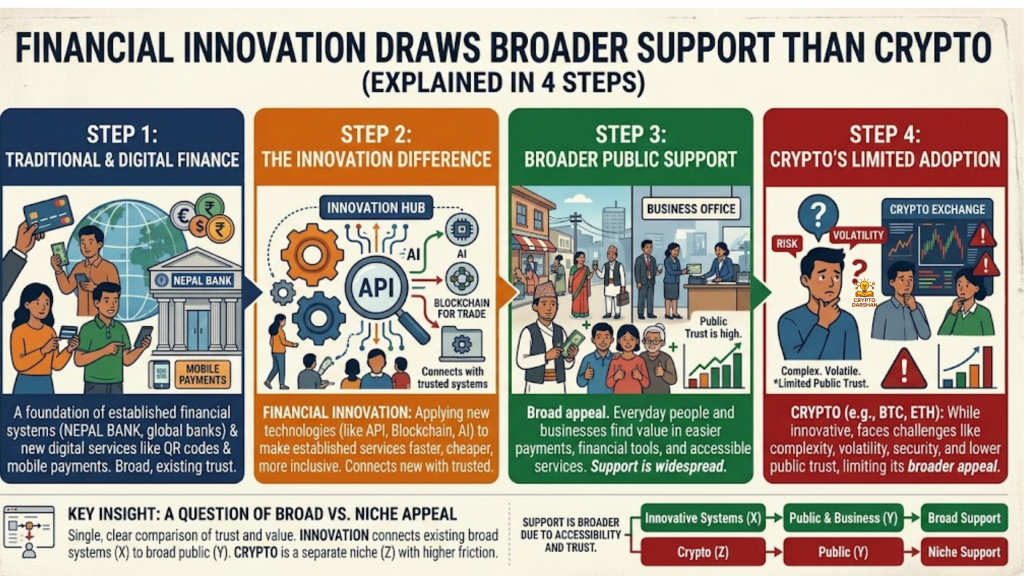
Financial Innovation Draws Broader Support Than Crypto
Published on October 27 by the DeFi Education Foundation, the research surveyed 1,545 U.S. adults through Ipsos’ KnowledgePanel between September 8 and 16. Its findings arrive two weeks before the November 2026 midterm elections, when candidates are discussing the future of financial regulation and emerging technology.
The main finding concerns how respondents answered two differently framed questions. While 35% considered support for the next generation of American financial technology important for political candidates, only 13% expressed that view when blockchain, crypto, and decentralized finance were named.
Journalist Eleanor Terrett described the difference as a branding problem for the industry. However, the figures require careful interpretation. They measure responses to specific questions, not voting intentions or support for a particular crypto law. The survey also does not establish that people who favor financial innovation would necessarily support decentralized financial services.
That distinction matters. Financial technology is a broad category, and approval of improvements to financial services should not be treated as approval of every technology proposed to deliver them.
Low Familiarity and Trust Remain Major Obstacles
The research found that only 9% of respondents described themselves as very or extremely familiar with cryptocurrency. Just 5% reported substantial trust in decentralized platforms.
Those results show that the industry’s political challenge extends beyond choosing more appealing language. Many respondents lack a strong understanding of cryptocurrency, while confidence in the platforms offering decentralized financial services remains limited.
At the same time, 40% said they were at least somewhat likely to try decentralized finance, or DeFi, if it became available to them. This suggests openness to exploring the technology can exist alongside low familiarity and trust. It does not, however, mean that 40% currently use DeFi or are ready to commit money to it.
Americans Want Better Security and More Financial Control
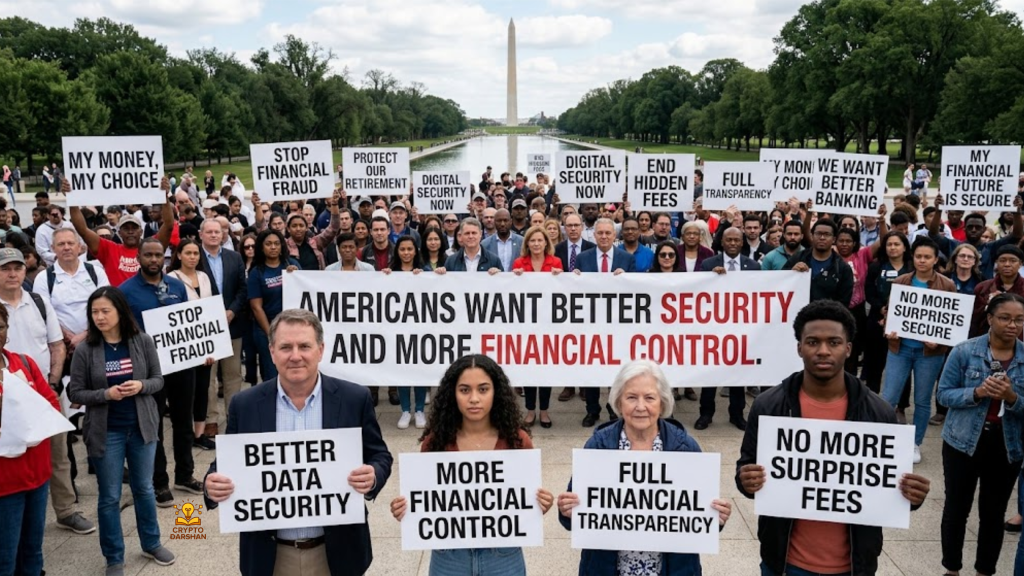
The survey revealed widespread concerns about the existing financial system. Only 19% considered the U.S. financial system secure, while 63% believed it needed upgrades to address emerging threats.
Privacy was another major concern:
- 80% said changes were needed to give people greater control over their personal data.
- 74% considered financial privacy important.
- 62% preferred keeping personal information private during financial transactions.
- 54% questioned whether financial institutions could adequately protect personal information from threats linked to artificial intelligence.
Respondents also wanted easier access to their funds. Two-thirds, or 66%, wanted access to their money at all times, while only 49% believed they had personal control over their financial assets.
These findings point to problems that consumers want addressed. But the results do not prove that respondents see cryptocurrency as the answer. The contrast between concern about traditional finance and low trust in decentralized platforms remains one of the survey’s clearest themes.
Crypto Ownership Rises, but Recent Use Stays Flat
The share of Americans who said they had owned or used cryptocurrency at some point rose to 22% in 2026, up from 18% in the previous year’s survey. That represents a four-percentage-point increase in lifetime participation.
Recent activity told a different story. Cryptocurrency use during the previous 12 months remained unchanged at 13%, according to Terrett’s account of the findings.
The difference is important when assessing adoption. Lifetime ownership or use includes people who tried cryptocurrency in the past but may no longer be active. A rise in that measure does not necessarily show that more people are regularly using digital assets today.
The research also found relatively small differences between the two major political parties. Previous crypto ownership or use reached 24% among Republicans and 21% among Democrats. Interest in learning more stood at 17% and 16%, respectively.
Saving and Domestic Transfers Lead Potential DeFi Uses
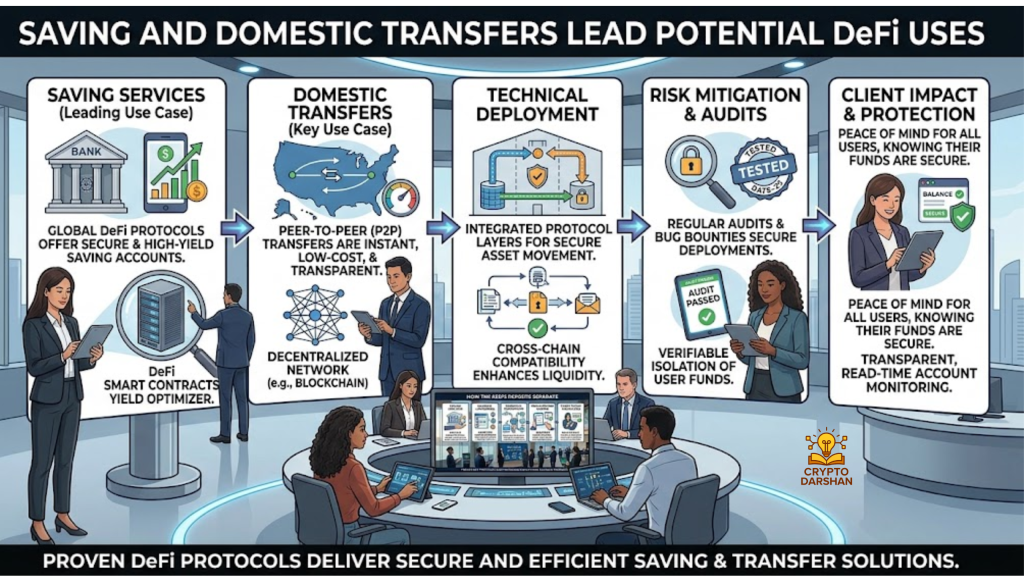
Among respondents who were open to trying DeFi, practical financial activities attracted the most interest.
Saving money was identified as a potential use by 85% of that group, up from 77% in 2025. Sending money to friends or family within the United States followed at 82%, compared with 73% in the earlier survey.
These percentages apply only to respondents who were at least somewhat likely to try DeFi, not to all American adults. They also measure potential interest rather than actual transactions or deposits.
Even with those limits, the results suggest that everyday financial needs may provide a more useful starting point for understanding consumer interest than broad claims about transforming the financial system. Saving and sending money are concrete activities that respondents can relate to, even when familiarity with the underlying technology is low.
What the Survey Can—and Cannot—Show
Ipsos weighted the responses across demographic and political characteristics. The survey reported a margin of error of ±2.8 percentage points and compared its findings with a separate study of 1,321 adults conducted from August 18 to 21, 2025.
The research offers a snapshot of public attitudes, not a forecast of election results or future crypto adoption. Its strongest finding is the distance between support for financial improvement and support for explicitly crypto-related policies.
For the industry, the challenge is not simply generating awareness. The survey shows that Americans want more secure, private, and accessible financial services, while remaining cautious about decentralized alternatives. Whether crypto platforms can earn greater confidence remains an open question