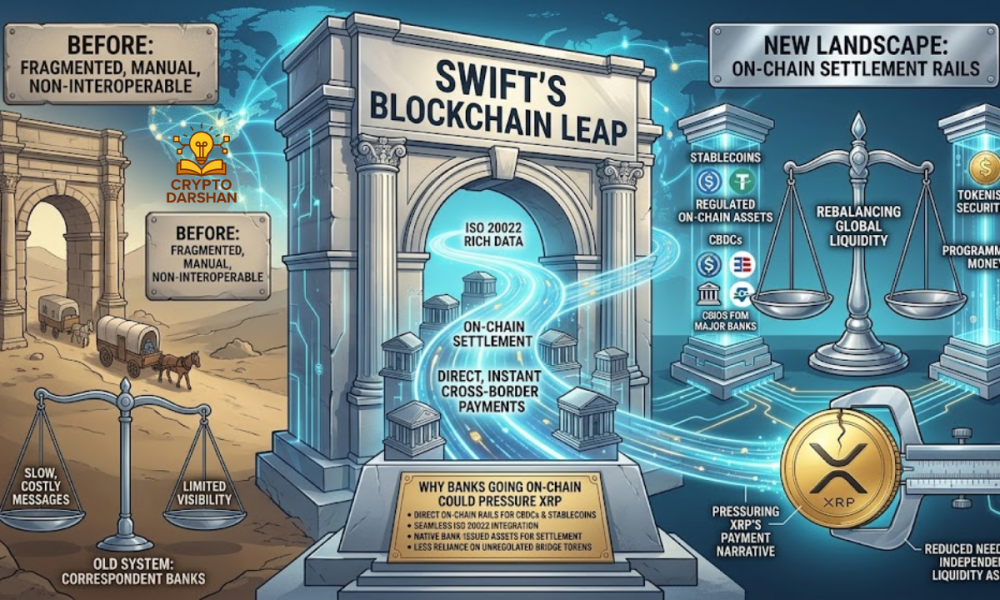
SWIFT has moved from pilot to production with its blockchain-based ledger for cross‑border payments, and the first live bank‑to‑bank transfer is already done. For XRP, the development is a headwind because it removes one of Ripple’s core narratives: that banks need a neutral, crypto-native bridge asset to settle global payments efficiently.
What SWIFT Just Achieved

SWIFT’s new system is a shared, blockchain-based ledger designed to coordinate tokenized deposits across different banks and chains. On August 19, 2026, HSBC and Standard Chartered completed the first live cross‑border transaction using this ledger, exchanging payment messages that were recorded as tokenized deposit obligations on each bank’s own infrastructure while SWIFT matched, reconciled, and netted the obligations before final settlement ran through existing payment systems.
This is not a testnet demo. SWIFT announced in July 2026 that its ledger was ready for initial use, with 17 major banks across six continents preparing to pilot live transactions using tokenized deposits for 24/7 payment availability and better liquidity efficiency. The HSBC–Standard Chartered transfer is the first interbank transaction executed on that ledger, showing that SWIFT can orchestrate interoperability without forcing banks onto a single chain or a single asset.
How SWIFT’s Model Works (Without XRP)
The key detail is what’s moving on-chain. SWIFT’s pilot uses tokenized deposits—digital representations of traditional bank deposits—rather than a public crypto asset like XRP or a stablecoin issued outside the banking system. In practice:
- Each bank keeps custody of its own deposit tokens on its systems.
- SWIFT’s ledger acts as a secure messaging and orchestration layer that matches obligations between institutions.
- Final settlement still flows through existing payment rails, but the coordination happens in near real time on the shared ledger.
This design lets banks retain control over compliance, custody, and balance-sheet treatment while still gaining many of the speed and transparency benefits associated with blockchain. Crucially, it does not require a bridge cryptocurrency.
Why This Is Bearish for XRP’s Payments Narrative
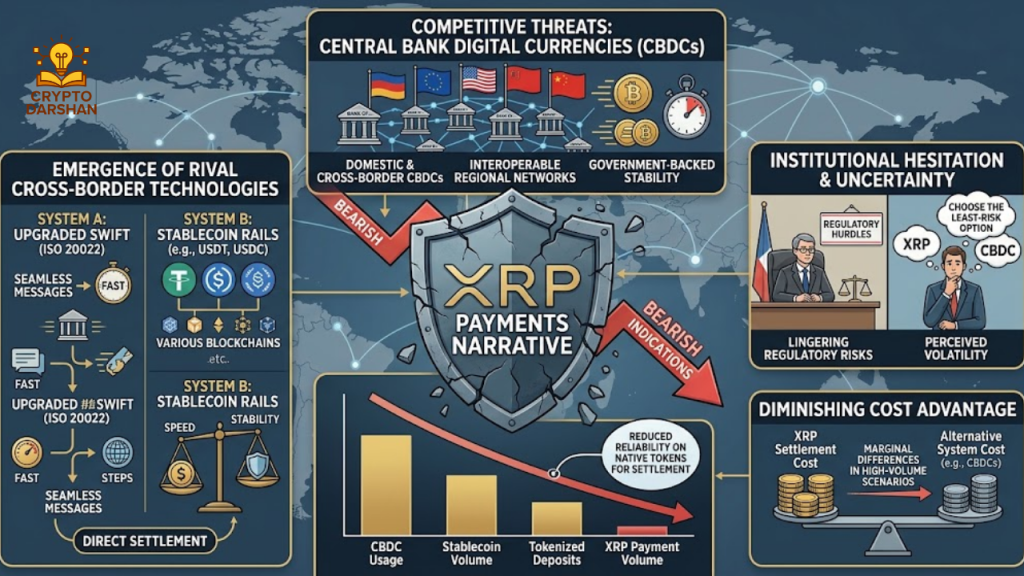
XRP’s long-standing value proposition in cross-border payments has centered on capital efficiency and liquidity sourcing at the moment of transfer, rather than pre-funding accounts in multiple corridors. Ripple has argued that using XRP as a bridge asset reduces trapped liquidity and improves settlement certainty for institutions.
SWIFT’s approach directly competes with that thesis in the institutional lane:
- No bridge asset needed. By coordinating tokenized deposits across banks, SWIFT shows that institutions can achieve 24/7, near real-time cross-border coordination without introducing a separate crypto asset into the settlement flow.
- Banks keep control. The model preserves existing regulatory and operational frameworks, which lowers adoption friction compared to integrating a public-chain native token into core treasury operations.
- Interoperability without a single chain. SWIFT’s ledger connects tokens issued on different infrastructures, reducing the need for a universal settlement token like XRP to act as the “common language” between disparate systems.
As more banks join the pilot and move real volume onto tokenized deposit rails, the incremental demand for a bridge asset in traditional bank-to-bank flows could be lower than some XRP bulls had anticipated. That’s why analysts and commentators are framing SWIFT’s milestone as a structural headwind for XRP’s payments narrative, even if the token still has other use cases and a large holder base.
Market Reaction: XRP Pulls Back After a Big Rally
The timing matters. XRP had surged roughly 50% over the prior week before slipping back into negative territory as news of expanding bank-run blockchain networks circulated. Reports note that XRP turned weaker after the 50% rally, with price down around 2.2% in 24 hours as markets digested the implications of banks building their own rails.digitaltoday.
While crypto prices move on many factors, the narrative shift is clear: if major banks can coordinate tokenized deposits through SWIFT’s ledger, the perceived urgency to adopt a separate bridge cryptocurrency for institutional cross-border payments diminishes.
What This Means for Ripple and XRP Going Forward
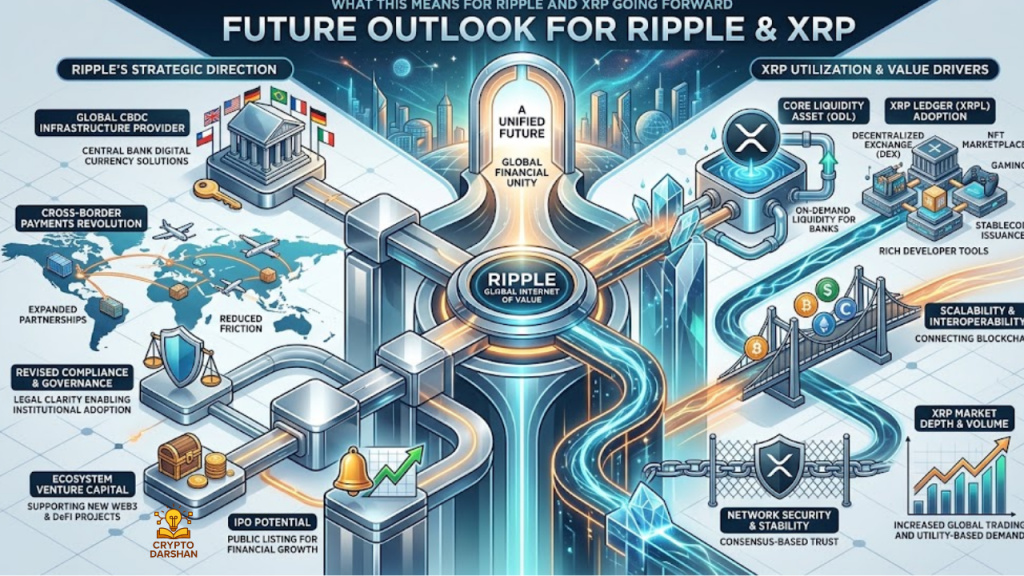
SWIFT’s progress does not erase XRP’s ecosystem, but it does narrow one of its most-cited institutional use cases. Ripple may still find demand in corridors where banks are slower to adopt tokenized deposits, or in non-bank liquidity providers that prefer a neutral, always-on settlement asset. However, the baseline assumption that traditional finance will need XRP as the primary bridge for cross-border value transfer now faces a credible, bank-backed alternative.
For investors and observers, the key metric to watch is adoption scale: how many of the 17 pilot banks move from “preparing live transactions” to processing meaningful daily volume on SWIFT’s ledger over the next 12–24 months. If that number grows quickly, the bearish implication for XRP’s payments thesis becomes more than just narrative—it becomes a structural competitive dynamic.