The cryptocurrency market saw a major change in trading behavior during July 2026. Trading volume on centralized exchanges, or CEXs, dropped to its lowest level in nearly three years, while decentralized exchanges, known as DEXs, captured their largest share of the spot market on record.
According to CoinDesk Research, centralized exchange volume fell 23.9% to approximately $3.76 trillion in July. At the same time, DEX spot trading reached a record share of 19.5% of the wider spot market. The report also highlighted strong activity in real-world asset perpetual contracts, which reached about $460 billion during the month.
Centralized Exchange Volume Drops Sharply
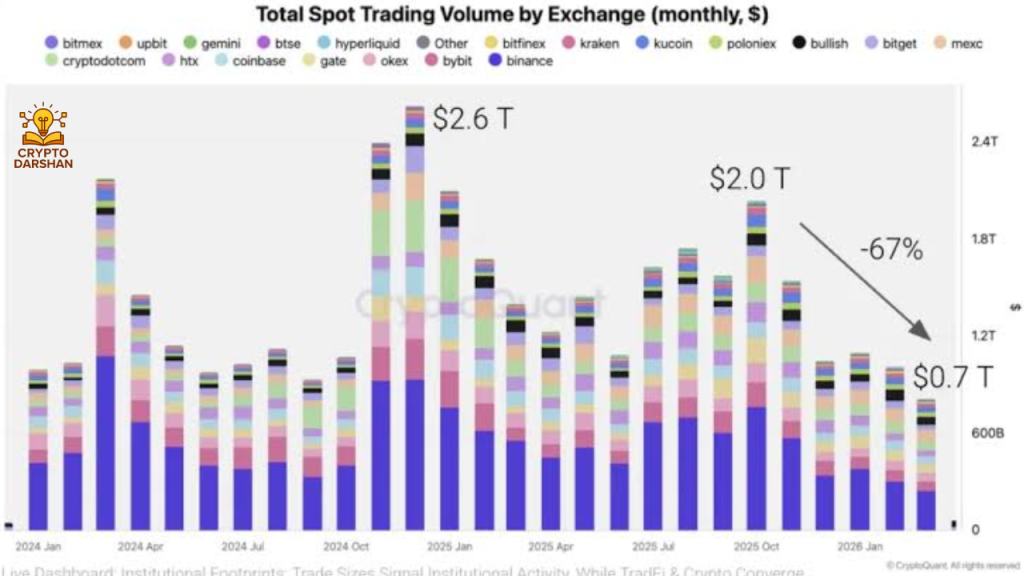
Centralized exchanges remain the main gateway for most crypto users. Platforms such as Binance, Coinbase, OKX and Bybit provide deep liquidity, fast order matching and access to both spot and derivatives markets.
However, July brought a clear slowdown in activity. Total CEX trading volume declined by almost one-quarter from the previous month. The fall pushed monthly trading to a 32-month low, showing that traders were less active across major centralized platforms.
Several factors may have contributed to the decline:
- Lower market volatility reduced the number of short-term trading opportunities.
- Investors appeared less willing to take large speculative positions.
- Some activity moved from traditional exchanges to on-chain trading platforms.
- Prediction markets and other crypto applications may have absorbed part of the trading demand.
- A weaker market mood reduced interest in altcoins and high-risk tokens.
A drop in volume does not always mean that investors are leaving crypto completely. It can also mean that traders are waiting for clearer price signals before committing capital. When prices move within a narrow range, both professional and retail traders often reduce their activity.
DEX Market Share Reaches a Record
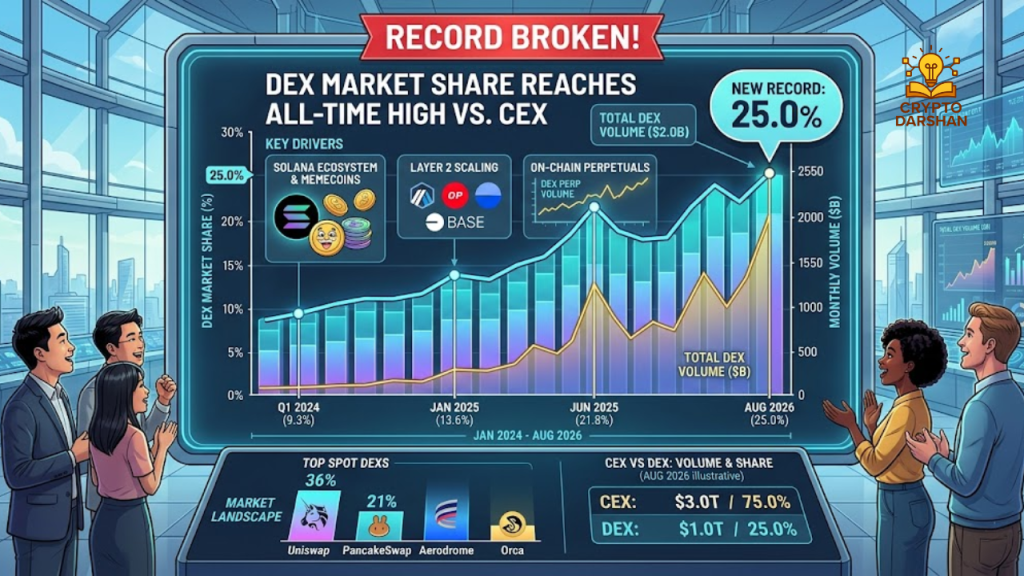
While CEX volume declined, decentralized exchanges increased their relative share of spot trading. DEXs allow users to trade directly from their crypto wallets without depositing funds with a central company.
Protocols such as Uniswap, PancakeSwap, Aerodrome and others use smart contracts to process trades. Instead of relying on a traditional order book, many DEXs use automated market makers. These systems allow users to trade against liquidity pools funded by other participants.
CoinDesk reported that DEX spot market share reached 19.5% in July, the highest level recorded in its tracked data. Other market data reports placed the DEX-to-CEX spot volume ratio near 24% during the same period, although the exact figure varies depending on the exchanges, assets and methodology included in the calculation.coindesk+2
This difference is important. A higher DEX share does not necessarily mean that DEX trading volume increased in absolute terms. In fact, other reports showed that DEX spot volume also declined during July, but at a slower pace than CEX volume. One estimate placed July DEX spot volume at about $130.77 billion, down roughly 26% from June.
In simple terms, DEXs gained market share partly because centralized exchanges lost more volume.
Why Traders Are Using DEXs

The growing use of DEXs reflects several long-term changes in the crypto market.
First, wallet-based trading has become easier. Modern decentralized applications offer simpler interfaces, better transaction routing and improved support for multiple blockchain networks. Users can now trade tokens without opening an account or completing the same onboarding process required by many centralized platforms.
Second, DEXs often list new tokens before centralized exchanges do. This attracts traders who want early access to emerging projects, ecosystem tokens and meme coins.
Third, on-chain traders can access a wider range of decentralized finance products. These include liquidity pools, yield strategies, lending markets and tokenized assets. In some cases, users can move between trading and lending services without leaving the same blockchain ecosystem.
The growth of Layer 2 networks and high-speed blockchains has also helped. Lower fees and faster transaction confirmation make decentralized trading more practical for everyday users. Solana, BNB Chain and several Ethereum Layer 2 networks have been among the key areas supporting on-chain activity.
DEX Growth Comes With Risks

Despite their rising market share, DEXs are not risk-free. Users are responsible for managing their own wallets and protecting their private keys. A mistake in a wallet transaction can be difficult or impossible to reverse.
Smart contract vulnerabilities are another concern. If a protocol contains a coding flaw, attackers may exploit it and drain liquidity pools. DEX users also face risks from fake tokens, malicious approvals and sudden changes in liquidity.
Price impact can be a problem as well. A trade made in a shallow liquidity pool may cause significant slippage. This means the final execution price can be worse than the price shown when the transaction is submitted.
Centralized exchanges have their own risks, including custody failures, account restrictions, cyberattacks and regulatory issues. The July figures show that traders are not necessarily choosing one model exclusively. Many are using both CEXs and DEXs based on liquidity, speed, asset availability and risk tolerance.
Real-World Asset Perpetuals Gain Attention

Another important development in the July exchange review was the rise of perpetual contracts linked to real-world assets. Trading volume in these products reached approximately $460 billion, according to CoinDesk Research.
Perpetual contracts are derivative products that allow traders to speculate on price movements without owning the underlying asset. Unlike traditional futures, they usually do not have an expiry date.
Real-world asset perpetuals can provide exposure to markets such as commodities, equities or other tokenized financial instruments. Their growth suggests that crypto traders are becoming more interested in products that connect digital markets with traditional finance.
However, these contracts can carry high leverage and significant liquidation risk. A small price movement against a leveraged position can lead to the rapid loss of a trader’s collateral.
What the July Data Means
July’s trading figures point to a changing crypto market structure. Centralized exchanges still handle the majority of activity, but their dominance is no longer as strong as it once was. DEXs are gaining ground as blockchain infrastructure improves and more users become comfortable managing their own assets.
At the same time, the data should not be interpreted as a simple victory for decentralized finance. Both CEX and DEX activity weakened during the month. The record DEX share partly reflects a sharper decline in centralized exchange volume.
The broader message is that traders now have more choices. They can use centralized platforms for deep liquidity and convenient fiat access, while turning to DEXs for self-custody, early token access and on-chain financial services.
If this trend continues, exchanges may compete less on basic trading access and more on security, liquidity, compliance, user experience and connections to decentralized networks. July 2026 may therefore be remembered not only for weak trading volume, but also as another important step in the gradual shift toward a more hybrid crypto market.