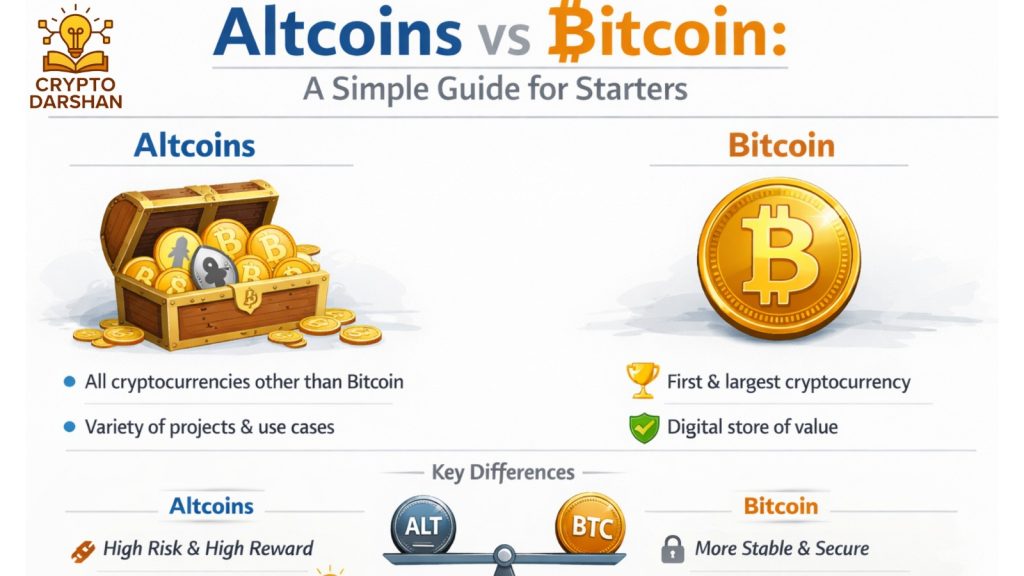
Altcoins vs Bitcoin: Explore their key differences in this simple starter guide tailored for newcomers. Cryptocurrency has transformed the global financial landscape, offering a decentralized alternative to traditional banking systems. Among the thousands of digital currencies available today, Bitcoin and altcoins remain the most recognized and valuable. However, the rise of altcoins, a term used to describe all cryptocurrencies other than Bitcoin, has introduced new opportunities, innovations, and challenges for investors and enthusiasts alike.
This guide provides a comprehensive yet simple explanation of the differences between Bitcoin and altcoins. It explores their origins, technology, use cases, advantages, and risks, helping beginners understand how these digital assets fit into the broader crypto ecosystem.
1. Understanding Cryptocurrency Basics
1.1 What Is Cryptocurrency?
A cryptocurrency is a digital or virtual currency that uses cryptography for security. Unlike traditional currencies issued by governments, cryptocurrencies operate on decentralized networks based on blockchain technology. This means transactions are verified by network participants rather than a central authority.
1.2 What Is Blockchain?
Blockchain is the underlying technology behind most cryptocurrencies. It is a distributed ledger that records transactions across multiple computers, ensuring transparency and security. Each block contains a list of transactions, and once added to the chain, it cannot be altered.
1.3 Why Cryptocurrencies Matter
Cryptocurrencies offer several advantages over traditional financial systems:
- Decentralization: No single entity controls the network.
- Transparency: All transactions are publicly recorded.
- Security: Cryptographic algorithms protect user data and funds.
- Accessibility: Anyone with an internet connection can participate.
2. What Is Bitcoin?
2.1 The Birth of Bitcoin
Bitcoin was introduced in 2009 by an anonymous person or group known as Satoshi Nakamoto. It was designed as a peer-to-peer electronic cash system that allows users to send and receive payments without intermediaries like banks.
2.2 How Bitcoin Works
Bitcoin operates on a proof-of-work (PoW) consensus mechanism. Miners compete to solve complex mathematical puzzles, and the first to solve one adds a new block to the blockchain. In return, miners receive newly minted bitcoins as a reward.
2.3 Bitcoin’s Key Features
- Limited Supply: Only 21 million bitcoins will ever exist, making it a deflationary asset.
- Decentralization: No central authority controls Bitcoin.
- Security: Bitcoin’s network is one of the most secure due to its vast number of miners.
- Transparency: All transactions are recorded on a public ledger.
2.4 Bitcoin as Digital Gold
Bitcoin is often referred to as digital gold because it serves as a store of value. Many investors view it as a hedge against inflation and economic instability. Its scarcity and decentralized nature make it an attractive alternative to traditional assets.
Bitcoin is often compared to traditional assets like gold because of its limited supply and long-term value proposition. For beginners trying to understand why Bitcoin is considered digital gold, this comparison becomes clearer when viewed alongside traditional investments. You can explore this further in our detailed guide on Bitcoin vs Gold Investment for Beginners, which explains how Bitcoin differs from physical assets in risk, returns, and accessibility.
3. What Are Altcoins?
3.1 Definition of Altcoins
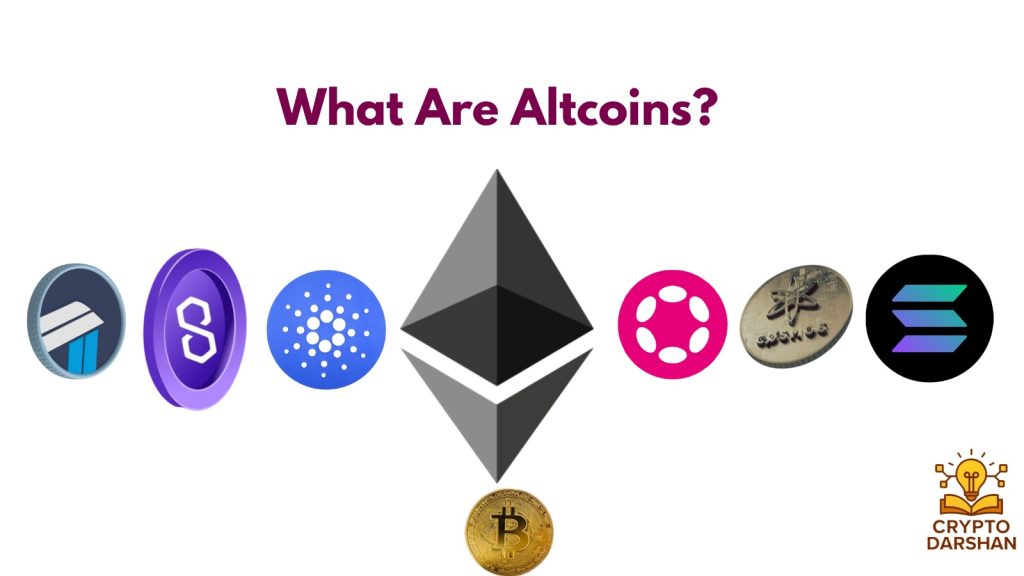
The term altcoin stands for “alternative coin.” Altcoins represent all cryptocurrencies and tokens that are not Bitcoin, with some interpretations excluding Ethereum from this category. They’re crafted by developers with unique visions, often using distinct consensus mechanisms.
3.2 Types of Altcoins
Altcoins can be categorized based on their functionality and underlying technology:
- Stablecoins: Pegged to fiat currencies like the US dollar to reduce volatility (e.g., USDT, USDC).
- Utility Tokens: Used to access specific services or products within a blockchain ecosystem (e.g., BNB, UNI).
- Security Tokens: Represent ownership in an asset or company and are subject to regulations.
- Governance Tokens: Allow holders to vote on project decisions (e.g., AAVE, COMP).
- Meme Coins: Created for fun or community engagement, often driven by social media (e.g., Dogecoin, Shiba Inu).
- Privacy Coins: Focus on enhancing transaction anonymity (e.g., Monero, Zcash).
3.3 Popular Altcoins
Some of the most well-known altcoins include:
- Ethereum (ETH): Introduced smart contracts and decentralized applications (dApps).
- Ripple (XRP): Focuses on fast and low-cost cross-border payments.
- Litecoin (LTC): Designed as a faster and lighter version of Bitcoin.
- Cardano (ADA): Emphasizes scalability and sustainability.
- Polkadot (DOT): Enables interoperability between different blockchains.
- Solana (SOL): Known for high-speed transactions and low fees.
4. Altcoins vs Bitcoin
Understanding the differences between Bitcoin and Altcoins is essential for anyone entering the crypto world. While both are digital currencies built on blockchain technology, they serve different purposes, use different technologies, and have unique advantages and challenges.
4.1 Purpose and Vision
- Bitcoin:
Bitcoin was created as a decentralized digital currency to allow peer-to-peer transactions without banks or intermediaries. Its primary goal is to serve as a store of value and a medium of exchange, much like digital gold. - Altcoins:
Altcoins were developed to improve upon Bitcoin’s limitations or to introduce new features. Some focus on faster transactions, others on privacy, smart contracts, or decentralized applications (dApps). Each altcoin has its own vision and use case for example, Ethereum enables smart contracts, while Ripple (XRP) focuses on cross-border payments.
4.2 Technology and Consensus Mechanisms
- Bitcoin:
Bitcoin uses the Proof-of-Work (PoW) consensus mechanism. Miners solve complex mathematical puzzles to validate transactions and secure the network. While this system is highly secure, it consumes a lot of energy and can be slow. - Altcoins:
Many altcoins use alternative consensus mechanisms like Proof-of-Stake (PoS), Delegated Proof-of-Stake (DPoS), or Proof-of-Authority (PoA). These methods are faster, more energy-efficient, and allow more scalability. For example, Cardano and Solana use PoS-based systems to process thousands of transactions per second.
4.3 Transaction Speed and Fees
- Bitcoin:
Bitcoin transactions can take several minutes to confirm, especially during network congestion. Transaction fees can also rise when demand is high. - Altcoins:
Many altcoins are designed to process transactions faster and at lower costs. For instance, Litecoin confirms transactions in about 2.5 minutes, while Solana can handle thousands of transactions per second with minimal fees.
4.4 Market Dominance

- Bitcoin:
Bitcoin remains the largest and most valuable cryptocurrency by market capitalization. It often represents over 40% of the total crypto market. Its dominance gives it stability and trust among investors. - Altcoins:
Altcoins collectively make up the remaining portion of the market. While some, like Ethereum, have strong ecosystems, most altcoins are smaller and more volatile. However, they also offer higher growth potential.
4.5 Volatility and Risk
- Bitcoin:
Bitcoin is volatile but relatively more stable compared to smaller altcoins. Its large market cap and widespread adoption reduce extreme price swings. - Altcoins:
Altcoins are generally more volatile. Their prices can rise or fall dramatically in short periods due to speculation, low liquidity, or project news. This makes them riskier but potentially more rewarding for traders.
4.6 Adoption and Recognition
- Bitcoin:
Bitcoin is the most recognized and widely accepted cryptocurrency. Many businesses, institutions, and even governments acknowledge it as a legitimate asset. - Altcoins:
Altcoins are gaining traction but still face challenges in adoption and regulation. Some are used mainly within specific ecosystems or industries rather than for general payments.
4.7 Supply and Tokenomics
- Bitcoin:
Bitcoin has a fixed supply of 21 million coins, making it a deflationary asset. This scarcity supports its long-term value. - Altcoins:
Altcoins have varying supply models. Some have fixed limits like Bitcoin, while others have inflationary systems or token burns to control supply. For example, Ethereum has introduced a burning mechanism to reduce token circulation over time.
4.8 Community and Development
- Bitcoin:
Bitcoin’s development is conservative and slow-moving. Changes to its protocol require broad consensus, ensuring stability and security. - Altcoins:
Altcoins often have more flexible and experimental development teams. This allows faster innovation but can also lead to instability or security risks if not properly managed.
5. Advantages of Bitcoin
- First-Mover Advantage: Bitcoin’s early start gives it strong brand recognition and trust.
- Security: Its large network of miners makes it highly resistant to attacks.
- Scarcity: The fixed supply of 21 million coins supports its value over time.
- Liquidity: Bitcoin is the most traded cryptocurrency, ensuring easy buying and selling.
- Institutional Adoption: Increasing acceptance by major companies and financial institutions.
6. Advantages of Altcoins
- Innovation: Many altcoins introduce new technologies such as smart contracts, DeFi, and NFTs.
- Lower Transaction Costs: Faster and cheaper transactions compared to Bitcoin.
- Diverse Use Cases: From gaming to supply chain management, altcoins power various industries.
- Potential for Growth: Smaller market caps mean higher potential returns for early investors.
- Environmental Efficiency: Many altcoins use eco-friendly consensus mechanisms like PoS.
7. Risks and Challenges
7.1 Bitcoin Risks
- Regulatory Pressure: Governments may impose restrictions or taxes.
- Scalability Issues: Limited transaction throughput.
- Energy Consumption: Mining requires significant electricity.
7.2 Altcoin Risks
- High Volatility: Prices can fluctuate dramatically.
- Scams and Rug Pulls: Some projects lack transparency or are fraudulent.
- Low Liquidity: Smaller altcoins may be difficult to trade.
- Regulatory Uncertainty: Many altcoins face unclear legal status.
8. Investment Considerations

Investing in cryptocurrencies like Bitcoin and altcoins can be exciting and profitable, but it also carries significant risks. Understanding how to approach crypto investments wisely is crucial for beginners. This section explains the key factors to consider before putting your money into digital assets.
8.1 Portfolio Diversification
Diversification means spreading your investments across different assets to reduce risk. In the crypto world, this often involves holding both Bitcoin and altcoins.
- Bitcoin’s Role:
Bitcoin is considered the most stable and reliable cryptocurrency. It acts as the foundation of a crypto portfolio, similar to how gold or blue-chip stocks anchor traditional investments. - Altcoins’ Role:
Altcoins can offer higher returns but come with greater volatility. Including a few promising altcoins can increase potential profits while balancing risk.
Example:
An investor might allocate 60% of their portfolio to Bitcoin for stability and 40% to altcoins like Ethereum, Cardano, or Solana for growth potential.
8.2 Research and Due Diligence
Before investing in any cryptocurrency, thorough research is essential. Many altcoins fail or turn out to be scams, so understanding what you’re buying is critical.
Key steps for research:
- Read the Whitepaper:
This document explains the project’s purpose, technology, and goals. A clear and detailed whitepaper is a good sign of legitimacy. - Check the Team:
Look into the developers and founders. Experienced and transparent teams are more likely to deliver long-term success. - Analyze Tokenomics:
Study how the token is distributed, its total supply, and how new tokens are created or burned. Poor tokenomics can lead to inflation and price drops. - Evaluate the Community:
A strong, active community often indicates trust and long-term interest in the project. - Review Partnerships and Use Cases:
Real-world applications and credible partnerships add value and credibility to a project.
8.3 Long-Term vs Short-Term Strategy
Your investment strategy should match your goals, risk tolerance, and time horizon.
- Long-Term (HODL) Strategy:
This approach involves buying and holding cryptocurrencies for years, expecting their value to rise as adoption grows. Bitcoin is often favored for long-term holding due to its stability and scarcity. - Short-Term (Trading) Strategy:
Traders buy and sell cryptocurrencies frequently to profit from price fluctuations. This method requires market knowledge, technical analysis, and emotional discipline. Altcoins are often used for short-term trading because of their higher volatility.
Tip:
Beginners usually benefit from a long-term approach, as short-term trading can be risky and stressful without experience.
8.4 Security and Storage
Keeping your crypto assets safe is just as important as choosing the right ones.
Storage options:
- Hardware Wallets: Physical devices that store your private keys offline, offering maximum security.
- Software Wallets: Apps for mobile or desktop use, convenient but slightly less secure.
- Exchange Wallets: Provided by trading platforms, but keeping large amounts there is risky due to potential hacks.
Security tips:
- Enable two-factor authentication (2FA).
- Never share your private keys or seed phrases.
- Use reputable exchanges and wallets only.
8.5 Understanding Market Cycles
Cryptocurrency markets move in cycles periods of growth (bull markets) followed by declines (bear markets). Recognizing these patterns helps investors make better decisions.
- Bull Market: Prices rise rapidly, and optimism dominates. It’s easy to make profits, but overconfidence can lead to poor timing.
- Bear Market: Prices fall, and fear spreads. This is often the best time to accumulate quality assets at lower prices.
Patience and discipline are key to surviving market cycles.
9. The Role of Bitcoin and Altcoins in the Future
9.1 Bitcoin’s Future
Bitcoin is likely to remain the dominant store of value in the crypto space. Its limited supply and growing institutional interest strengthen its position as digital gold.
9.2 Altcoins’ Future
Altcoins will continue to drive innovation. Projects focusing on scalability, interoperability, and real-world applications will shape the next generation of blockchain technology.
9.3 Coexistence of Bitcoin and Altcoins
Rather than competing, Bitcoin and altcoins complement each other. Bitcoin provides stability and trust, while altcoins expand the possibilities of blockchain technology.
10. How to Get Started

10.1 Choosing a Crypto Exchange
Select a reputable exchange that supports both Bitcoin and altcoins. Look for:
- Strong security measures
- User-friendly interface
- Low fees
- Regulatory compliance
10.2 Setting Up a Wallet
A crypto wallet stores private keys and allows secure transactions. Options include:
- Hardware Wallets: Physical devices offering maximum security.
- Software Wallets: Apps for mobile or desktop use.
- Web Wallets: Online wallets accessible through browsers.
10.3 Staying Safe
- Enable two-factor authentication (2FA).
- Avoid sharing private keys.
- Beware of phishing scams.
- Use trusted platforms only.
11. Real-World Applications
11.1 Bitcoin Use Cases
- Online payments
- Remittances
- Store of value
- Hedge against inflation
11.2 Altcoin Use Cases
- Ethereum: Smart contracts and decentralized finance (DeFi)
- Ripple: Cross-border payments
- Chainlink: Decentralized oracles
- Polygon: Layer-2 scaling solutions
- Filecoin: Decentralized storage
12. Common Myths and Misconceptions

- “Bitcoin and altcoins are the same.”
Bitcoin is the original cryptocurrency, while altcoins serve different purposes and technologies. - “Cryptocurrencies are only for criminals.”
Blockchain transparency makes illicit activities traceable. - “Altcoins will replace Bitcoin.”
Altcoins may innovate, but Bitcoin’s dominance and trust make it irreplaceable for now. - “Crypto has no real value.”
Value comes from utility, scarcity, and community trust just like traditional assets.
13. The Environmental Debate
Bitcoin’s proof-of-work system consumes significant energy, leading to environmental concerns. In contrast, many altcoins use proof-of-stake, which drastically reduces energy usage. The industry is also exploring renewable energy solutions to make mining more sustainable.
14. Regulatory Landscape

The regulatory landscape for cryptocurrencies is one of the most important and evolving aspects of the digital asset world. Governments and financial authorities across the globe are working to create frameworks that balance innovation with consumer protection, financial stability, and anti-crime measures. Understanding how regulations affect Bitcoin and altcoins helps investors and businesses operate safely and legally.
14.1 Why Regulation Matters
Cryptocurrency operates in a decentralized environment, which makes it difficult for traditional financial systems to monitor or control. While this independence is one of crypto’s biggest strengths, it also raises concerns about:
- Money laundering and fraud
- Tax evasion
- Investor protection
- Market manipulation
Regulations aim to address these issues while allowing legitimate innovation to thrive.
14.2 Bitcoin’s Regulatory Status
Bitcoin is often treated differently from other cryptocurrencies because of its unique characteristics:
- Commodity Classification: Many countries, including the United States, classify Bitcoin as a commodity rather than a security. This means it’s regulated similarly to gold or oil, focusing on trading and taxation rather than corporate governance.
- Legal Recognition: Some nations, such as El Salvador, have adopted Bitcoin as legal tender, allowing it to be used for everyday transactions.
- Taxation: In most jurisdictions, Bitcoin is subject to capital gains tax when sold or traded for profit.
Bitcoin’s decentralized nature and lack of a central issuer make it easier for regulators to define compared to newer altcoins.
14.3 Altcoins and Regulatory Challenges
Altcoins face more complex regulatory scrutiny because they vary widely in purpose, structure, and governance.
- Security Classification:
Many altcoins are considered securities under laws like the U.S. Securities Act. This means they must comply with strict regulations regarding issuance, trading, and disclosure. Projects that raise funds through token sales (ICOs or IDOs) are especially vulnerable to this classification. - Utility Tokens:
Some altcoins are designed as utility tokens, giving users access to a product or service rather than representing ownership. These tokens may avoid being classified as securities if they meet certain conditions. - Stablecoins:
Stablecoins, which are pegged to fiat currencies like the U.S. dollar, face increasing regulation due to their potential impact on monetary policy and financial stability. Governments are demanding transparency about reserves and auditing practices. - Privacy Coins:
Cryptocurrencies like Monero (XMR) and Zcash (ZEC), which focus on anonymity, are under heavy scrutiny. Some countries have banned or restricted them due to concerns about illegal activities.
14.4 Global Regulatory Approaches
Different countries have taken varied approaches to cryptocurrency regulation:
- United States:
The U.S. has multiple agencies overseeing crypto, including the SEC (Securities and Exchange Commission), CFTC (Commodity Futures Trading Commission), and FinCEN (Financial Crimes Enforcement Network). The SEC often targets bitcoin and altcoins that it deems to be unregistered securities, while the CFTC treats Bitcoin and Ethereum as commodities. - European Union:
The EU introduced the Markets in Crypto-Assets (MiCA) regulation, which provides a unified legal framework for crypto assets across member states. MiCA focuses on consumer protection, stablecoin regulation, and transparency. - Asia:
- Japan recognizes Bitcoin and some altcoins as legal property and requires exchanges to register with the Financial Services Agency (FSA).
- China has banned cryptocurrency trading and mining but continues to develop its own central bank digital currency (CBDC).
- India allows crypto trading but imposes high taxes and strict reporting requirements.
- Middle East and Africa:
Countries like the UAE and Bahrain are becoming crypto-friendly hubs, offering clear licensing frameworks for exchanges and blockchain startups. In contrast, some African nations remain cautious or restrictive.
14.5 Institutional and Corporate Adoption

Regulatory clarity has encouraged more institutions and corporations to enter the crypto space.
- Publicly traded companies like Tesla and MicroStrategy hold Bitcoin as part of their treasury.
- Banks and payment providers are integrating crypto services under regulated frameworks.
- Exchange-traded funds (ETFs) for Bitcoin and Ethereum are being approved in several countries, giving investors safer access to crypto markets.
This growing institutional involvement signals that regulation, rather than hindering crypto, can actually promote mainstream adoption.
15. Conclusion
The debate between Bitcoin and Altcoins is not about which is better but about understanding their unique roles in the digital economy. Bitcoin remains the foundation of the cryptocurrency world, a secure, decentralized store of value. Altcoins, on the other hand, represent innovation, diversity, and the future of blockchain applications.
For beginners, the key is education and caution. Understanding the fundamentals, researching projects, and managing risks are essential steps toward successful participation in the crypto market. As the industry evolves, both Bitcoin and altcoins will continue to shape the future of finance, technology, and global commerce.