Bitcoin vs Ethereum offers new investors a clear path to understanding these top cryptocurrencies and their unique strengths. Cryptocurrency has changed the way people handle money, offering new methods for storing, sending, and investing funds. Among the many digital currencies, Bitcoin (BTC) and Ethereum (ETH) are the two most prominent and widely accepted. For beginners, understanding the differences between these two major cryptocurrencies is important before making investment choices.
Before comparing Bitcoin and Ethereum, it is important to understand why Bitcoin is often called digital gold. Bitcoin was created as a decentralized currency with a limited supply, making it attractive for long-term investors. If you are new to crypto, our guide on Altcoins vs Bitcoin: A Simple Guide for Starters explains how Bitcoin differs from other cryptocurrencies and why it remains the most trusted asset in the market.
This guide provides a simple and detailed comparison between Bitcoin and Ethereum, covering their origins, technology, use cases, investment opportunities, and future potential. It is written in a clear and accessible style for those new to the subject.
1. Understanding Cryptocurrency Basics.

What Is Cryptocurrency?
A cryptocurrency is a digital or virtual currency that uses cryptography for security. Unlike traditional money issued by governments, cryptocurrencies operate on decentralized networks based on blockchain technology. This means no single authority controls them, making transactions transparent and secure.
What Is Blockchain?
Blockchain is a distributed ledger that keeps track of all transactions across a network of computers. Each block holds a list of transactions, and once added to the chain, it cannot be changed. This characteristic ensures trust and transparency in the system.
Why Bitcoin and Ethereum Matter.
Bitcoin and Ethereum are foundational to the cryptocurrency world. Bitcoin introduced the idea of decentralized digital money, while Ethereum expanded the use of blockchain by introducing smart contracts and decentralized applications (dApps). Together, they represent two different approaches to what blockchain can achieve.
2. Bitcoin: The Pioneer of Digital Currency
The Birth of Bitcoin.
Bitcoin was created in 2009 by an anonymous person or group known as Satoshi Nakamoto. It was designed as a peer-to-peer electronic cash system that allows users to send and receive payments without intermediaries like banks.
Bitcoin’s Core Purpose.
Bitcoin’s main goal is to serve as a store of value and medium of exchange. It aims to provide an alternative to traditional fiat currencies, offering financial freedom and protection against inflation.
How Bitcoin Works.
Bitcoin operates on a decentralized network of computers called nodes. Transactions are verified by miners who solve complex mathematical problems to add new blocks to the blockchain. This process is known as Proof of Work (PoW).
Bitcoin Supply and Halving.
Bitcoin has a fixed supply of 21 million coins, making it a deflationary asset. Every four years, the reward for mining new blocks is cut in half, an event known as Bitcoin halving. This mechanism ensures scarcity and often influences price increases over time.
Key Features of Bitcoin
- Decentralization: No central authority controls Bitcoin.
- Limited Supply: Only 21 million BTC will ever exist.
- Security: Strong cryptographic algorithms protect the network.
- Transparency: All transactions are publicly recorded on the blockchain.
- Global Accessibility: Anyone with internet access can use Bitcoin.
3. Ethereum: The Smart Contract Platform.

The Birth of Ethereum.
Ethereum was launched in 2015 by Vitalik Buterin and a team of developers. While inspired by Bitcoin, Ethereum was designed to do more than just handle payments. Ethereum is a decentralized, open-source blockchain network and software development platform, powered by the cryptocurrency ether (ETH). Ethereum is the secure, global foundation for a new generation of unstoppable applications.
Ethereum’s Core Purpose.
Ethereum aims to be a decentralized platform for applications that operate exactly as programmed without interruption, fraud, or interference. It serves as the foundation for decentralized finance (DeFi), non-fungible tokens (NFTs), and many other innovations in blockchain.
How Ethereum Works.
Ethereum also uses blockchain technology, but instead of focusing solely on transactions, it supports programmable contracts. These smart contracts automatically execute when certain conditions are met, removing the need for intermediaries.
Ethereum 2.0 and Proof of Stake.
Ethereum originally used Proof of Work (PoW), similar to Bitcoin. However, it has transitioned to Proof of Stake (PoS) through the Ethereum 2.0 upgrade. In PoS, validators are selected to create new blocks based on their staked ETH. This change makes the network more energy-efficient and scalable.
Key Features of Ethereum
- Smart Contracts: Self-executing agreements coded on the blockchain.
- Decentralized Applications (dApps): Apps that run without central control.
- DeFi Ecosystem: Enables decentralized financial services.
- NFTs: Supports unique digital assets and collectibles.
- Scalability Upgrades: Ongoing improvements to handle more transactions efficiently.
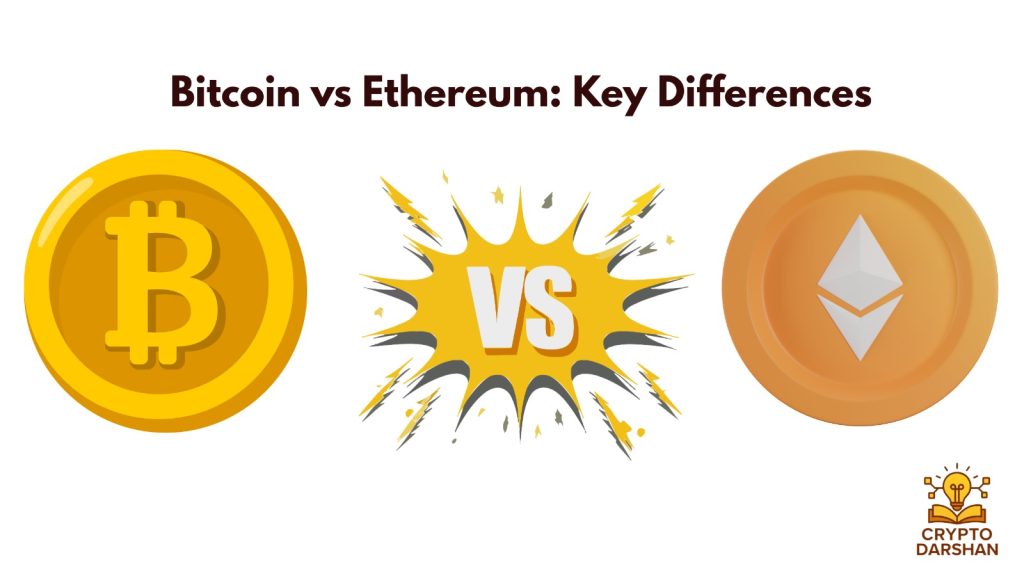
4. Bitcoin vs Ethereum: Key Differences
| Feature | Bitcoin (BTC) | Ethereum (ETH) |
| Launch Year | 2009 | 2015 |
| Founder | Satoshi Nakamoto | Vitalik Buterin |
| Primary Purpose | Digital currency and store of value | Smart contracts and decentralized applications |
| Consensus Mechanism | Proof of Work (PoW) | Proof of Stake (PoS) |
| Supply Limit | 21 million | No fixed limit |
| Block Time | ~10 minutes | ~12 seconds |
| Transaction Speed | 3–7 transactions per second | 15–30 transactions per second |
| Energy Efficiency | High energy use | More energy-efficient after PoS |
| Use Cases | Payments, investment, store of value | DeFi, NFTs, dApps, smart contracts |
| Programming Language | Script (limited) | Solidity (flexible and programmable) |
5.Investment Perspective: Bitcoin vs Ethereum.

When comparing Bitcoin and Ethereum from an investment perspective, it’s important to understand that both serve different purposes in the crypto ecosystem. While they share similarities as leading digital assets, their value propositions, risks, and growth potential differ significantly.
1. Bitcoin as an Investment
Bitcoin is often referred to as “digital gold” because it functions as a store of value rather than a technology platform. Its key appeal lies in its limited supply and decentralized structure. With a maximum supply of 21 million coins, Bitcoin is designed to be deflationary, meaning its value could increase over time as demand rises and supply stays fixed.
Many investors compare Bitcoin to traditional safe-haven assets due to its scarcity and long-term value potential. This comparison often places Bitcoin alongside gold as a hedge against inflation. For a deeper understanding of this investment perspective, check out our detailed analysis in Bitcoin vs Gold Investment for Beginners, which breaks down the strengths and risks of both assets.
Why Investors Choose Bitcoin:
- Store of Value: Like gold, Bitcoin is used to preserve wealth over the long term.
- Hedge Against Inflation: As fiat currencies lose value due to inflation, Bitcoin’s limited supply makes it an attractive alternative.
- Institutional Adoption: Many companies and funds now hold Bitcoin as part of their portfolios, adding credibility and stability.
- Liquidity: Bitcoin is the most traded cryptocurrency, making it easy to buy or sell at any time.
Risks of Bitcoin Investment:
- Volatility: Prices can fluctuate sharply in short periods.
- Regulatory Uncertainty: Government policies can affect its price and adoption.
- Energy Concerns: Mining consumes large amounts of electricity, raising environmental issues.
In essence, Bitcoin is ideal for investors seeking a long-term, relatively stable crypto asset that acts as a hedge against traditional financial risks.
2. Ethereum as an Investment.
Ethereum, on the other hand, is more than just a digital currency; it’s a technology platform that powers decentralized applications (dApps), smart contracts, and decentralized finance (DeFi). Investing in Ethereum is like investing in the infrastructure of the blockchain economy.
Why Investors Choose Ethereum:
- Innovation and Utility: Ethereum supports thousands of projects, from DeFi platforms to NFTs, giving it real-world use cases.
- Growth Potential: As blockchain adoption expands, demand for Ethereum’s network and its native token (ETH) increases.
- Transition to Proof of Stake: The shift to PoS has made Ethereum more energy-efficient and scalable, attracting environmentally conscious investors.
- Ecosystem Dominance: Ethereum remains the leading platform for developers and decentralized applications.
Risks of Ethereum Investment:
- No Fixed Supply: Unlike Bitcoin, Ethereum doesn’t have a capped supply, which could affect long-term scarcity.
- Competition: Other smart contract platforms (like Solana or Cardano) compete for market share.
- Network Congestion: High demand can lead to slow transactions and high fees, though upgrades aim to fix this.
Ethereum appeals to investors who believe in the future of decentralized technology and want exposure to the broader blockchain ecosystem.
3. Which Is Better for Investors?
- Bitcoin suits conservative investors who want a long-term store of value and protection against inflation.
- Ethereum suits growth-oriented investors who want exposure to innovation and blockchain technology.
- Many investors choose to diversify by holding both, balancing Bitcoin’s stability with Ethereum’s growth potential.
6. Use Cases and Real-World Applications.

Bitcoin Use Cases.
- Digital Payments: Enables peer-to-peer transactions without banks.
- Store of Value: Acts as a hedge against inflation and currency devaluation.
- Remittances: Allows fast, low-cost international money transfers.
- Institutional Investment: Increasingly adopted by companies and funds.
Ethereum Use Cases
- Decentralized Finance (DeFi): Enables lending, borrowing, and trading without intermediaries.
- Non-Fungible Tokens (NFTs): Powers digital art, collectibles, and gaming assets.
- Decentralized Applications (dApps): Supports apps in gaming, social media, and more.
- Enterprise Solutions: Used by businesses for supply chain, identity, and data management.
7. Market Performance and Price Trends.

Understanding the market performance and price trends of Bitcoin and Ethereum helps investors see how each asset has evolved and what factors influence their value. Both cryptocurrencies have experienced significant growth, but their price movements are shaped by different dynamics.
1. Bitcoin’s Market Performance.
Bitcoin is the first and most valuable cryptocurrency by market capitalization. Since its launch in 2009, it has gone through multiple bull and bear cycles, each driven by adoption, investor sentiment, and macroeconomic factors.
Key Phases in Bitcoin’s Price History:
- 2009–2012: Bitcoin had little to no market value. Early adopters mined or traded it for cents.
- 2013–2016: Bitcoin gained attention, reaching around $1,000 before dropping due to exchange hacks and regulatory uncertainty.
- 2017 Bull Run: Bitcoin hit nearly $20,000 as global interest surged, marking its first major mainstream exposure.
- 2018–2019 Bear Market: Prices fell below $4,000 as the market corrected.
- 2020–2021 Rally: Institutional investors entered the market, pushing Bitcoin above $60,000.
- 2022–2023 Volatility: Global inflation, interest rate hikes, and market corrections caused price fluctuations.
- 2024–2025 Recovery: Bitcoin regained momentum as adoption increased and halving expectations grew.
Factors Influencing Bitcoin’s Price:
- Supply and Demand: With only 21 million coins, scarcity drives long-term value.
- Halving Events: Every four years, mining rewards are cut in half, reducing supply and often triggering price rallies.
- Institutional Adoption: Companies and funds buying Bitcoin increase demand and credibility.
- Macroeconomic Conditions: Inflation, interest rates, and global economic uncertainty affect investor behavior.
Bitcoin’s long-term trend remains upward, despite short-term volatility. It continues to act as a store of value and a hedge against inflation for many investors.
2. Ethereum’s Market Performance
Ethereum entered the market in 2015 and quickly became the second-largest cryptocurrency. Unlike Bitcoin, Ethereum’s value is tied not only to its currency (ETH) but also to the activity on its network such as decentralized finance (DeFi), NFTs, and smart contracts.
Key Phases in Ethereum’s Price History:
- 2015–2016: Ethereum launched at around $0.75 per ETH and gained traction among developers.
- 2017–2018 Boom: The ICO (Initial Coin Offering) craze drove ETH prices to around $1,400.
- 2018–2019 Correction: After the ICO bubble burst, prices dropped below $100.
- 2020–2021 DeFi and NFT Surge: Ethereum’s role in powering DeFi and NFTs pushed prices above $4,000.
- 2022–2023 Market Downturn: Broader crypto market declines affected ETH, though it remained a top asset.
- 2024–2025 Growth: The transition to Proof of Stake and Layer 2 scaling solutions improved performance and investor confidence.
Factors Influencing Ethereum’s Price:
- Network Usage: More activity in DeFi, NFTs, and dApps increases demand for ETH.
- Upgrades and Technology: Major updates like Ethereum 2.0 and Layer 2 solutions enhance scalability and efficiency.
- Competition: Other smart contract platforms can impact Ethereum’s market share.
- Market Sentiment: Investor confidence in blockchain innovation drives ETH’s value.
Ethereum’s price tends to be more volatile than Bitcoin’s because it’s tied to technological developments and ecosystem growth. However, it also offers higher growth potential due to its expanding use cases.
3. Market Capitalization Comparison.
Market capitalization (market cap) measures the total value of all coins in circulation. It’s calculated by multiplying the current price by the total supply.
- Bitcoin: Consistently holds the largest market cap, often representing over 40% of the entire crypto market.
- Ethereum: Usually ranks second, accounting for 15–20% of the total market.
Together, Bitcoin and Ethereum dominate the cryptocurrency landscape, influencing the direction of the entire market.
4. Is It Better to Buy Ethereum or Bitcoin?
Bitcoin is primarily designed to be an alternative to traditional currencies and a medium of exchange and store of value. Ethereum is a programmable blockchain that finds application in numerous areas including DeFi, smart contracts, and NFTs. Which is a better buy depends on your market outlook and investing preferences.
5. Price Correlation Between Bitcoin and Ethereum.
Bitcoin and Ethereum often move in similar directions because the overall crypto market sentiment affects both. When Bitcoin rises, it usually boosts confidence across the market, leading to gains in Ethereum and other altcoins. However, Ethereum sometimes outperforms Bitcoin during periods of strong innovation or network upgrades.
8. Security and Network Stability

Bitcoin Security.
Bitcoin’s network is considered one of the most secure in the world. Its massive hash rate and decentralized structure make it extremely difficult to attack. The simplicity of its code also reduces vulnerabilities.
Ethereum Security.
Ethereum’s flexibility enables innovation, but it also introduces complexity. Smart contracts can contain bugs or vulnerabilities if not coded properly. However, Ethereum’s core network remains robust, and ongoing upgrades aim to enhance security.
9. Scalability and Future Upgrades.

Bitcoin Scalability.
Bitcoin’s scalability is limited due to its block size and transaction speed. Solutions like the Lightning Network aim to improve transaction throughput by enabling off-chain payments that settle instantly and at a lower cost.
Ethereum Scalability.
Ethereum faces scalability challenges due to high demand. The Ethereum 2.0 upgrade and Layer 2 solutions like Optimism and Arbitrum are designed to increase transaction capacity and reduce fees.
10. Environmental Impact.

Bitcoin’s Energy Use.
Bitcoin’s Proof of Work mechanism consumes significant energy, leading to environmental concerns. However, many miners are shifting to renewable energy sources to reduce their carbon footprint.
Ethereum’s Green Transition.
Ethereum’s move to Proof of Stake has drastically reduced its energy consumption by over 99%. This makes it one of the most eco-friendly major blockchains.
11. Community and Developer Ecosystem.

Bitcoin Community.
Bitcoin’s community focuses on maintaining decentralization, security, and simplicity. Development is conservative, prioritizing stability over rapid innovation.
Ethereum Community.
Ethereum’s community is highly active and innovative. Thousands of developers contribute to building new applications, tools, and protocols, driving continuous growth and experimentation.
12. Regulatory Landscape.

Bitcoin Regulation.
Bitcoin is recognized as a digital asset or commodity in many countries. Regulations vary, but most governments focus on anti-money laundering (AML) and taxation compliance.
Ethereum Regulation.
Ethereum’s classification is more complex due to its programmable nature. Regulators are still defining how to treat tokens and smart contracts built on its network.
13. Risks and Challenges
Bitcoin Risks
- Price volatility.
- Regulatory uncertainty.
- Energy consumption concerns.
- Limited scalability.
Ethereum Risks
- Smart contract vulnerabilities.
- Competition from other blockchains.
- Network congestion.
- Regulatory ambiguity.
14. Future Outlook

The Future of Bitcoin.
Bitcoin is expected to remain the leading store of value in the crypto world. Its scarcity and growing institutional adoption strengthen its position as “digital gold.” Future developments like the Lightning Network may enhance its usability for everyday payments.
The Future of Ethereum.
Ethereum’s future looks promising as it continues to evolve into a scalable, energy-efficient platform. With the rise of DeFi, NFTs, and Web3, Ethereum is likely to remain the backbone of decentralized innovation.
15. Which Is Better for New Investors?

The choice between Bitcoin and Ethereum depends on investment goals:
- For long-term value storage: Bitcoin is often preferred due to its limited supply and stability.
- For technology and innovation exposure: Ethereum offers more growth potential through its ecosystem of applications.
- For diversification: Many investors hold both to balance risk and opportunity.
Conclusion.
Bitcoin and Ethereum represent two distinct yet complementary visions of the blockchain revolution. Bitcoin focuses on being a secure, decentralized store of value, while Ethereum expands blockchain’s potential through smart contracts and decentralized applications.
For new investors, understanding these differences is crucial. Bitcoin offers simplicity and reliability, while Ethereum provides innovation and versatility. Both have proven their resilience and continue to shape the future of finance and technology.
Investing in either or both requires research, patience, and a long-term perspective. As the crypto market evolves, Bitcoin and Ethereum will likely remain at the forefront, driving the next wave of digital transformation.