The decentralized finance (DeFi) ecosystem continues to evolve rapidly, and Uniswap V4 represents one of the most significant milestones in this journey. As the next major upgrade to the world’s leading decentralized exchange (DEX), Uniswap V4 introduces a revolutionary concept known as Hooks, which promises to redefine how automated market makers (AMMs) operate. This innovation aims to make liquidity pools more flexible, efficient, and customizable than ever before.
Since its inception, Uniswap has been at the forefront of DeFi innovation. From the simple constant product formula of Uniswap V1 to the concentrated liquidity model of Uniswap V3, each version has pushed the boundaries of what decentralized trading can achieve. Now, Uniswap V4 takes another leap forward by introducing a modular architecture that allows developers to build custom logic directly into liquidity pools through Hooks.
This article explores Uniswap V4 in depth—its architecture, the role of Hooks, how it improves efficiency, and why it could shape the future of automated market makers. It also examines the potential challenges, use cases, and implications for traders, developers, and the broader DeFi ecosystem.
Understanding Automated Market Makers (AMMs)

Before diving into Uniswap V4, it’s essential to understand what Automated Market Makers (AMMs) are and why they are the foundation of decentralized exchanges.
1. What Is an Automated Market Maker?
An Automated Market Maker (AMM) is a type of decentralized exchange protocol that uses mathematical formulas to determine the price of assets instead of relying on traditional order books. In an AMM, users trade directly against a liquidity pool rather than another trader.
2. How Liquidity Pools Work
A liquidity pool is a smart contract that holds two or more tokens. Users known as liquidity providers (LPs) deposit their tokens into these pools, enabling others to trade between them. In return, LPs earn a portion of the trading fees generated by the pool.
For example, in an ETH/USDC pool, LPs deposit equal values of ETH and USDC. When a trader swaps ETH for USDC, the pool automatically adjusts the token ratios to maintain balance.
3. The Constant Product Formula
Most AMMs, including Uniswap, use the constant product formula:
x * y = k
- x = amount of Token A
- y = amount of Token B
- k = constant value
This formula ensures that the product of the two token reserves remains constant. When a trader buys Token A, the pool’s Token A balance decreases, and Token B increases, causing the price of Token A to rise. This mechanism allows the market to self-regulate without centralized control.
4. The Advantages of AMMs
- Decentralization: No central authority controls trading.
- Continuous Liquidity: Traders can always buy or sell tokens as long as the pool has liquidity.
- Accessibility: Anyone can become a liquidity provider and earn fees.
- Transparency: All transactions occur on-chain and are verifiable.
5. The Limitations of AMMs
While AMMs revolutionized DeFi, they also introduced challenges:
- Slippage: Large trades can significantly affect prices in smaller pools.
- Impermanent Loss: LPs may lose value compared to simply holding their tokens.
- Capital Inefficiency: Liquidity is often spread across wide price ranges, reducing effectiveness.
- Static Design: Traditional AMMs have fixed rules that cannot adapt to market conditions.
These limitations set the stage for Uniswap V4, which aims to make AMMs more dynamic, efficient, and customizable.
The Evolution of Uniswap: From V1 to V4

Uniswap V1: The Birth of AMMs
Launched in 2018, Uniswap V1 introduced the concept of AMMs using the constant product formula. It allowed anyone to trade ERC-20 tokens against ETH, creating the foundation for decentralized trading. However, it only supported ETH-token pairs and lacked flexibility.
Uniswap V2: ERC-20 to ERC-20 Trading
Uniswap V2, launched in 2020, expanded functionality by enabling direct ERC-20 to ERC-20 swaps. It also introduced flash swaps and improved price oracles. This version made Uniswap more versatile but still suffered from capital inefficiency.
Uniswap V3: Concentrated Liquidity
In 2021, Uniswap V3 introduced concentrated liquidity, allowing LPs to allocate capital within specific price ranges. This improved efficiency and returns but increased complexity for users who had to manage positions actively.
Uniswap V4: The Modular Revolution
Now, Uniswap V4 builds on these foundations with a focus on flexibility, efficiency, and composability. The introduction of Hooks allows developers to customize pool behavior, automate strategies, and create entirely new types of AMMs—all within the Uniswap ecosystem.
What Is Uniswap V4?
Uniswap V4 is the next-generation version of the Uniswap protocol, designed to make decentralized trading more efficient and customizable. It introduces a new architecture that consolidates liquidity management, reduces gas costs, and enables developers to extend functionality through Hooks.
At its core, Uniswap V4 aims to solve three major challenges:
- Customization: Allow developers to create unique pool behaviors without deploying entirely new AMMs.
- Efficiency: Reduce gas costs and improve transaction throughput.
- Composability: Enable seamless integration between different DeFi protocols and liquidity strategies.
The most groundbreaking feature of Uniswap V4 is the Hook system, which acts as a programmable layer that can modify how pools behave before, during, and after swaps.
Understanding Hooks in Uniswap V4
What Are Hooks?
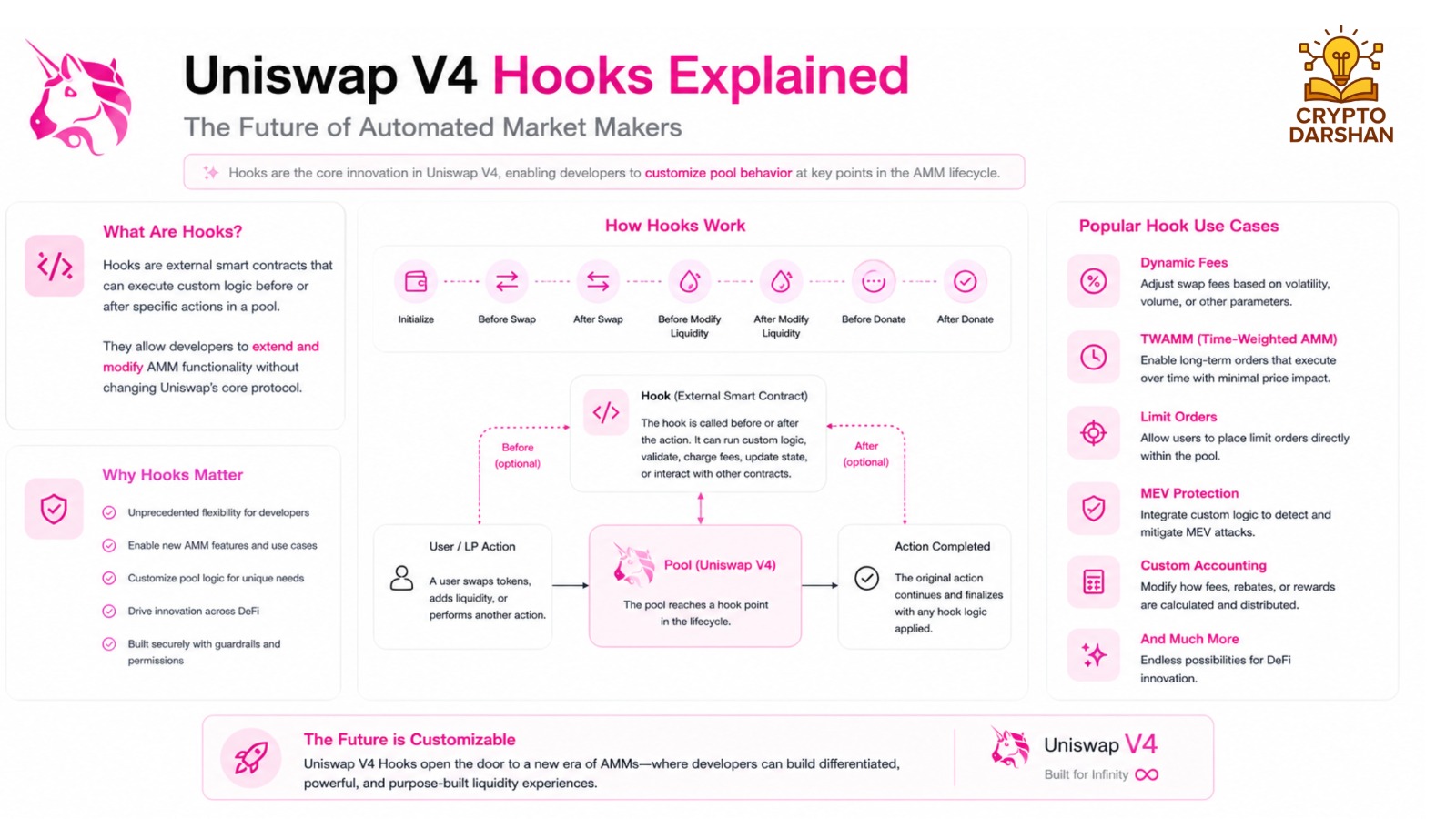
Hooks are smart contract functions that allow developers to insert custom logic into the lifecycle of a liquidity pool. In Uniswap V4, Hooks can be triggered at specific points—such as before a swap, after a swap, before liquidity is added, or after liquidity is removed.
This means that instead of creating a new AMM from scratch, developers can use Hooks to modify existing pool behavior. Hooks make Uniswap V4 a modular and extensible platform, similar to how plugins work in software systems.
How Hooks Work
Each Uniswap V4 pool can have an associated Hook contract. When a user interacts with the pool, the Hook executes predefined logic at specific moments. For example:
- BeforeSwap Hook: Adjusts fees or applies dynamic pricing.
- AfterSwap Hook: Triggers external actions like staking rewards.
- BeforeAddLiquidity Hook: Enforces conditions for liquidity providers.
- AfterRemoveLiquidity Hook: Distributes rewards or penalties.
This modular design allows for endless customization while maintaining the core security and efficiency of the Uniswap protocol.
Example Use Cases for Hooks
- Dynamic Fees: Adjust trading fees based on market volatility or liquidity depth.
- On-Chain Limit Orders: Implement limit orders directly within the AMM.
- Time-Weighted Average Market Makers (TWAMMs): Execute large trades gradually to reduce price impact.
- Auto-Rebalancing Pools: Automatically adjust liquidity positions based on price movements.
- Custom Incentives: Reward liquidity providers with tokens or NFTs for specific behaviors.
By enabling these features, Uniswap V4 transforms from a static AMM into a programmable liquidity platform.
The Singleton Architecture: A Key Innovation in Uniswap V4
Another major innovation in Uniswap V4 is the Singleton architecture. In previous versions, each liquidity pool was deployed as a separate smart contract. This design was simple but inefficient, as it required multiple contract deployments and redundant storage.
In Uniswap V4, all pools exist within a single smart contract—the Singleton. This change drastically reduces gas costs and simplifies interactions between pools.
Benefits of the Singleton Architecture
- Lower Gas Fees: Users no longer need to deploy new contracts for each pool, saving significant gas.
- Improved Efficiency: Shared storage and logic reduce redundancy.
- Enhanced Composability: Pools can interact directly with each other within the same contract.
- Simplified Development: Developers can focus on Hooks and pool logic without managing multiple contracts.
The Singleton model makes Uniswap V4 more scalable and cost-effective, paving the way for broader adoption.
Flash Accounting: Reducing Gas Costs Further

Uniswap V4 introduces another optimization called Flash Accounting, which minimizes the number of token transfers during swaps. Instead of transferring tokens after every individual swap, the protocol aggregates all transfers and settles them at the end of the transaction.
How Flash Accounting Works
In traditional AMMs, each swap involves multiple token transfers between users and pools. This process consumes gas and slows down transactions. With Flash Accounting, Uniswap V4 keeps track of net balances internally and only performs the final transfers once all operations are complete.
Benefits of Flash Accounting
- Lower Gas Usage: Fewer token transfers mean cheaper transactions.
- Faster Execution: Reduced computational overhead improves performance.
- Better User Experience: Traders and LPs benefit from lower costs and faster confirmations.
Combined with the Singleton architecture, Flash Accounting makes Uniswap V4 one of the most gas-efficient AMMs ever built.
The Power of Customization in Uniswap V4

The introduction of Hooks gives developers unprecedented control over how liquidity pools behave. This flexibility opens the door to a wide range of new financial instruments and trading strategies.
1. Dynamic Fee Structures
Hooks can adjust fees in real time based on market conditions. For example, during periods of high volatility, a Hook could increase fees to compensate LPs for risk. Conversely, during stable periods, it could lower fees to attract more trading volume.
2. On-Chain Limit Orders
Traditional AMMs execute trades instantly at the current market price. With Hooks, developers can implement limit orders that execute only when certain price conditions are met. This feature brings centralized exchange functionality to decentralized platforms.
3. TWAMMs (Time-Weighted Average Market Makers)
Large trades can cause significant price slippage. Hooks can implement TWAMMs that break large orders into smaller chunks executed over time, reducing market impact and improving execution quality.
4. Liquidity Mining and Incentives
Hooks can automatically distribute rewards to LPs based on their activity or performance. This allows for more sophisticated incentive programs without requiring external contracts.
5. Risk Management Tools
Developers can use Hooks to implement stop-loss mechanisms, impermanent loss protection, or other risk management strategies directly within the pool.
Uniswap V4 vs. Previous Versions
| Feature | Uniswap V3 | Uniswap V4 |
| Liquidity Model | Concentrated Liquidity | Customizable via Hooks |
| Architecture | Multiple Pool Contracts | Singleton Contract |
| Customization | Limited | Fully Modular with Hooks |
| Gas Efficiency | Moderate | Highly Optimized (Flash Accounting) |
| Composability | Restricted | Seamless Inter-Pool Interaction |
| Fee Structure | Fixed Tiers | Dynamic and Programmable |
| Innovation Focus | Capital Efficiency | Flexibility and Extensibility |
Uniswap V4 represents a paradigm shift from static AMMs to programmable liquidity systems. It combines the efficiency of centralized exchanges with the trustlessness of DeFi.
The Role of Governance in Uniswap V4

Governance remains a crucial part of the Uniswap V4 ecosystem. The Uniswap DAO (Decentralized Autonomous Organization) oversees protocol upgrades, fee structures, and community initiatives. With the introduction of Hooks, governance may also play a role in approving or curating certain types of Hooks to ensure security and compliance.
This governance model ensures that Uniswap V4 remains community-driven while maintaining high standards of safety and innovation.
Security Considerations in Uniswap V4

While Hooks offer immense flexibility, they also introduce new security challenges. Each Hook is a smart contract that can contain custom logic, which means vulnerabilities in Hooks could potentially affect pool behavior.
Key Security Measures
- Auditing: All Hook contracts should undergo rigorous security audits.
- Permission Controls: Developers can restrict who can deploy or interact with certain Hooks.
- Sandboxing: Hooks operate within defined boundaries to prevent malicious actions.
- Community Review: Open-source Hooks can be reviewed and vetted by the community.
By combining these measures, Uniswap V4 aims to maintain the same level of trust and reliability that has made Uniswap the leading DEX in DeFi.
Potential Use Cases for Uniswap V4 Hooks

1. Algorithmic Stablecoins
Hooks can maintain peg stability by automatically adjusting liquidity or fees based on price deviations. This could lead to more resilient stablecoin systems.
2. Yield Aggregators
Hooks can route liquidity to the most profitable pools or protocols automatically, optimizing yield for LPs.
3. Cross-Chain Liquidity
With the rise of cross-chain bridges, Hooks could facilitate seamless liquidity movement between different blockchains, enhancing interoperability.
4. NFT Marketplaces
Hooks can enable dynamic pricing models for NFTs, allowing for automated auctions or bonding curves within the Uniswap framework.
5. Institutional Trading
Institutions can use Hooks to implement compliance checks, KYC requirements, or custom reporting tools, making Uniswap V4 suitable for regulated environments.
The Economic Impact of Uniswap V4

Uniswap V4 could significantly reshape the DeFi economy by lowering costs, increasing flexibility, and enabling new financial products. Lower gas fees make trading more accessible, while customizable pools attract developers and liquidity providers seeking innovative strategies.
This evolution could lead to:
- Higher Liquidity Depth: More efficient capital allocation.
- Increased Trading Volume: Lower costs attract more users.
- New Revenue Streams: Developers can monetize custom Hooks.
- Enhanced Ecosystem Growth: Integration with other DeFi protocols.
Challenges and Limitations of Uniswap V4

Despite its potential, Uniswap V4 faces several challenges:
- Complexity: The flexibility of Hooks may increase the learning curve for developers and users.
- Security Risks: Custom Hooks introduce new attack vectors.
- Governance Overhead: Managing and approving Hooks could become complex.
- Adoption Barriers: Migrating liquidity from previous versions may take time.
However, these challenges are not insurmountable. With proper governance, education, and community engagement, Uniswap V4 can overcome these hurdles and set new standards for DeFi innovation.
The Future of Automated Market Makers

Uniswap V4 represents the next stage in the evolution of AMMs—from static liquidity pools to programmable, intelligent systems. As DeFi matures, the demand for customization, efficiency, and composability will only grow. Hooks provide the foundation for this future, enabling developers to experiment with new models of trading, liquidity, and governance.
In the coming years, Uniswap V4 could inspire a new wave of innovation across DeFi, from algorithmic trading strategies to decentralized derivatives and beyond.
FAQ: Uniswap V4 Hooks Explained: The Future of Automated Market Makers

1. What is Uniswap V4?
Uniswap V4 is the latest version of the Uniswap protocol, introducing customizable features called Hooks that allow developers to modify how liquidity pools and swaps operate.
2. What are Hooks in Uniswap V4?
Hooks are smart contracts that execute custom logic before or after specific pool actions, such as swaps, liquidity additions, or liquidity removals. They enable developers to create highly customizable AMM experiences.
3. Why are Hooks important?
Hooks make Uniswap V4 more flexible by allowing developers to build unique features without modifying the core protocol, opening the door to new trading strategies and liquidity management tools.
4. How do Hooks work?
Hooks can trigger predefined actions at different stages of a pool interaction. For example, a Hook can adjust fees dynamically, distribute rewards, or implement custom risk controls.
5. What problems do Hooks solve?
Hooks reduce the need to create entirely new AMM protocols for specialized features. Developers can instead build custom functionality directly within Uniswap V4 pools.
6. Can Hooks change trading fees?
Yes. One of the most popular use cases is dynamic fee management, where trading fees automatically adjust based on market volatility, trading volume, or liquidity conditions.
7. How do Hooks benefit liquidity providers?
Hooks can create customized incentives, optimize fee generation, improve capital efficiency, and introduce new reward mechanisms for liquidity providers.
8. Are Hooks compatible with existing Uniswap pools?
No. Hooks are a feature introduced specifically in Uniswap V4 and require pools built on the V4 architecture.
Conclusion
Uniswap V4 is more than just an upgrade—it is a reimagining of what decentralized exchanges can be. By introducing Hooks, the Singleton architecture, and Flash Accounting, it creates a flexible, efficient, and programmable foundation for the next generation of DeFi applications.
Hooks empower developers to build custom logic directly into liquidity pools, transforming Uniswap from a simple AMM into a dynamic liquidity platform. The result is a system that can adapt to any market condition, support any asset type, and integrate seamlessly with other protocols.
While challenges remain, the potential of Uniswap V4 is immense. It could redefine how liquidity is managed, how trades are executed, and how decentralized finance evolves. As the DeFi ecosystem continues to expand, Uniswap V4 stands poised to lead the way—ushering in a new era of innovation, efficiency, and financial freedom.